
Dundalk AW Racecourse – Trainers to follow.
I often get asked about my approach to tipping and selecting horses for the Betting School members. Although I am a firm believer in trends analysis being a profitable long-term betting tool, I also use several other approaches depending on which meetings are being held.
As you will know, I also lean heavily towards trainer stats and again I think this is a good tool to use when appropriate. Trainers do not send any runner to any course and you can usually get a feel for a particular track and a particular type of runner where trainers often excel. In fact, for smaller stables, it is often a case of good placement of runners – the right race at the right course for a particular type of horse. This information can be beneficial to the punter, especially in some of the lower grade races at the less fanciful tracks.
Over the past couple of years, I have branched out the service I give to the members to include Irish and overseas racing. Both have seen excellent profits since 2016 and I am still very much on a steep learning curve in terms of these races.
However, the one Irish track I have yet to get my teeth into is Ireland’s only all-weather track at Dundalk.
In this month’s article, I am going to look at data from all the races run at the track since 2010 in the hope of uncovering a few useful angles we can exploit for the rest of the year. The focus will be on those trainers with a good strike rate, plenty of runners and a decent profit. Once we have identified a few potential trainers to follow, we will drill down into their runners to see if there is a specific type of horse or a specific type of race where we should sit up and take notice.
Without further ado, let’s see what the numbers tell us.
Aiden O’Brien
No surprise to see the Master Trainer near the top of the list. Ballydoyle sends a fair few runners to Dundalk and, as you would expect, they get plenty of winners too.

Aiden O’Brien operates at a 22% strike rate at Ireland’s AW track, saddling 121 winners since 2010 from 548 runners. He averages around 60 runners a year, so you will not need to go looking too hard. In fact, just look near the top of the market since most go off the favourite. And therein lies the problem for someone like me who prefers to back at double figure odds. If you like to back favourites or those at short odds, then O’Brien runners at Dundalk are right up your street.
First, you need to look no further than his 2yo and 3yo runners who have combined for 97 of those 121 winners. Next, we are looking at outright favourites. Pretty obvious I know, but his favourites have a strike rate of 54% and those that do not go off favourite have a lowly strike rate of 13%.
Next, we want to be concentrating on maiden and non-handicap races. Forget the handicaps. He does not run many in these and they have a poor strike rate anyhow.
Finally, we are backing shorties and we are looking at those sent off at a Betfair starting price (BFSP) of 3.5 or shorter. That leaves us with the following results since 2010:

A system such as this has produced about 10 qualifiers a year since 2010 and 62% of those have won. The P/L is low, not surprisingly, at £18.78 but the return on investment is very respectable at around 21%.
I think if you can get on early and not take BFSP then you should push that ROI up over 30%.
System: One for favourite backers only. Back Aidan O'Brien runners at Dundalk. 2 and 3 yr old runners in Maidens and Non Handicaps going off at BFSP of 3.50 or less.
You may think that Aiden O’Brien tops the list in terms of the number of runners, but he doesn’t. That accolade goes to Mick Halford, a trainer I have a lot of respect for.
Mick Halford
His bare stats are shown below:

He has notched up an impressive 189 winners at a strike rate of 15%. Unfortunately, backing all those runners blind is not the way to go and we need to dig a little deeper. Fortunately for us, there is one blindingly obvious angle which we see when we focus on race distance.
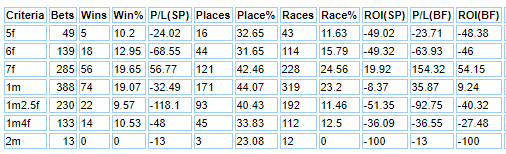
We see a 10 to 12% strike rate at sprint trips and around a 10% strike rate over the middle to long distances. However, look at the figures for 7f and 1 mile races.
Not only does the strike rate jump up to around 20%, but some serious profits are realised in the process. More remarkable is that no fewer than 130 of the 189 winners were racing over these trips. We are now looking a P/L off £190 to £1 level stakes at BFSP.

I like it when I come across a set of numbers like this at it gives you the option of leaving it exactly there. A 20% strike rate and a 28% ROI at BFSP is decent enough, but I always try and see if I can increase both. What happens is that the overall profit can remain more or less the same, but the amount of money you risk achieving the same reward can often be reduced.
The first thing to note is that his veteran runners fare poorly overall. Mick Halford horses aged 7yo to 10yo racing at Dundalk have a combined record of 4-71. Eliminating these runners and concentrating on those aged 2yo to 6yo is a simple, yet effective, filter.

In doing so, the ROI is up 10% and the strike rate is slightly higher. The P/L increases in this case. The next option depends entirely on your style of betting and it will become more obvious when we look at the difference in performance between the handicappers and the non-handicappers.
Before we do that, just to recap, we are looking at Mick Halford trained runners at Dundalk, aged 2yo to 6yo racing over 7f and a mile.

As you can see, the profits lie with the handicappers.
However, if we do away with the non-handicap runners we lose half our bets and around half our winners. Finding winners tends to keep punters confidence up and they are less likely to chase losses or do equally reckless things.
Personally, I can tolerate long losing runs and so I am happy to lose half the winners and reduce the total number of bets by 50%. So, sticking to the handicappers, we now see the following results:

The overall P/L is slightly down (after all, the non-handicapper did chip in with around 9 points profit) but the ROI has rocketed up to 75%. Half the action, half the winners, but double the ROI.
There are lots of different types of handicap races such as nurseries (2yo handicaps), 3yo+ handicaps (races open to any horse aged 3yo and older), 4yo+ and 3yo (races strictly limited to 3yo runners). I can tell you that all handicap races are profitable to varying degrees, with the 3yo+ handicap races realising the biggest P/L. However, I am happy to leave it there and save this system in HRB. The next time Mick Halford has a 2yo to 6yo runner at Dundalk racing in a 7f or 1 mile handicap, I will get to know the night before and will hopefully get on at a decent price to boot.
System: Mick Halford runners at Dundalk aged between 2 and 6 yrs old inclusive running over 7f or 1 mile handicap.
Ger Lyons
Next up is Ger Lyons and his numbers are fascinating. What is even more appealing is that he has success with a completely different type of runner compared to Mick Halford. That means you can follow both trainers and their runners will actually complement each other, giving you good coverage across different types of races, as opposed to lining up in the same field and taking each other on.

His bare figures show 103 winners from 716 runners at a strike rate of 14% and a small Profit at BFSP of £20.37. However, take a look at the breakdown of his runners in handicaps and non-handicaps:

The handicap runners check in with a 10% strike rate and show a big loss. In contrast, his runners in non-handicap races have a 17% strike rate, weigh in with a big profit of £124.29 at BFSP and show a more than healthy return on investment of 30%. So, let us strike a line through the handicappers and concentrate on the non-handicap runners.

So, when we take a closer look at those non-handicap races we see that it is his runners in maiden races that realise all the profit. Sticking to maiden races at Dundalk, Ger Lyons has saddled 55 winners from 294 runners (19% strike rate) and these runners have produced profits of £159.64 at an ROI of 54%.
We can improve even further on these already impressive results without fear of back-fitting by concentrating on his 2yo runners, who have the following record in maiden races:

We started with an overall record for Ger Lyons of 103 winners from 716 runners at a strike rate of 14% and a small profit of around £20 to £1 level stakes at BFSP. By concentrating on the non-handicap races and maiden races, in particular, the strike rate increases to 19% and the profits are boosted to £159.64.
By just backing his 2yo runners in maiden races, we lose about 18 of those 55 winners along the way, but the profits increase to £178.85, the strike rate goes up to 22% and the ROI comes in at a massive 106%.
That certainly seems to be the way to go.
System: Ger Lyons 2 yr old runners at Dundalk running in Maiden races.
Jim Bolger
Classic winning trainer Jim Bolger is another who tastes plenty of success with the runners he places at Dundalk. His form since 2010 reads as follows:

You can probably chalk that up a level as 2010 and 2011 saw him saddle just 10 winners from 107 runners for a loss of around £29 to £1 level stakes. The strike rate is quite low, so we need to see what we can do to improve that. There are several ways to look at the data.
At first glance, handicaps appear to be the way to go:

You can probably chalk that up a level as 2010 and 2011 saw him saddle just 10 winners from 107 runners for a loss of around £29 to £1 level stakes. The strike rate is quite low, so we need to see what we can do to improve that. There are several ways to look at the data.
At first glance, handicaps appear to be the way to go:
That actually knocks the strike rate down a touch but it is obvious to see where the profits lie. Another important factor is race distance. Runners in races of 5f, 6f and 7f have a combined record of 11-141.
However, runners in races over 1 mile and 1m 2 ½f (there are no race distances between these two at Dundalk) have a combined record of 50-300 (16.67% strike rate) and generate profits of £125.65 at Betfair SP.
The safest option may be to go with his older runners. His 2yo’s are 8-94, his 3yo’s are 22-206 but his horses aged 4yo and older appear to do best, and more importantly, increase the strike rate to something more manageable for the average punter.
The combined record of his runners aged 4yo to 7yo is shown below:

System: Jim Bolger Handicap runners aged 4 to 7 yrs old at Dundalk.

Who’s Hot Right Now?
Past performance can be a useful indicator of future performance, but it is not the be all and end all. With that in mind, it is worth looking at whose runners are hot on the AW track at Dundalk right now. In terms of most recent form, I have looked at those trainers whose runners have made a decent profit since the beginning of 2017.
Clearly, the sample size is small, but AW winners often return to the track and rack up a sequence or at least prove their liking for the artificial surface. Here are those trainers:
Joseph O’Brien
Joseph O’Brien is a trainer on the up having saddled the winner of the Melbourne Cup and the Irish Derby. He went 21-172 at Dundalk in 2017 but 2018 is a different story and his runners are currently 15-67 this year.
Sticking to his 3yo runners appears to be the way to go as they are 20-101 since January 2017 and have produced a profit of £51.37 to £1 level stakes at Betfair SP. Those 3yo runners are 12-44 in the 2018 year to date (July 2018) for a profit of £54.11.
Winners have come over sprint trips, 7f, a mile and middle distances so no need to worry about race distance. First time up could be another potential angle as these 3yo’s are 5-15 in 2018. Most may have already made their reappearance at this stage of the season, but it is certainly something to bear in mind.
Since writing this he has just racked up a treble at 3/1, 7/1 and 20/1. System: Jospeh O'Brien 3yr old runners at Dundalk
Andrew Oliver
Andrew Oliver does not have a big string, but he places his horses very well, including on the AW at Dundalk.
Since 2017 he has saddled 10 winners from just 41 runners at a strike rate of 24% and backing all those selections would have realised a profit in the region of £236.65. Now, as always, that type of P/L is indicative of something going in at a huge price at Betfair SP.
A look at those runners shows us that Panther Soul won at an industry SP of 50/1 and a Betfair starting price of 246.21. Take that one out of the equation and he shows a level stakes loss of around £10 to £1 level stakes.
However, rather than throw the towel in right there, it is worth exploring those other winners to see if there is a profitable angle. After all, a strike rate of 24% gives plenty of scope to do just that.
All 10 winners were aged 3yo or 4yo and all 10 winners were racing over a trip between 7f and 1m 4f. Panther Soul was making his seasonal reappearance, take him out of the equation and the other seasonal debutants come in with a record of 1-14 suggesting that, Panther Soul aside, his runners come on for a run.
In fact, those to have run 1 to 3 times in the current season, aged 3yo to 4yo, racing over 7f to 1m 4f, have the following record:

The icing on the cake is that 7 of those winners had already placed at the track and those runners are 7-12 in the last 18 months. Those without any placed form at Dundalk are 1-8 but the winner returned a Betfair SP of 10.77 and three of the other runners placed, so I would not dismiss them totally out of hand.
System: Andrew Oliver runners at Dundalk which have run 1 to 3 times in the current season, aged 3 or 4 yrs old, running over a distance of between 7f and 1m 4f.
Fozzy Stack
Fozzy Stack took over the training licence from father Tommy in 2016 and has hit the ground running.
His record at Dundalk since 2017 reads:

Highly respectable, but we can improve on the bare figures. 5f appears to be a good trip for his runners and they are 5-13 (38% strike rate) for a profit of £19.76 since the start of 2017.
Similarly, those with 1 or 2 runs under their belts in the current season have a combined record of 5-13 and have produced a profit of £12.15 at Betfair SP.
Early days for this trainer but the signs are there that he usually sends a good one over to Dundalk.
System: Fozzy Stack runners at Dundalk over 5f.