
In Running Research
What I normally do when writing an article is start with an idea of what I’d like to look into, research it thoroughly, then write it up and share the most useful findings. On this occasion I am going to do it slightly differently – so currently I have an idea, and some initial thoughts on where to go with it, but that’s it at present. Hence, at this juncture, I am not 100 per cent sure which direction we are headed. The style of the piece, therefore, may be slightly different in places to how I usually write – which may make a pleasant change I guess!!
What area to research? – the area I want to dig into is one I have researched before, but even now I feel I’ve barely scratched the surface. So, I am going to be looking and trying to interpret some ‘in running’ data.
What in running data will I be using? – I decided to choose to look at some ‘in running’ data for a group of seasoned handicap sprinters. I created an original ‘pool’ of around 1000 horses. From there these horses were picked randomly. Each horse in the original list had run at least 25 times in their lifetime as a racehorse. The reason I wanted at least 25 runs for each horse was a) to give me a decent data set and b) make some of my research less time-consuming. Regardless of the number of career runs, my initial research for one horse takes the same amount of time as it would for another. Therefore, it made sense to find horses with a decent number of runs. I sourced the ‘in running’ data from the excellent www.horseracebase.com.
What horses did I choose? – I chose the following horses.
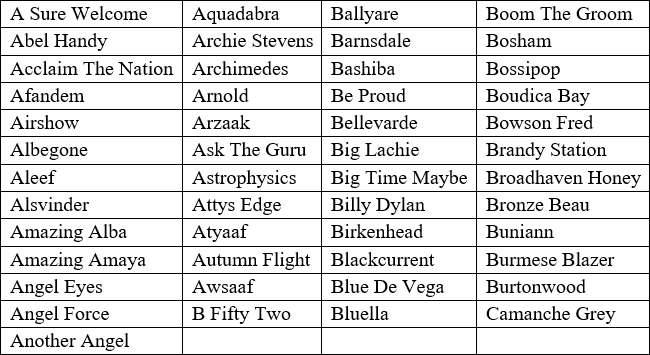
As you can probably gather, I simply went down my original sprinter list alphabetically. I thought that was as random as anything.
Between them these horses had run a combined number of races just in excess of 3000 (up to the end of September 2022). Some are still racing, some are retired. Despite these horses essentially being ‘handicap sprinters,’ not all their races were over 5 or 6f, but over 96% of them were. Therefore, we are essentially dealing with 5-6f data here.
Research Phase 1 – Dobbing (in general)
Dobbing is a term I came across a few years back and have written about before. The word ‘DOB’ in terms of betting ‘in running’ means ‘double or bust.’ Essentially if the trade is successful, we double our original stake, if the trade is unsuccessful, we ‘bust’ or lose our stake.
For people who have not read about dobbing before I will give you a worked example:
Let us imagine you back a horse pre race at 10.00 for £10; in order to create a potential DOB, you try and lay at half the odds for double the stake – so you set a lay at 5.00 for £20.
If the horse hits 5.00 or lower in running, your lay bet will be matched and regardless of the result you will win £10 (less commission).
Here is the simple mathematics behind the two potential winning outcomes – if the horse goes onto win the race you get £90 returned from the ‘back’ part of the bet; you lose £80 on the ‘lay’ part of the bet giving you £10 profit.
If the horse does not go onto win, you lose your £10 stake from the ‘back’ bet but gain £20 from the lay stake as that priced was matched in play – again giving you a £10 profit.
Of course, if the lay part of the bet is not matched you will lose your original £10 stake.
For dobbing to be profitable long term, you are probably looking to have a success rate of 54% or more. This figure has to be a bit higher than say 50.10% as we need to take commission into account.
I looked at all the horses in the list and worked out how many times they had dobbed successfully.
Of the 3004 races, these horses had dobbed a total of 1355 times which equates to 45.10%. This is some way short of the 54% target. This of course is to be expected as my past research has indicated that on average around 40-45% of all horses hit that successful ‘dob’ point of half their odds ‘in running’.
There was a big range of dobbing success across the horses in my group.
Angel Eyes had dobbed an impressive 70.30% of the time (26 times in 37 races); at the other end of the scale, Camanche Grey had dobbed just 22% of the time (11 times in 50 races).
Research Phase 2 – How does the run style affect Dobbing?
Back in 2013 I wrote an article exploring run style and dobbing with the main focus being on front runners / early leaders.
The reason the focus was on front runners was due to the fact that they tended to ‘dob’ far more often than any other run style. Front running horses having better ‘dob’ chances than say hold up horses makes sense I suppose, as ‘in running’ traders have to react to how the race unfolds – horses that get a soft lead for example contract quickly in running, whereas most hold up horses only start to contract significantly in price if they move up the field later in the race.
Also, I found that horses that led early in sprints contract more quickly than at longer distances. So, what does my new set of data tell me in regard to run style and dobbing?
Here are the findings:
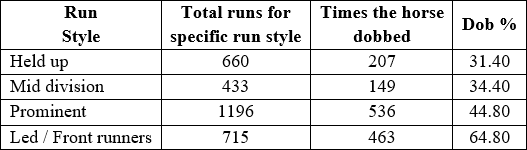
These results back up all my previous research.
All early leaders / front runners have dobbed nearly 65% of the time. So, if only you could predict the front runner in all handicap sprints you could make a tidy sum dobbing each and every one of them!
Of course, predicting the front runner all the time is impossible, although there are ways you can improve your chances. Past run style is generally a good indicator with seasoned handicappers and draw position, form can all play a part.
Research Phase 3 – For front runners does the price of the horse affect Dobbing?
When looking at prices we need to ignore odds on horses as they cannot physically halve in price. Fortunately, because I have chosen handicap sprinters there are very few horses that had odds on prices.
Let me look at the dobbing percentages of front runners grouping them by price bands. In terms of price bands, I have used Betfair Starting Price and I have tried to make sure there is a similar number of runners in each grouping:
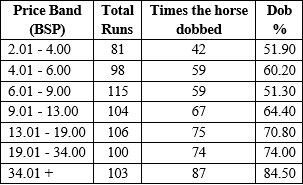
It should be stated before I comment on the data, that groupings of around 100 races is still relatively small sample in reality.
Having said that, the pattern seems to be clear – bigger priced front runners tend to dob more often than shorter priced front runners. The dob success rate beyond a BSP of
13.01 is impressive.
Research Phase 4 – For hold up horses does the price of the horse affect Dobbing?
We have seen what happens with front runners – what about hold up horses in terms of price and dobbing.
I have kept the same price bands although the shortest price band has a very small sample:
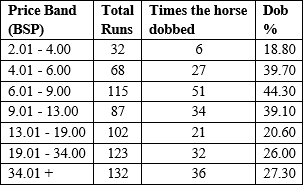
If we ignore that small sample (BSP 2.01 – 4.00) this data is somewhat reversed as compared to the front running data.
Horses priced 13.01 or higher have dobbed considerably less often than shorter prices. This does make sense, but it is worth doing the research to make sure.
Research Phase 5 – Does long term dobbing data for individual horses mean anything?
Finally, I am looking at some of individual horses in this study and splitting their records in half. From there I am going to compare their dobbing percentages in the first half of their career with the second half of their career.
My guess is that the second half of their career may see a slight drop off in dob percentage simply because the horse is getting older.
Overall, I am hoping that there are not massive differences. I looked at 16 horses and here are my findings:
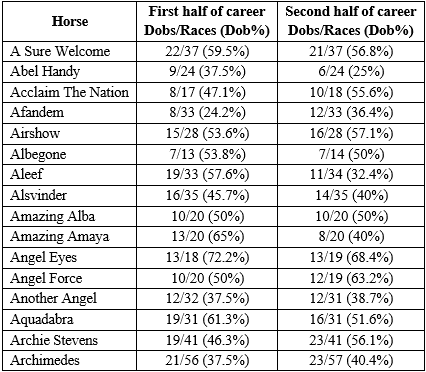
OK, so this horse sample size is small, but when researching anything we have to start somewhere … and this type of research is quite time consuming. You cannot check 100s of horses in this way in a few minutes.
However, as a general rule, most of this group of horses have similar records in terms of dobbing percentage. Only Aleef and Amazing Amaya have ‘wildly’ differing figures.
11 of the 16 horses had a % difference of less than 10%.
Of those who had a 50% or more dob percentage in the first half of their career, 7 of the 9 repeated that in the second half of their career.
All in all, these results suggest to me that this is an area that I need to continue to look into. And it is here I am going to end this piece. I am in the process of looking at further research phases with the data I have and if there are enough useful findings for a follow up article, I will write that up and share it early next year.
There are several ‘takeaways’ from this research article, but for me the key one is – a mid to high priced front running handicap sprinter has excellent potential to ‘dob’ and make you money in the long term.
David Renham