Top Trends for The Big Race – The Grand National 2026 – Sat 11th April
The Grand National is simply the most famous horse race on the planet, bar none!
The history of the Grand National, now sponsored by Randox, can be traced back to the early 1800’s.
In February 1839, Lottery became the first winner of the Grand Liverpool Steeplechase, the race that would become known as the Grand National. Horses had to jump a stone wall, cross a stretch of ploughed land and finish over two hurdles.
Mr Edward William Topham, a respected handicapper, was responsible for turning the Grand National into a handicap in 1843 after it had been a weight-for-age race for the first four years. The Topham family-owned substantial tracts of land around Aintree and in 1949 they bought the course outright from Lord Sefton, from whom the land had previously been leased since the racecourse’s opening in 1829.
The current course, which stages races over conventional fences and hurdles, opened in 1839.
A difficult period for Aintree in the post-war years led to a sale to a property developer and concerns about the future of the Grand National. Bookmaker Ladbrokes stepped in to manage the Grand National until 1984, when Seagram Distillers became sponsors.
They provided the solid foundation on which Aintree’s revival was built. Today Aintree is owned and managed by Jockey Club Racecourses, one of 15 operated by The Jockey Club subsidiary.
The 2014 Grand National boasted a seven-figure prize fund for the first time, and the 2025 event has a million pounds guaranteed prize fund, with the connections of the winner set to receive £500,000.
There will be a maximum of 34 runners this time around and they will compete over 30 fences covering a distance of 4 miles 2 furlongs and 74 yards.
To many Red Rum springs to mind when considering the Grand National and remains the only horse to have won the big race three times.
Over the years there have been numerous reported gambles on the famous race such as in 1866 when owner/trainer Edward Studd placed a £1000 wager at odds of 40/1 on the winner Salamander with the winnings being the equivalent of 3 million pounds in today’s value.
More recently Monty’s Pass was backed by the syndicate of owners at 66/1 before going off at 16/1 and winning the 2003 renewal.
Having said that there have also been some big priced winners over the years such as 100/1 shots Mon Mome (2009), Fionavon (1967) and Caughoo (1947).
The 2013 winner Auroras Encore went off at 66/1, whilst a couple of years ago Noble Yeats was returned a 50/1 winner.
With regards to Noble Yeats, in 2022 the top amateur jockey Sam Waley-Cohen made it known that his ride on Noble Yeats would signal the end of his riding career and the horse produced a fairytale finale.
For the last two years Irish Trainer Willie Mullins has trained the winner with I am Maximus (7/1) in 2024 and last time around Nick Rockett prevailed at 33/1. That made it 7 of the last 10 renewals having been won by Irish trained horses.
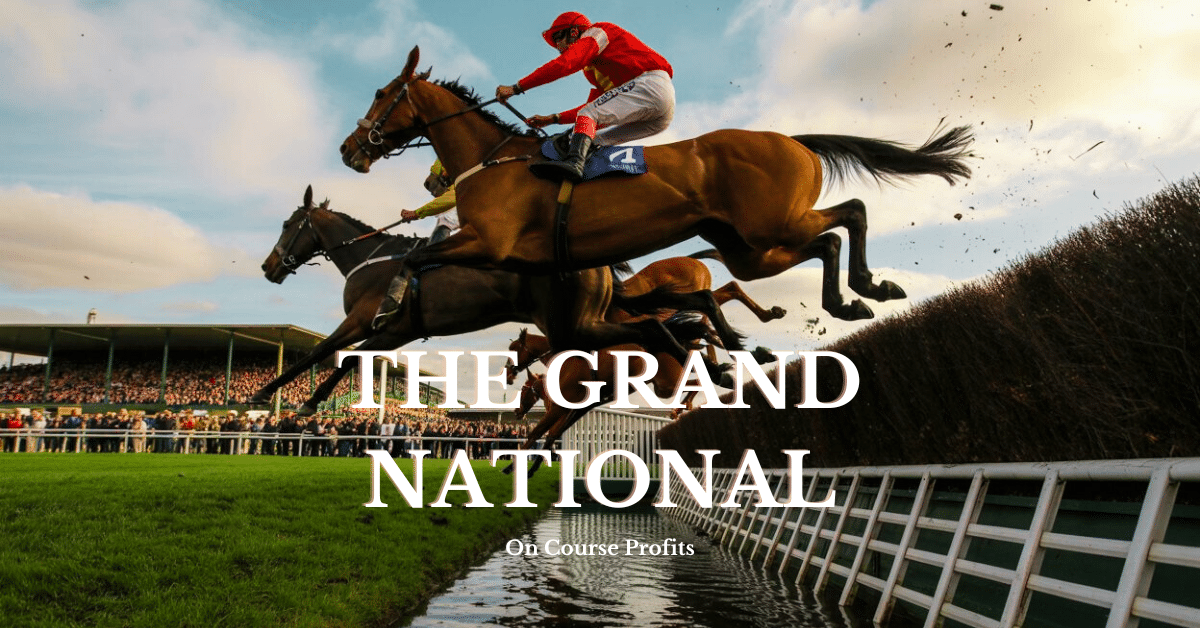
The Grand National fences have continually been modified during the last half-century but there was a revolution in 2013. Before then they were comprised of wooden stakes driven into the ground, dressed with birch, padded and topped with 6-8 inches of tightly packed green spruce.
In 2013 the wooden core was replaced with plastic, which made the fences less rigid and so with more give.
This has led to a better way for horses to tackle the fences as it has become a disadvantage to jump cleanly over the fences as that uses a lot of energy.
The Tiger Roll method of jumping lower and through the loose spruce, landing running, is now the ideal technique for the National.
For that in mind it makes sense to focus our look see at the trends during the years since that major fence adjustment.
The race itself is different from the vast majority of other marathon handicap chases as the quality and size of the field mean they tend to go quicker and therefore it favours a certain type of runner which can be summarised as follows: –
• A cruising speed to hold a position, (they don’t hunt round on the first circuit now)
• Even more stamina because the faster tempo requires horses to stay better.
• Jumping efficiently through the top of, not over, the fences
Some of the more poignant stats regarding the most recent decade are a top nine finish is pretty much a must with all 10 having that profile.
Interestingly those that fell, unseated or pulled up on their latest run were 0 from 66.
A top 6 finish last time out has produced a solid place strike rate, 12.85%, which contrasts positively with those 7th or worse, which had 8 placers from a total of 131 such runners (6.11% Strike Rate)
Market wise there has been a recent trend to shorter priced winners, except for Nobel Yeats at 50/1.
All of the most recent 10 winners were aged between 7 and 9 (the race didn’t take place in 2020 due to Covid) but that group did include the majority of the runners (217).
Outside of that age bracket 164 have competed and lost although 13 did manage to place.
Winners of this prestigious contest have generally been kept busy in the current campaign with those with 2 or less runs drawing a blank from 74 such runners in the last decade.
Based on the above the profile of the more recent Aintree Grand National winners includes the following traits: –
• A prominent run style.
• A top 9 finish last time out (top 6 even better)
• Look towards the fore of the betting.
• Runners aged 7 to 9 years old.
• 3 or more runs in the current season.
On Raceday we will use the above stats along with several form and speed ratings to home in on a few of the more likely contenders for the 2026 Grand National. The findings will be published in the Platinum Members Bulletin.
Steve Carter