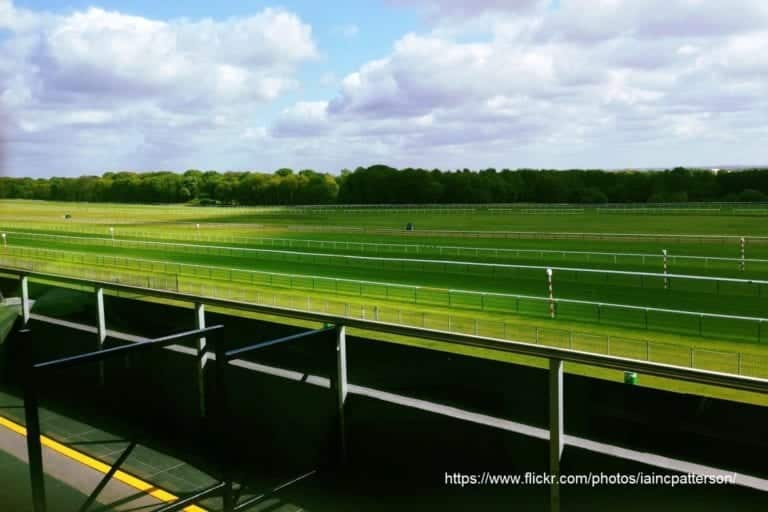

Different Challenges on the All Weather – No course is quite the same…
In the UK we have six all weather courses that are used all the year round, but perhaps more importantly for flat fans offer the only flat racing during the cold, dank winter months.
Three of the courses have a Polytrack surface, those being Chelmsford, Kempton and Lingfield; three have a tapeta surface namely Newcastle, Southwell, and Wolverhampton.
It is important to remember that all six courses are different – not only due to the surface not being the same at all six, but for other reasons as well.
Kempton for example is the only right-handed track; the circumferences of the track differ markedly in shape; the course circumferences also vary in terms of length from:
Wolverhampton the smallest (1 mile) to Newcastle the biggest (1m6f); the lengths of the finishing straight vary too with Newcastle at just under 4 furlongs, Kempton and Southwell 3 furlongs, Chelmsford 2 furlongs and Lingfield and Wolverhampton at 1¾ furlongs; Southwell has a straight 5f track, Newcastle runs 5, 6, 7 and 8 furlong (1 mile) races on the straight course, while the other four courses run all their distances on a round course. Hence each track is unique and has differences compared with the other five.
Therefore, you cannot use the same blanket approach at each track and each distance when it comes to race reading and selecting horses to back.
Let me look at the courses one by one giving you my personal thoughts as well as some stats that help me and hopefully will help you too.
Chelmsford
From a personal perspective this is my favourite track to bet on out of all the all weather courses.
The map of the course looks like this:
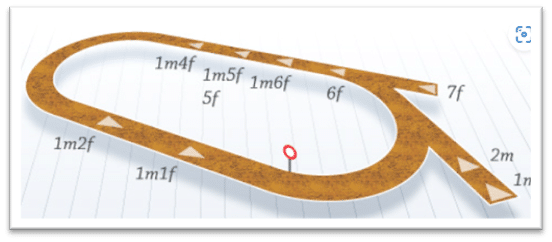
Chelmsford is considered a fair test for horses and this round course resembles American dirt tracks. The kickback can be quite severe, and this means that horses need to be near the pace especially in races up to 1 mile.
Over 5 furlongs front runners have the biggest edge of all the AW courses and this edge remains strong in all races up to a mile. The minimum 5f trip also strongly favours lower drawn runners.
Going back to the start of 2020 horses in handicaps of 8+ runners drawn 8 or wider have won just 10 races from 225 runners (SR 4.4%) for losses to SP of nearly 50 pence in the £.
Compare that to those horses drawn in the bottom four stalls (1 to 4) who have won 50 races from 368 runners (SR 13.6%) for losses of under 4 pence in the £.
Over 6f low draw runners also have an edge although it is not quite as potent as it is over 5.
Horses drawn 1 to 4 are still around twice as likely to win than those drawn 8 or wider. Front runners again have a big advantage over the other run styles over the second of the two sprint trips.
Over 7f there seems little draw bias, but front runners continue to hold sway, while over 1-mile the front running bias is evident but less strong.
Draw wise over 1-mile low draws do have a nagging edge.
The market has been a good guide in recent years and backing all horses in the top three in the betting blind would have made a profit in non handicaps to Betfair SP and only small losses in handicaps.
In terms of trainers, in recent years it has paid to keep on the right side of Ralph Beckett and John Quinn, while any fancied runner from Michael Bell, Charlie Hills and Charlie Johnston should be noted.
Kempton
Kempton is another course I bet regularly at.
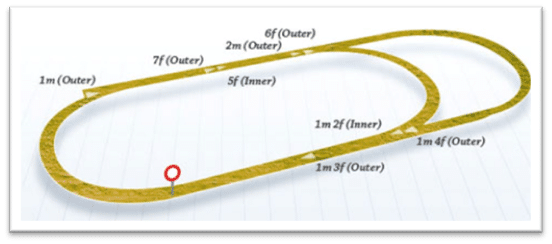
It has an outer and inner course, but the inner course is rarely used these days with only 7 races using that inside loop in the whole of 2024 (at time of writing). When they race over 5f and 1m 2f they use the inner course, all other distances use the outer loop. The main outer loop has a circumference of 1m2f with a 3-furlong run in.
The racecourse map is shown below:
There are a considerable number of 6f handicaps each year which personally is the distance I tend to concentrate on as there is a strong low draw bias coupled with a potent front running bias.
Horses drawn 1 to 3 have combined to win 14.1% of races compared with those drawn 8 or higher who have combined to win just 5.5% of the time. The difference in losses between the two has been 30p in the £ (in favour of the lower draws). As you would expect low drawn front runners have an excellent record.
7f and 1-mile handicaps offer a draw and run style edge too, but it is less powerful than it is over 6. Over 5f front runners have a massive edge but there are so few races these days to make the most of it.
Kempton is not a trainer friendly track in terms of finding those who seem to do well with all their runners.
If focusing on the top end of the market four trainers have been profitable to follow in recent years namely Saeed Bin Suroor, David Evans, George Boughey, and Roger Varian. Another trainer to keep an eye on is Richard Hughes who has proved very profitable with his 2yo runners.
Finally, LTO winners at Kempton trying to repeat their win at the Surrey course have proved costly to follow losing 25p in the £ to SP, 18p in the £ to BSP. Conversely a win at any of the other five tracks before racing at Kempton next time has seen a BSP profit for each of the LTO tracks.
When combining the results for a LTO win at either Chelmsford, Lingfield, Newcastle, Southwell, or Wolverhampton (2020-2024), when their follow-up run has been at Kempton, we get a strike rate of nearly 22% and a BSP profit of £111.26 (ROI +13.2%).
Lingfield
I am not so keen on Lingfield when it comes to betting. I will target 5f handicaps and occasionally races over 6 / 7f, but that’s about it. For whatever reason I have always found Lingfield a hard hunting ground.
Lingfield is a speedy, sharp track where, as with most all weather courses, track position is important. With such a short straight you do not want to be too far back turning in. The layout of the track is shown below:

Front runners have a strong edge over 5f, while front runners/prominent runners also dominate 6 and 7f contests. Over 1m2f front runners actually are at a disadvantage and a prominent pitch is preferred.
In terms of the draw only 5f gives an edge and this is to a lower drawn runners closest to the inside rail.
Three trainers with a good recent record there include Charlie Appleby, Andrew Balding and Sir Michael Stoute. Also look out for Archie Watson when running 2yos – he has an excellent record with his juveniles.
I find speed ratings useful to use when betting on the all weather and this is especially so at Lingfield. I always take note of the speed ratings when tackling 5,6 and 7f races.
Newcastle
Let’s start by looking at the racecourse map for Newcastle:
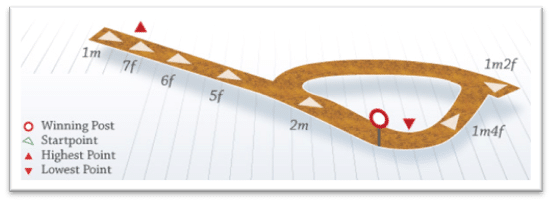
Newcastle is completely different to the other five tracks for several reasons, but three in particular:
- Firstly, it is so much bigger in circumference (4 furlongs longer than any of the others).
- Secondly, it has four distances from 5 furlongs to 1 mile where they race on a straight track.
- Thirdly it is a galloping track with a long uphill finish in the straight. Hence, a key requirement for success at Newcastle is stamina.
Hold Up horses do far better at Newcastle than at any other AW track.
In contrast the strong front running edge you tend to see at other tracks (especially in distances of 5f to 1 mile) is not in evidence here. Yes, front runners enjoy a solid edge over 5f, but shorter distance races at Newcastle give all types of runners in terms of run style a chance. This is due to these races being run on a straight course, coupled with a stiff last few furlongs to the finish.
Having said that, front runners do win their fair share of races on the straight track and are probably under-bet due to how the track ‘rides.’
In terms of the draw, on the straight course a higher draw is slightly more advantageous than a low one.
This is especially true over 7f and 1 mile and when the going is standard (rather than standard to slow). In addition, the high draw bias appears stronger in the winter months. My guess therefore is that colder weather does affect the surface in a way that accentuates the edge to higher drawn runners. On the round course over 1m 2f and 2m very low draws (especially draws 1 and 2) struggle.
Trainers that are worth following at the track include Andrew Balding and Archie Watson. The Gosden stable have plenty of winners at the course (roughly one in every three runners), but their horses start at quite short prices, so it is hard to profit from them.
|
The rest of this article is for Platinum members. You've just seen what our experts do with publicly available data — the Platinum section is where the specific angles, numbers and actionable conclusions live. Platinum members also get daily system selections in their inbox by 2am, tips from top tipsters, Win Big Golf selections, and access to 11 years of magazine archives. |