Further Draw and Run Style Biases for 2025
A lot is spoken and written about draw bias in the mainstream media, and understandably so because it can be a major determinant in the outcome of flat races. The problem is that, as more information comes to light on the subject, the prices of favourably drawn runners diminish.
In plain English, finding winners becomes a little easier with this enhanced knowledge; but making a profit gets harder due to the deflated odds returned.
This article is part of our Complete Draw Bias Guide — covering every UK course and distance in one place.
More recently, there’s been a rise in the amount of discussion around pace, or run style, bias. Put simply, this is when a horse has an advantage (or a disadvantage) from the position it takes in the early part of race. Run style bias is a little more nuanced than draw bias because it involves consideration not just of individual horses preferred early positions, but also the spread of run styles in the field, and the configuration of the course.
If that sounds complicated, it kind of is, but there’s some good news which I’ll come on to in a moment. First, let’s consider some run style bias examples.
Example 1: Lone front runner on a pace-favouring track
In many ways, this is the holy grail of run style biases. A single horse likely to go forward will enjoy an uncontested lead and, as such, its jockey may be able to dictate a steady tempo, leaving enough petrol to get first run in the sprint finish.
Example 2: Three or more front runners in a big field
In this scenario, there’s a reasonable chance that the pace will be overly fast and that those closest to the front will be compromised by their early exertions. Here, we might expect a horse ridden more patiently to come through ‘at the one pace’ while those showing early dash slow down dramatically.
Example 3: No obvious pace angle
If there’s no obvious leader in a race, one of two things can happen. First, a horse that doesn’t normally go forward may be sent on if connections see that as an opportunity. Second, the race might be run at a muddling clip with the horse that can show the best turn of foot likely to prevail. (This is where sectional timing can help, but that conversation is very much for another day!)
It is the case, then, that a horse can be advantaged by the draw, or by its run style, or by a combination of both.
At geegeez.co.uk we have all sorts of tools and ‘views’ to help our members very quickly see which part of the draw/run style grid is favoured, and which horses are likely to be in that segment.
In the rest of this article, I’ll share three specific examples that you can use this flat season and beyond.
In each case, I’ve used 8-12 runners on good or good to firm ground, covering the period since 2009. I am also showing ‘actual draw’ data (which is the draw number from the racecard but accounting for non-runners; so, for example, if stall 1 is a non-runner, the horse advertised in stall 2 because ‘actual draw’ 1).
Catterick 5f
There is a pronounced bias towards low numbers when the ground is riding good or faster over five furlongs at Catterick, as the below graph, based on IV3*, shows:
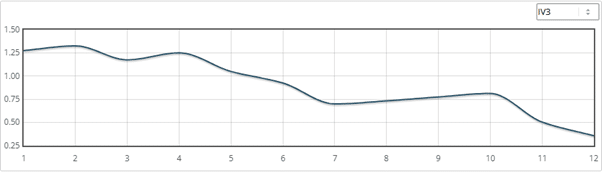
*To understand what IV3 is, check out this article. In a nutshell, it’s a measure of how groups of something (stall positions in this example) perform compared to all of the something (all stall positions in this example).
We can see from the graph that horses drawn 1-4 are roughly 1.25x more likely to win than the average; and that those in stalls 7+ are 0.75x or less likely to win than the average.
But…
What if we add run style into the equation?
This chart shows the twelve combinations of draw (low, middle, high) and run style (led, prominent, midfield, held up) – and the colour coding makes it abundantly clear where to be, and where not to be!
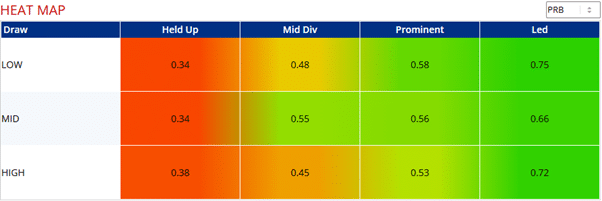
Putting these two visuals together, we can see that it’s not really much use being drawn low if you’re a hold up type. Equally, if you’re on a horse that likes to lead but which is drawn high, maybe it’s not such an impediment after all.
Here is a table that pulls all of the detail above together, and we can see immediately that identifying front-runners on fast ground over 5f at Catterick, regardless of stall position, has been a profitable endeavour:
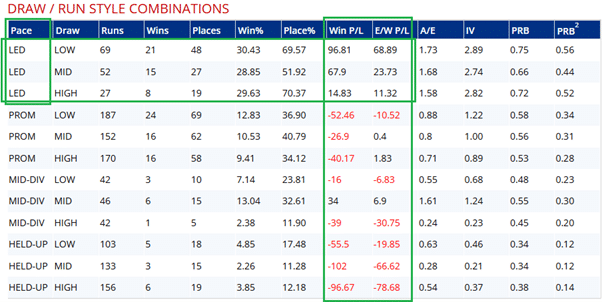
I’ve used a lot of words and pictures to really tease out this example; but when Geegeez Gold members are looking at the form, it’s literally a ten second glance of the DRAW tab in our racecards to see if a race is worth closer scrutiny.
Ripon 1m
It’s not just sprint trips where biases exist. Ripon is a notoriously biased track, even over longer distances. Here are some one mile handicap data.

Notice how choosing a draw segment offers nothing of betting value (big red negative numbers in the win and each way profit/loss columns).
Now take a look at the run style chart.
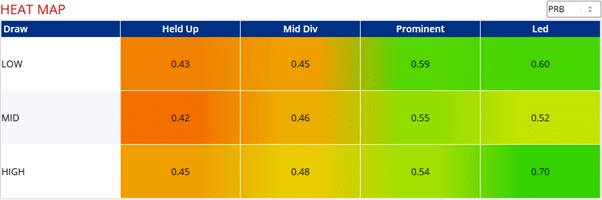
Again, we see this strong advantage to horses that lead or race prominently; and a commensurate disadvantage for horses that tend to be further back in the early part of their races.
This time it’s not exclusively a sea of profit, but there remains a very clear indication of where a horse should ideally be drawn and positioned early in the race.
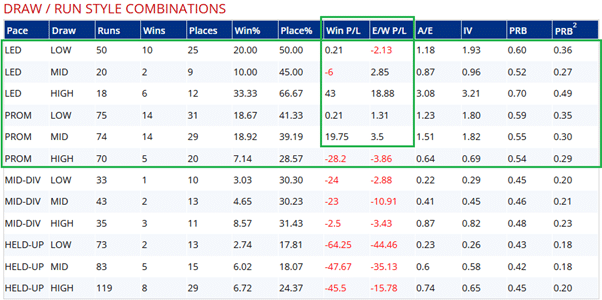
If you’re a layer, note the terrible record of hold up horses. Of the 42 runners sent off favourite and racing either midfield or held up early in an 8-12 runner handicap over this course and distance, only three won. 39 of 42 favourites were beaten in this context!

York 5f
York’s five furlong strip is an interesting one. A cursory look at the draw thirds offers two conflicting views.

Looking at any of win percent, or place percent, or PRB (Percentage of Rivals Beaten) will leave the impression that low draws do better than middle draws, which in turn fare better than high draws.
But a squint at the Win P/L column delivers an altogether different conclusion: the profit has all been with high.
However, again, it’s not as simple as where a horse is drawn (and hallelujah for all the pundits out there who try to imply that it is – their chatter increases the odds available on the horses with the best chances for people like us!)
Let’s again consider run style as part of the equation.
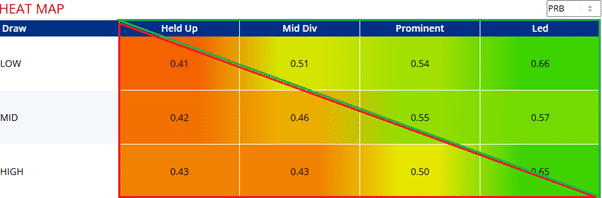
This time, rather than the two rectangles (led/prominent and mid-div/held up) we saw in the Ripon example, we can now see two triangles. We tend to see this sort of split more often on tracks with a tight bend, where fast starting inside drawn horses can take full advantage of their ‘geographical good fortune’.
But York’s straight five furlongs strongly favours front runners, and less strongly favours low draws, when the ground rides on the quick side.
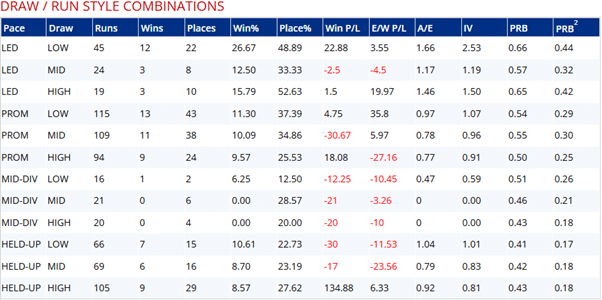
That in itself is not necessarily enough to elicit a profit, as the table above shows; but we can still see – albeit less clearly than the previous examples – where not to be! Specifically, the middle ground is unfavoured, both from a draw and a run style perspective.
Horses drawn low that raced on the lead or prominently were a profitable group; as were horses drawn high, regardless of run style. But that big number for high drawn hold up horses owes everything and more to the wins of Angel Meadow at 66/1 in 2016 and Sole Power at 100/1 in the 2010 Nunthorpe Stakes. There was also 22/1 Secretinthepark in 2019 in that segment. It can be a very long time between drinks betting horses at those sorts of prices!
Geegeez has a suite of tools to help make winner-finding and value-spotting more visual and, therefore, quicker and more intuitive. Our draw and pace tools, which cover all flat races in UK and Ireland, are just two of them.
As an OCP reader, for the next two weeks only, you can claim 25% off membership to either Geegeez Gold or Geegeez Lite for as long as you remain a member.
Use the coupon code OCP25 on this page.
Matt Bisogno