
Uncovering Potential Stable Gambles Using Racing Post Racecards and AI
Here is a simple way to use AI to help identify possible live-market moves on a horse race. The idea is not to ask AI to pick winners. The useful part is getting AI to do the repetitive comparison work quickly: reading a racecard screenshot, extracting the Betting Forecast, comparing it with the live Best Odds, and showing which horses are trading shorter than expected.
The Basic Theory
This live-market strategy starts with one working assumption: the Racing Post Betting Forecast is a reasonable independent estimate of where the market might be expected to sit.
If a horse is available at shorter live odds than its Betting Forecast price, that may indicate a market move. Sometimes this can be a meaningful shortening; sometimes it is just a market adjustment. The purpose of the AI process is to spot the difference quickly and present the information in a clean table. This is a research tool, not betting advice. Always check the race conditions, non-runners, place terms, liquidity, and your own staking rules before drawing conclusions.
Step 1: Capture the Full Racecard
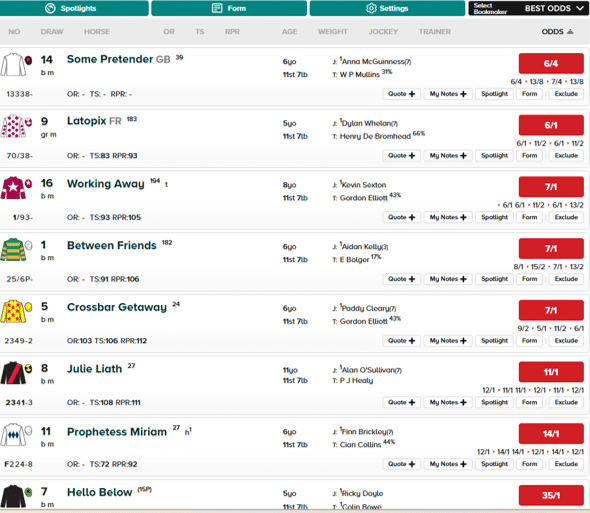
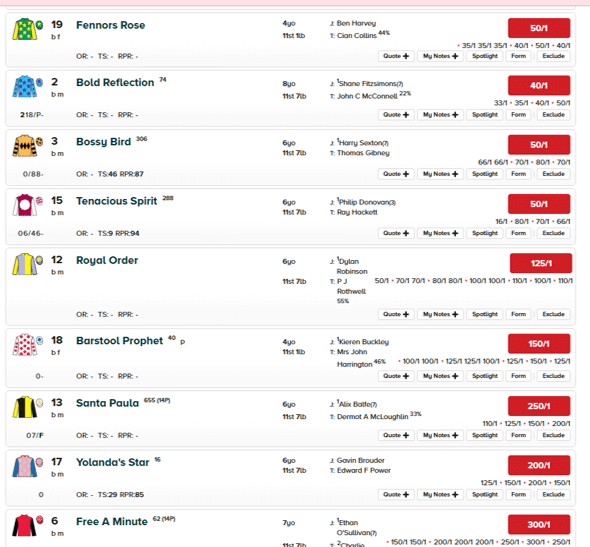
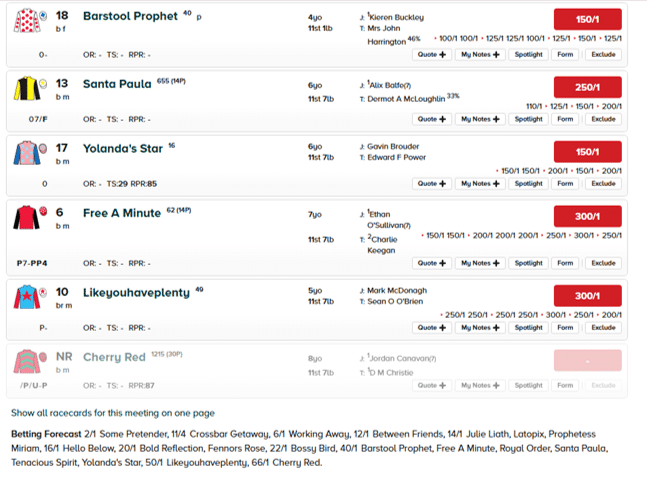
Take screenshots of the full racecard at Racing Post. With a large field, you may need several screenshots. Make sure you capture all runners, the Best Odds column, and the Betting Forecast line at the bottom of the card.
On Windows, you can use Ctrl + PrtScn, the Snipping Tool, or your browser screenshot function. The important point is that the horse names and odds must be readable.
Step 2: Upload the Screenshots to ChatGPT
Once you have the screenshots, upload them into ChatGPT and use a precise prompt. The more specific the prompt, the less likely AI is to miss grouped odds, confuse runners, or invent missing information.
Copy-and-Paste Prompt
Act as a horse-racing screenshot analyst. I am uploading one or more screenshots from the same racecard.
Your task is to compare the Betting Forecast with the live Best Odds shown on the racecard.
Important rules:
1. Only use the screenshots I upload. Do not invent odds and do not search online.
2. First, find the Betting Forecast line, usually near the bottom of the racecard.
3. Convert the Betting Forecast into a horse-by-horse vertical list.
4. Be careful with grouped forecast prices. If the forecast says: “14/1 Horse A, Horse B, Horse C”, then Horse A, Horse B and Horse C all have a forecast price of 14/1. The same forecast price applies until a new price appears.
5. Next, read the Best Odds column from the racecard. These are usually shown in the red odds boxes on the right-hand side.
6. Match each horse from the Betting Forecast to its Best Odds.
7. Create a table with these columns: Horse | Betting Forecast | Best Odds shown | Is Best Odds shorter than Forecast? | Notes.
8. To decide whether odds are shorter, compare the fractional value. For example, 6/4 = 1.5, 2/1 = 2.0, and 7/1 = 7.0. A lower fractional value is shorter. Therefore, 6/4 is shorter than 2/1, while 7/1 is longer than 2/1.
9. In the notes column, write: “YES — shorter” if the Best Odds are shorter than the Betting Forecast; “No — longer” if the Best Odds are bigger than the Betting Forecast; “No — same” if they are identical; and “N/A” if the horse is a non-runner or no active price is shown.
10. If the same horse appears in more than one screenshot and the price differs, flag the conflict instead of hiding it. Use the clearest or latest visible screenshot, but mention the discrepancy.
11. After the table, give me a short summary headed: “Market-shortener flags”.
12. Under that heading, list only the horses whose Best Odds are shorter than the Betting Forecast, ranked from the strongest shortening to the weakest.
13. Do not give betting advice. This is for data extraction, form study and article research only.
It is a big prompt, but that is deliberate. You want AI to produce a structured answer that is easy to double-check, rather than a vague summary.
Example AI Output
In this example, AI converted the Betting Forecast into a vertical list, matched each horse to the live Best Odds column, and flagged the runners whose live odds were shorter than the forecast.
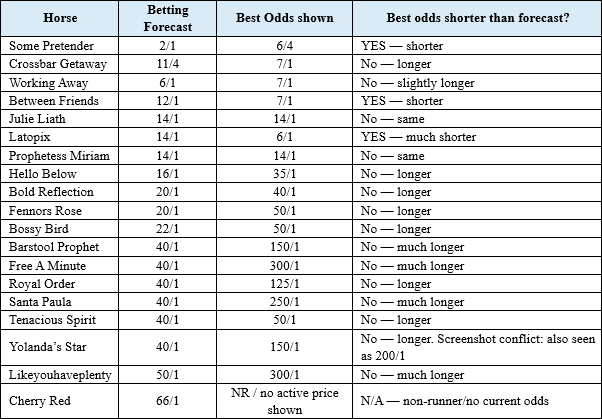
Market-Shortener Flags from This Screenshot
- Latopix — forecast 14/1, best odds 6/1.
- Between Friends — forecast 12/1, best odds 7/1.
- Some Pretender — forecast 2/1, best odds 6/4.
This is the useful article angle: AI can turn a messy large-field racecard into a structured forecast-versus-live-market comparison and instantly isolate horses trading shorter than expected.
Example Result
In this example, AI highlighted three horses. Two of them were involved in the finish: Between Friends won and Latopix finished second. That does not prove the method will work every time, but it does show why this type of market-comparison workflow can be useful for race analysis.
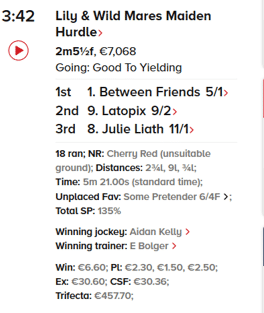
Personally, I would treat any highlighted runner at 11/4 or bigger as an each-way candidate rather than an automatic bet. Exchange prices, including Betfair SP where available, can sometimes be more competitive than fixed-odds bookmaker prices. However, this should always be checked race by race, with proper staking discipline and responsible betting limits.
Important Note on Non-Runners
When comparing the Betting Forecast with live market odds, always check for non-runners.
If a horse was included in the original Betting Forecast but later becomes a non-runner, the comparison can be distorted. This is especially important when the withdrawn horse was near the head of the market.
For example, if a forecast 3/1 or 4/1 horse is withdrawn, the live odds of the remaining runners may shorten simply because the market has been recalculated. That does not necessarily mean those horses have been strongly backed. It may just reflect the removal of a major contender.
The same applies even more strongly when there are multiple non-runners near the top of the market. Several withdrawals can make many horses look shorter than the original forecast, even when there has been no meaningful positive market move behind them.
By contrast, big-priced non-runners usually have much less impact. If a 100/1 or 150/1 outsider is withdrawn, it will rarely change the shape of the market in a major way.
So, when using this system, treat market-shortening signals with caution if one or more short-priced horses have been declared non-runners. The cleaner the racecard, the more reliable the forecast-versus-live-odds comparison is likely to be.
Automating the Process with an AI App
This is the more advanced version of the same idea. Instead of manually uploading screenshots into ChatGPT each time, I created an app to perform the comparison automatically. These apps can be created for free, and all you need is a gmail email address….more in the next article dedicated to AI tools for you.
In the example below, the app selected Jerry From Kerry.
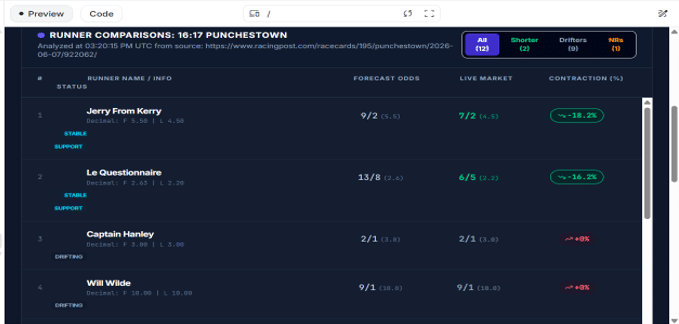
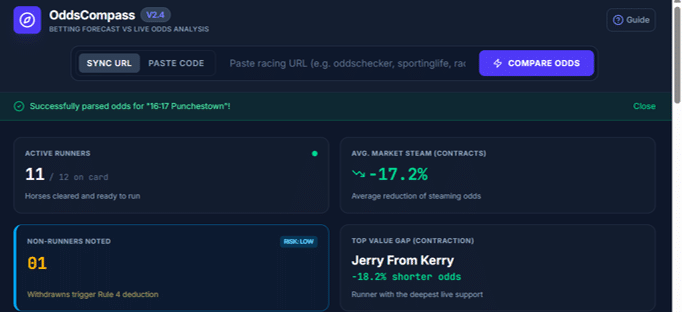
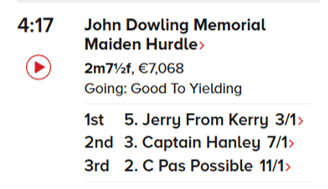
Using the same logic as the prompt above, AI produced a shortlist. If one or two of the shortlisted runners win or place, the result can be enough to make the exercise worthwhile. In this example, the method found the winner.
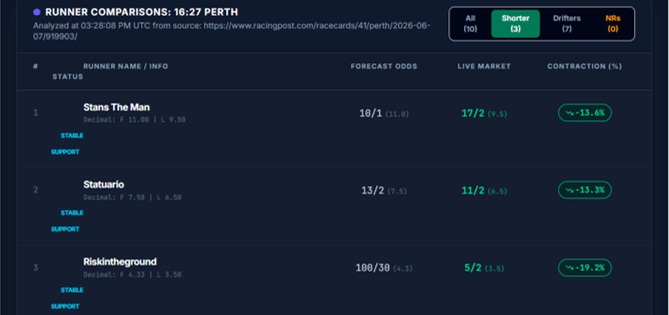
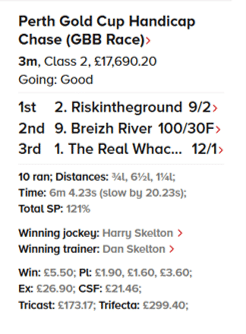
A pity one or two of the other horses did not place, but the winner was identified.
Bottom Line
This is one of several live-market strategies I use to uncover possible stable gambles. The main point is not that AI magically predicts winners.
The real value is that AI can act as a personal research assistant, extracting information from screenshots and doing the comparison work quickly.
Provide the screenshots, give AI the prompt, and then review the shortlist of potential market movers. Always pay close attention to non-runners, especially short-priced non-runners, because they can skew the comparison.
I also use another live-market system based on the odds at Sporting Life, but that is for another article. It is simple and effective.
I have also written a wider tutorial on how AI can help with horse-racing research. Space probably prevents including that full tutorial here, but readers who want more can contact On Course Profits and I can forward a tutorial for you. AI can help with form reading, screenshot analysis, racecard comparison, and even bespoke app creation. Do not be intimidated: if you can write a clear sentence, you can learn to create a useful AI workflow and you will be able to, eventually, create your own AI App Army!
Clive Keeling