

Big Race Trends Analysis – May
For the past three months I have
looked at the ten-year trends and how they are a fantastic tool to use when it
comes to looking at big races either handicap or non-handicap.
Add in the “less is more” approach into your trends analysis and there is no
doubt in my mind that you can improve your win strike rate in these big races.
I can’t stress too much the following. “You really don’t need to be using lots
of filters. Indeed, the more filters you use the more confusing the analysis
and the less reliable the trends become”.
Indeed, if you find that you can’t narrow down the field to four or five
trends, then maybe that race isn’t one to be looking to have a bet in anyway.
Arguably the most important aspect of trends analysis is that they can reveal
elements that you may not have found by more normal methods of race analysis.
Maybe a race favours younger or less experienced handicappers or higher
weighted runners. Such information can thus be an essential element of
assessment of the runners in a race.
I got some good feedback from readers regarding this approach. With some
requesting me to do it on a regular basis.
For those asking for it, my wish is your command and from now until the end of
the flat season I will look at couple of the following months big races using
my “less is more” approach to big race trends analysis.
As ever the ever reliable www.horseracebase.com is my
guide when looking at the trends for big races.
The Trends Have It: Lincoln Handicap Review
Last month I looked at two races
the Lincoln Handicap and the Scottish Grand National. At the time of writing
this the latter race has yet to be run but the Lincoln has taken place.
When looking at the Lincoln trends. I said I would be happy to focus on runners
with the following trends:
- Horses aged 4yo to 6yo.
- That last raced in Britain or Ireland between 151 to 240 days ago, thus ignoring any runs abroad.
- That were sent off 25/1 & under
Now those simple trends have shortlisted the winner of the Lincoln Handicap winner each year since 2013.
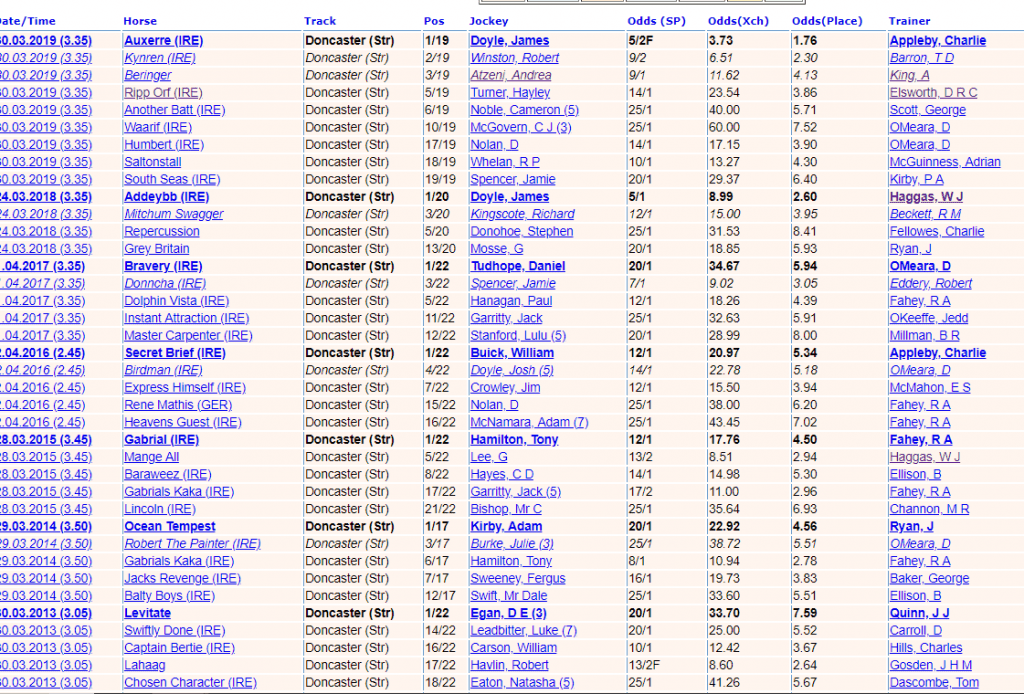
In previous seasons there have been an average of five qualifiers on the shortlist for further form study.
This season we had no fewer than
nine qualifiers. Still the trends used, identified the first three home,
including the easy winner Auxerre.
I was a little surprised to see many of the pundits who use big race trends
analysis didn’t have the winner on their shortlists for the race.
Maybe the problem is, using to
many filters does indeed confuse.
Now let’s be blunt here. Not all big races are as ‘clear cut’ as the Lincoln,
but over a season you will find more big race winners using a “less is more”
approach to trend analysis.
Chester Cup
The two races to come under the trends microscope this month are the Chester Cup and the Victoria Cup.
Both are flat races run over two very different distances.
Let’s begin by looking at the Chester Cup.
The Chester Cup is the feature race of Chester’s May Festival. Run over 2m 2f, around the twists and turns of Chester racecourse. Not surprisingly given the size of the field the race attracts there are plenty of ‘hard luck’ stories.
The race has a long and illustrious history dating back to 1824, although the race become formally known as the Chester Cup in 1884, arguably one of the most famous winners of the race was Sea Pigeon who was victorious in 1977 & 1978.
Last year’s winner of the race was the Ian Williams trained Magic Circle who was returned at odds of 8/1, to give owner Dr Marwan Koukash a third win in the race.
It’s a race with a long history and one that attracts a big field, an average of 16 runners. Thus, making it an ideal race for some trending.

If you had backed all 167 runners, you would have shown a loss to SP of £60.50 to a £1 stake.
So, the aim is to narrow down the number of bets but at the same time find a high percentage of the previous 10 winners.
My aim is to keep around 80% of the total previous winners and at the same time cut the number of runners by at least half.
Age
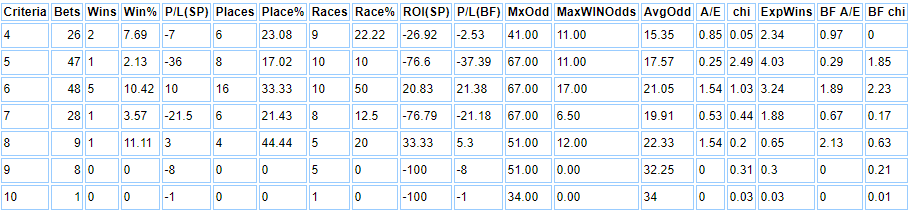
Six-year-olds with 5 winners from 48 runners 16 placed are the best performing age group.
Position in Odds Market
Favourites are performing below market expectations and produced the following set of results:

But those runners in the top five in the betting at the off produced the following set of results.

That means 80% of the winners, were in the top five in the betting, from just 32% of the total runners.
Official Rating
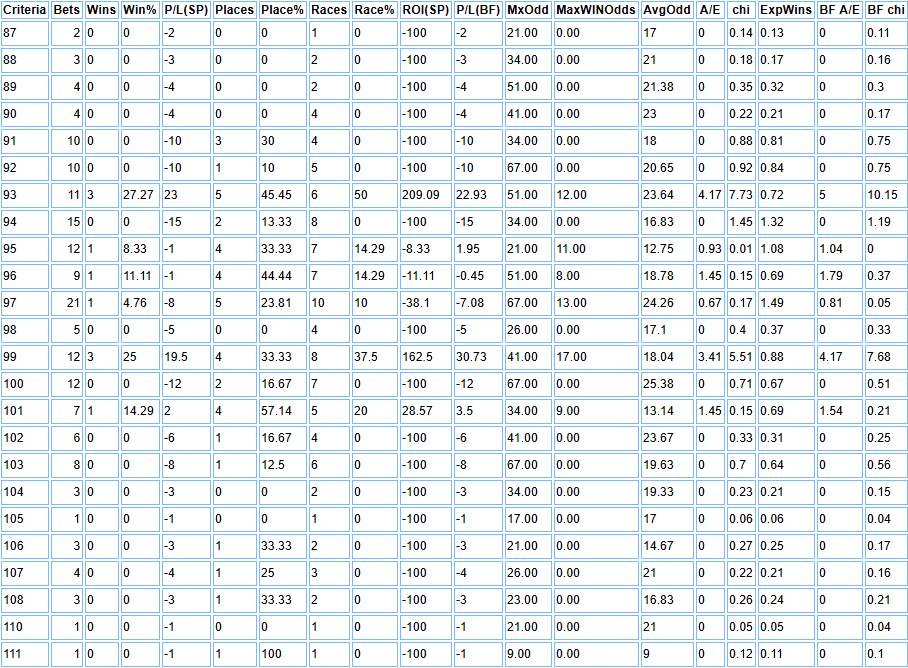
Those with an Official Rating (OR) between 93 & 101 have been the most favoured producing 10 winners from 104 runners.
Weight

Despite the sharp and turning track higher weighted horses. Carrying 9-7 or more have been under-performing in the past decade.
Draw
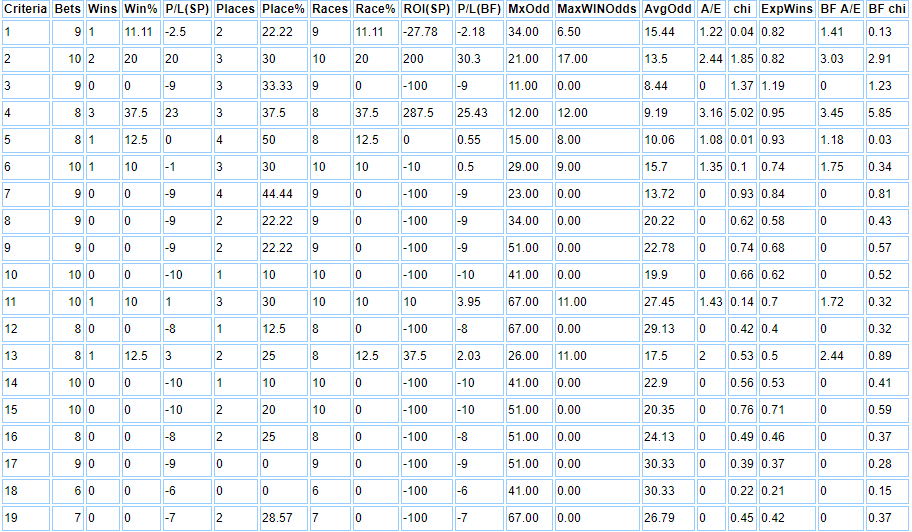
A low draw at Chester is a definite advantage and so it proved in the Chester Cup. Those runners drawn in stalls 1 to 6 are:
8 winners from 54 runners +30.5 18 placed.
If you had backed all runners drawn in stalls 1 to 6 you would have made £30.50 profit to a £1 stake.
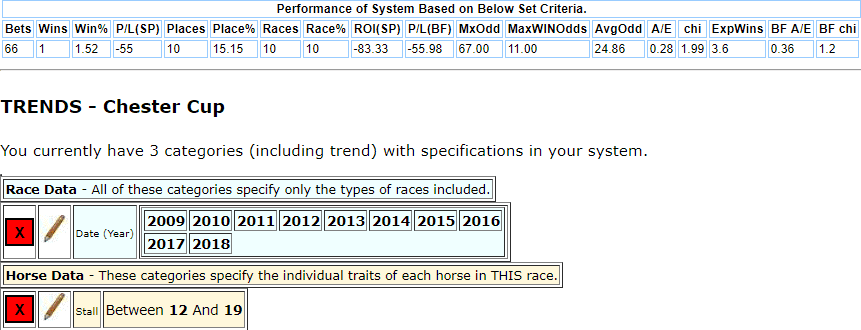
No runner drawn 14+ has won in the past 10-years and those drawn 12 & higher have produced:
Last Race Code

Those horses that had run on the
all-weather on their last start, particularly when compared to those runners
whose last start was over the jumps.
CHESTER CUP TRENDS VERDICT:
Going by these ten-year trends you can see that the winner is most likely to
have the following traits:
- Stall: 1 to 13
- Odds SP: 16/1 or less
- Official Rating: 93 to 101
- Last Race Code: Flat or NH
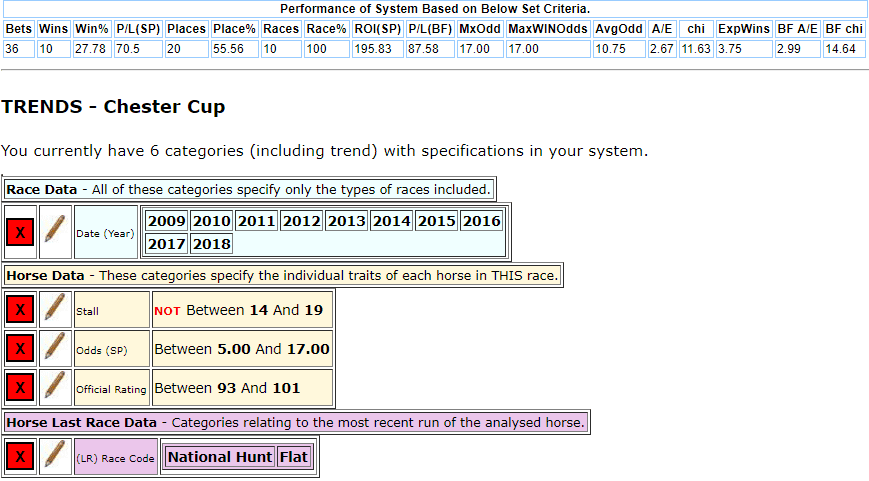
Those four simple rules which would have given you a profit from this race of £70.50 to a £1 level stake or £87.58 to BFSP. Backing all such qualifiers each way would have netted an £98.75 profit.
That’s 100% of the winners from just 22% of the total runners.
You can use those filters to cut down the field to small group of contenders before analysing race through form, speed or whatever method you use.
It’s a very simple, yet powerful, approach!
Victoria Cup
The feature race of Ascot’s last meeting before Royal Ascot. Many of the runners in the race will be returning to the course for one of the big handicaps next month.
However, with prize money in excess of £100,000 it’s race worth winning
in its own right.
Run over Ascot’s 7f on the straight course. The race has attracted an average
field of 25 runners in the past 10 years.
Last year’s renewal was won by Ripp Orf, trained by David Elsworth, who was sent off at odds of 20/1, giving his trainer a second win in the race.
Trying to pick a winner in handicaps like this is a tricky puzzle. Thankfully, there are certain trends we can use to point us in the right direction.

If you had backed each of the runners in the race you would have lost £102.50 to a £1 stake. As with the Chester Cup the aim is to cut down the number of bets but keep hold of 80% of the previous winners.
Age
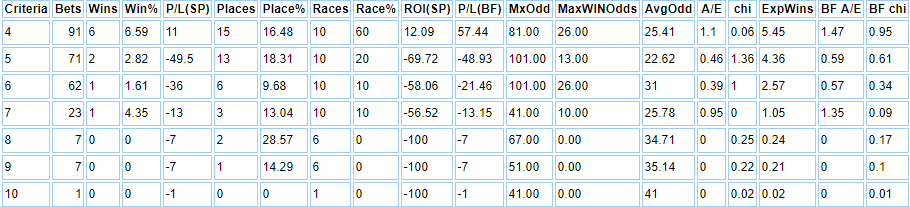
Four-year-olds have been the most dominant age group with 6 winners.
Odds
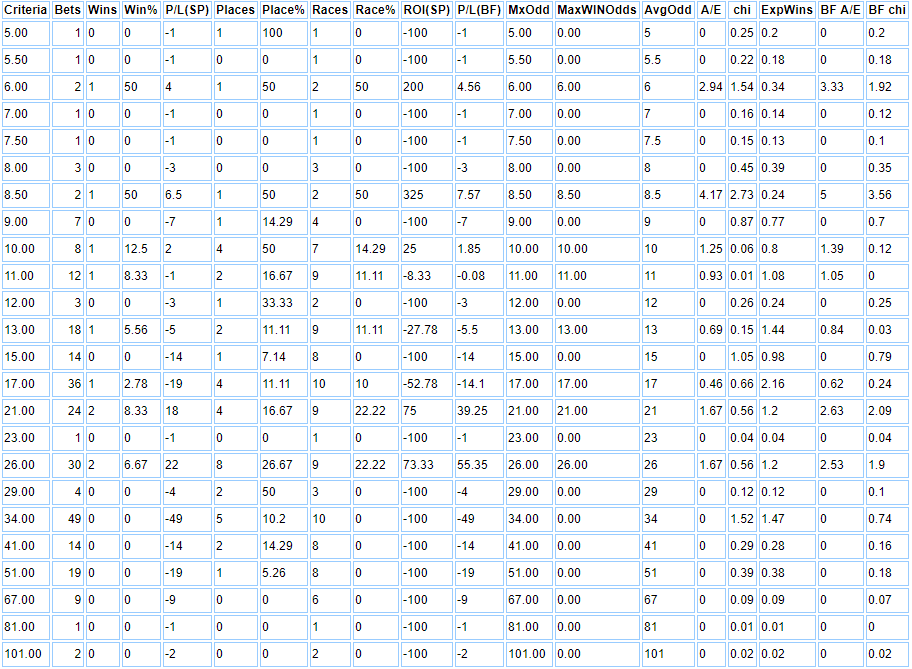
Runners sent off at odds 28/1 & bigger are 0 winners from 98 runners 10 placed in the past ten-years.
Favourite backers haven’t fared too well with just the one winner.

Albeit the top two in the betting have produced a healthy – 4 winners from 22 runners +13.5 6 placed.
Highest Class Run
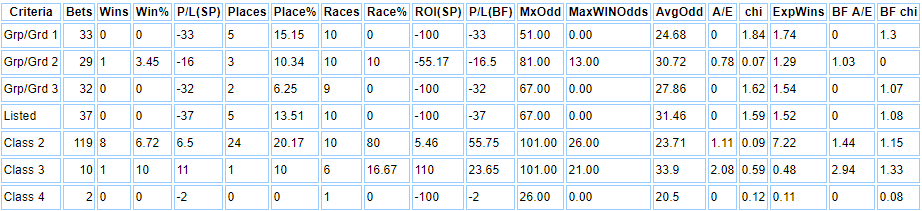
Runners that had raced above Class 2 level are just 1 winner from 131 runners -188 15 placed. You could have expected six winners, so such qualifiers have been performing well below expectations in the past ten years.
Handicap Wins
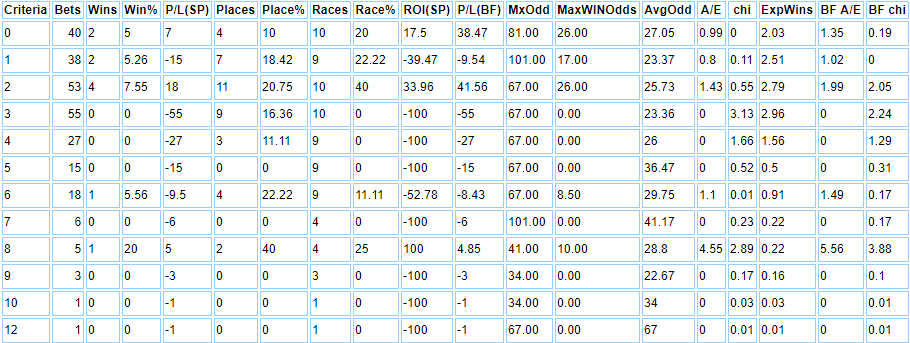
Those runners that had had 0 to 2 handicap wins have produced 80% of the winners from 50% of the total runners.
Last Time Out Placing
A top five finish on their last run has been a positive with nine winners having such a last time out placing.

Those runners who finished outside the first five on their last run produced just 1 winner from 119 runners – 14 placed.
Draw

Despite this race being run over Ascot’s straight course there has been no real draw bias in action.
Course Winners
Ascot’s straight course has a reputation for being a bit of a specialist’s track. How have previous course & distance winners fared?

Well if you had backed every C&D winner who ran in the race you would have found 1 winner and lost £15 to a £1 stake.
VICTORIA CUP TRENDS VERDICT
Going by these ten-year trends you can see that the winner is most likely to have the following traits:
- Odds SP: 25/1 & under
- Highest Class Run: Class 2 or 3
- Last Time Out Placing: First Five
- C&D Wins: 0

The above four rules
have given you a profit of £62.50 to a £1 level stake or a huge £109.87 to
BFSP. Backing all qualifiers each way would have netted £71.12 profit.
That’s 80% of the winners from just 22% of the total runners.
The Victoria Cup isn’t as strong a trend race as the Chester Cup but there some
keys one that can help reduce the field down to a manageable number of
qualifiers for further study.
Next month, I will be looking at a couple of big Royal Ascot handicaps from a
trends perspective.
Until next time.