

Breaking Murphy’s Law: How to Handle Trainer Multiple Entries
Don’t you hate it when you back a horse in a race only to realise – often after the fact – that the trainer has more than one horse in the same race… and the one you didn’t back has won?
It feels like a special kind of cosmic joke, one the form book never warned you about.
It happens often enough that many punters may instinctively avoid races or runners where a trainer is “mob-handed”—sending out two, three, sometimes even more runners. Are they spreading their chances too thinly? Surely one of the runners will be placed to win and the others are just there for fitness, pace, or distraction? If that’s the case, then how can you tell which one is most fancied? Do you rely on the market, the trainer’s pre-race comments (if any), jockey bookings, previous form under the conditions – or simple pin sticking?
But perhaps none of the above is the right question to ask. As the old joke goes when a traveller asks a local for directions to his destination only to be told “If I was going there, I wouldn’t start from here…”.
This got me thinking – what is the most important question in this case? What if, for certain trainers, the act of entering multiple horses in the same race is itself a signal—an intentional move that suggests an improvement in their overall chance of winning with at least one of their runners? And what if the converse is true for certain trainers – wouldn’t you want to avoid backing any of them?
Put another way are trainers who enter multiple horses in a single race just throwing darts in the vague hope one will stick? Or do they know exactly what they’re doing?
To answer that, as ever, we’ve used the programming friendly SmartForm database to compare each trainer’s performance (using Flat Turf races only since 2008) when running a single horse in a race vs when when they run two or more horses in the same race. The aim:
- Find the trainers who improve their strike rate when sending out multiple runners.
- Identify those who drop off badly when splitting their firepower.
- See the bigger picture — are multiple entries generally an advantage or disadvantage across the board?
To answer these questions, we will establish a baseline for expected performance and then compare that to actual performance. Clearly this must be adjusted for field size and the number of chances (runners) each trainer is giving themselves. If a trainer enters two horses in a ten-runner race, they automatically have a 2/10 = 20% random chance of winning, before we consider any other factors.
For the same trainer entering one horse in a 10-runner field, clearly the random baseline expectation is only a 10% chance of winning.
That means we can’t simply say “20% strike rate for trainers who enter 2 horses = good.” In fact, that would be exactly the strike rate you would expect from random chance — no better than if the trainer had entered just one horse in a ten-runner race.
We need to ask instead does the trainer’s actual strike rate exceed the random baseline for that scenario? And is the difference statistically significant?
Solo runner vs Multiple runners — the global picture
Pooled across all trainers, here’s the raw performance split:

Above we have forecast the expected wins based on the field size and the number of runners competing per trainer, giving us an expected strike rate based on random chance (Random SR) and, according to the number of wins, the actual strike rate.
For the big picture, therefore, we can see that when a trainer sends out a sole runner in a race, they collectively perform exactly as random chance would predict (~1.01× overperformance), whereas whenever a trainer (on average, pooled across all trainers) sends out multiple runners in the same race— they underperform the random baseline (~0.91×).
So, if you were to stop reading now, your one takeaway could be that on average, backing a single horse from trainers with multiple entries is a worse strategy than backing a horse from a trainer with a sole entry.
The exact entries curve
If we break down by exact number of entries per trainer per race we can see whether this picture varies according to the exact number of multiple entries.
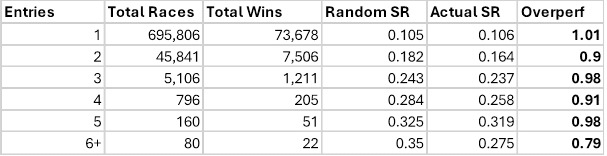
The most common case with the largest sample is two runners in the same race which underperforms by about 10% (0.90×). As the samples get smaller there is some uplift (though negative performance overall) at 3 or 5 race entries, while six or more runners show the sharpest drop — 0.79× — but that’s from such a small number of races that it’s not a robust finding.
However, the story is more interesting when we start to look at individual trainer performance
Trainer-by-trainer — Top 10 uplifts
Some trainers buck the trend completely, performing far better with multiple entries. Here are the top 10:
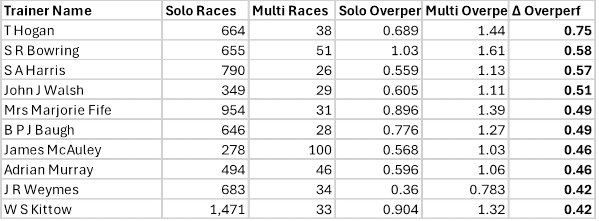
For example, our top trainer in this cohort, Tom Horgan, significantly underperforms when sending out one runner, but on the 38 occasions he has sent out multiple runners he outperforms the expected baseline by 44% – giving a 75% uplift over his solo performances.
This list is ordered by uplift over solo entries, but you can find plenty of trainers, such as the second in this list, Roy Bowring, who perform according to, or above expectation when sending out solo runners, and even better when sending out multiple runners in the same race.
Trainer-by-trainer — Bottom 10 drops
At the other end of the scale, the relative performance of some trainers collapses when sending out multiple runners:
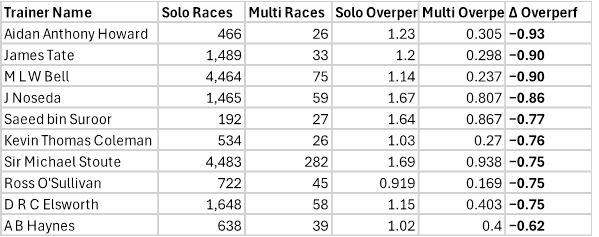
This list is notable for the fact that the solo runner performances (which are the majority of entries of course), are generally above average or well above average but performance is abysmally lower than expected versus the random winner baseline once they start sending out multiple runners in the same race. It seems that a lot of top-class trainers can be found in this category, so let the punter beware once the trainer sends out multiple chances.
Conclusion
Across the board, the data shows that trainers, on average, underperform the random baseline when running multiple horses in the same race — with the effect most pronounced for two-runner entries. A few trainers buck the trend spectacularly, while others see their strike rates collapse when splitting their firepower. The key takeaway is that multiple entries are not, in themselves, a sign of strength.
There is still plenty of scope to refine this analysis. Market behaviour and extreme price gaps may well influence outcomes, particularly in the rarer cases where a trainer deploys a clear pacemaker at big odds to aid a primary contender.
We have also not yet explored whether these patterns could be turned into a profitable betting approach — whether by selective backing or laying. That is a separate exercise requiring price, staking, and market-depth analysis. But without first establishing a solid statistical foundation, any profit model risks being built on sand. Now that the baseline is clear, the next step is to test whether this knowledge can be translated into a genuine betting edge.
Colin Magee