
Daily Sire Insights: Understanding Today’s Runners Through Sire Preferences
Following on from the recent introduction of Daily Trainer Stats, we’ve extended the same approach to another key area of racing analysis: sire statistics and the performance patterns that emerge within the history of each sire’s progeny.
Both views now sit together within the Daily Trainer & Sire Insights section on the Betwise website, although the focus here is very much on the new sire functionality and how it can be applied to today’s racing.
The objective is straightforward: To take some of the underlying Smartform sire data — already available for backtesting, modelling and deeper historical research — and surface it directly against today’s declarations in a practical daily format.
For existing Smartform users, the underlying sire history is nothing new. The database already contains results going back to 2008, covering a wide range of race conditions and engineered statistics.
What Daily Sire Insights provides is an easy way of accessing some of those patterns within the context of today’s racing.
In particular, it introduces a visual way of examining one of the more difficult areas of race analysis to quantify consistently: going.
Going and Sire Patterns
Going is one of the more fundamental influences in racing, but also one of the hardest variables to handle properly.
An individual horse often has only a limited number of runs under specific conditions, and many runners encounter completely new circumstances throughout their careers – whether that means heavy ground, extreme distances or a markedly different course configuration.
That creates uncertainty.
Sire data offers one way of approaching the problem because it expands the evidence base beyond the individual horse itself.
The underlying assumption is not especially controversial: physical traits that influence a horse’s conformation and how it moves can often be seen repeatedly across a sire’s progeny.
For lightly-raced horses in particular, that broader sample can provide a useful indication of how conditions may suit, and in particular how today’s going ranks within the range of going that a sire’s progeny has performed on in the past.
Built on Smartform Data
As with the earlier Daily Trainer Stats feature, the sire view is built directly on the underlying Smartform data.
In this case, it draws from the daily_sires_insights table, which contains engineered statistics for every runner since March 2008.
The data covers a wide range of conditions and profiling factors, including course and distance, race type, age bands, handicap status and multiple rolling timeframes.
Importantly, the figures are calculated on a ‘to date’ basis, meaning they reflect only information that would have been available at the time of each race.
That makes the data suitable not only for live use, but also for historical testing and modelling.
The Daily Sire Insights page is designed to make those patterns easier to access against today’s declarations in a visual and sortable format.
That makes it possible to identify potentially relevant patterns without having to manually interrogate large datasets before racing starts.
What Insights Can Sire Patterns Give You?
Using sire statistics can never be a substitute for the known form of the horse itself, which may easily buck the trend of the sire.
However, where there is insufficient form to go on, sire patterns really come into their own, because they give you an indication – albeit not an infallible one – of where the horse is likely to do well in the absence of any other evidence. This is obvious in the case of a racing debutante, however lack of form evidence should be thought of in broader terms than something that is only applicable to maidens or novice races.
It also helps answer many of the questions that arise when an otherwise exposed horse encounters conditions it has never previously faced.
Some example questions that sire insights help answer:
- How will a horse that has performed well on good ground behave when racing on heavy ground for the first time?
- How will a runner perform when switched from all weather to turf or vice versa?
- How is a horse that showed good form at two likely to progress at three, or from three to four?
- How will a horse stepping up or moving down in trip for the first time perform at the new distance?
- How will a horse that has never raced on a downhill course handle today’s course and distance?
Once we take in these wider cases, we can see that lack of form evidence occurs all the time, even amongst more seasoned performers.
And sometimes, irrespective of the genetic influence of the sire, it can also be a self-fulfilling prophecy – for example, trainers will naturally train and campaign the progeny of a well-known staying sire differently from the progeny of an established sprinter.
Whatever the reasons, we can profit from the patterns that emerge.
Some Practical Examples
Now a few examples including screenshots and commentary so you can see how to use the tools. Here’s the link again, and it’s free to sign up at the moment:
https://www.betwise.co.uk/daily_race_stats
Under each race you click on, you’ll see a tab trainer stats, which we have written about before, as well as the new sire stats tab. Click on the sire stats tab and you’ll see a bunch of metrics in a sortable table, where each row is a runner in the race and their sire, with statistics all measured by the aggregate percentage of rivals that the sire’s progeny have beaten in those conditions. Here’s an example from the first day of the Guineas meeting:

The first two stats – Mean PRB and Median PRB – relate to the percentage of rivals beaten according to today’s going patterns in the chart below – more on that shortly.
The other stats are all sortable by default from highest to lowest, so click on a column to suit.
Below the table, each sire has a set of box plots showing how their progeny have performed historically. See the screenshot for the charts (which can be toggled on or off from the main table):
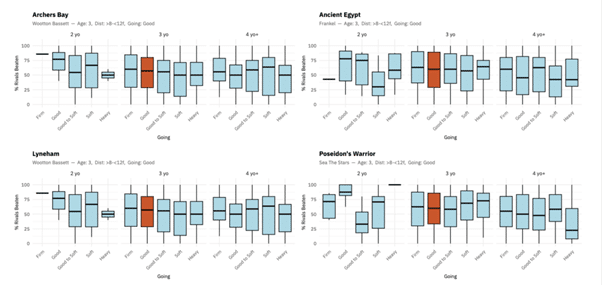
These are filtered for going performance over:
- All ages and distance
- Age and distance for 2yo,3yo and 4yo +
Each box shows the distribution of % rivals beaten (PRB) for that sire under different going conditions. Then, for today’s race, the current runner is placed directly into that distribution.
Each box gives you three useful pieces of information:
- The median line (shown in the table as Median PRB) -> typical level of performance
- The height of the box relative to the PRB → how consistently good or bad that performance is
- The whiskers → how wide the range of outcomes is
If the sample is robust, we’d typically expect the whiskers to extend from 0 to 100. Beware a short whisker – it typically means a small sample, not a stunning performance.
The height (long or short) and placement of the box (high or low) is what we’re looking at first and foremost. We also show the average finishing position within the box in the sortable table (as well as the median line in the chart). That stat is the Mean PRB, and is often worth sorting on to see how your runner’s siblings have performed on today’s going, on average. In this case we can see that Frankel’s progeny (sire of Ancient Egypt) came out on top in the going stats for today’s going. Then, looking at their performance in the individual charts, we can see how well they would fare if the going were different. In general, there is a downward trend the softer the going gets for 3 year old progeny of Frankel at this distance band. This is particularly useful information if the going changes.
Other stats from the table then support the going stats, which is ideally what you want to see. As discussed, in early season races, where the key question is often how well horses have trained from the previous year, the sire stats help assess the chances of all runners — and in this case highlighted the big-priced winner Ancient Egypt as top ranked.
In answer to the question “Do progeny of Frankel train on from two to three?”, the stats confirm Frankel as the top performing sire for 3 year old progeny in this race. The best thing is that you get to see that relative to all the other runners in the race.
The data on sires (particularly first or second season sires) is sometimes sparse, so interpret with care. However, as with this example, when the data is robust and there is a top rated performance, the signal can be very useful and gives us an interesting perspective that is often ignored.
Time for another example, this time from a horse trying a unique course and distance combination for the first time – namely the tight turns of the Chester Cup on a day when the going was the soft side of good.
On the Mean PRB stats, this horse was actually the second ranked, but the first with a sample over 10 (the first ranked sire only had 6 runs to its name in this age group so the stats were not to be trusted). Duraji on the other hand had one of the better profiles and as a son of Dubawi had hundreds of comparable sibling runs.
He was the only son of Dubawi in the race, as well as the only entire. And had one of the most consistent profiles when taking all races to try and determine going preferences at the distance – screenshot below – compared to all the other horses in the race. The age profile also, although grouped at 4 yo+ in the screenshot, was shown specifically for 5 year olds in the accompanying table to be one of the highest performing for his sire amongst all other age groups competing in the race.
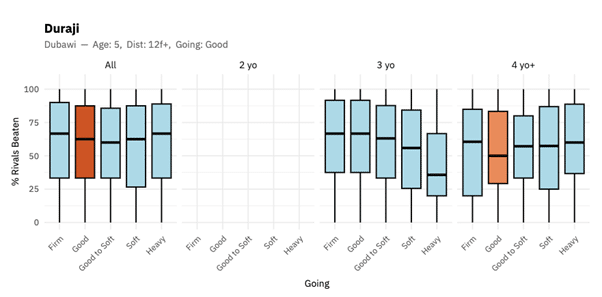
Certainly, he gave us a good run for our money at 50/1 coming in third, having led most of the way round.
For a third and final example let’s switch racing codes to Jumps, since sire stats there work equally well, and I suspect are even less commonly used.
For those Irish races that can be a punter’s graveyard, often with runners that have not shown much form, or have inconsistent form and often competing in massive fields, using sire stats can be particularly rewarding, in that they give a basis for expecting a decent or bad run in the absence of other evidence.
In this example, where Arouet by Galway wins a race at Cork on May 10th, the stats happen to highlight the favourite, but it’s a maiden hurdle, and knowing that the sire stats are well ahead of the competition in terms of handling the going and other metrics is a useful confidence booster.
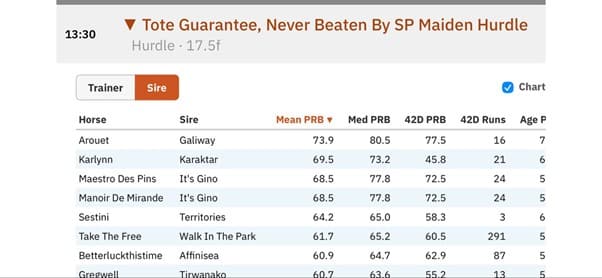
So, to the questions about runners progressing from one season to the next, try sorting by the age stats column, to the questions about about runners stepping up or down in distance, sort by the distance column, and as to whether the runner can handle the course characteristics (based on the performance of their sire’s progeny), sort by the Crs column. I like to use the C&D column, but, as with all statistics, beware of small samples. This is why we show the number of runs next to each column. Don’t get carried away with a 100% record of C&D based on one run, for example. Better to forget about stats that aren’t supported by a number of runs in the double digits, otherwise you’re back to the lack of evidence problem.
Final Thoughts
Racing already has an abundance of statistics. The challenge is not generating more numbers, but surfacing the ones that actually matter in a practical and usable format. The Daily Sire Insights approach focuses less on isolated percentages and more on behavioural patterns — understanding how a sire’s progeny tend to respond under different circumstances, and whether today’s conditions fit those historical tendencies. In increasingly efficient betting markets, the edge often comes not from headline stats themselves, but from interpreting them in context.
The purpose of Daily Trainer & Sire Insights is therefore not to replace traditional race reading, but to add another layer of structured evidence that can either confirm or challenge the market view, and occasionally highlight runners whose chances may be underestimated.
The accompanying Betwise posts go into more detail on the methodology behind the feature, and we also post regular examples of interesting trainer and sire patterns on Twitter/X via @betwise_insight.
Colin Magee
Start taking the guesswork out of sports betting and visit Betwise