Examining Big “Gambles”
Examining Big “Gambles”
I’m sure most readers have done the following – seen the price of a horse steaming in and deciding this is too good an opportunity to miss. Probably 80 to 90% of the time the gamble is not landed and we sit there solemnly licking our wounds. When the horse does win we probably got little value as we would have been nowhere near the price of the horse when the ‘gamble’ started.
In this article I am going to look at ‘gambles’ that occur on course between the time of the opening show (normally 10 to 15 mins before race time) and the start of the race. To do this I have used www.horseracebase.com which stores the type of data we can analyse. I am concentrating on flat racing in the UK (turf and all weather) going back to 2012.
How to define a ‘gamble’ is difficult – we assume that if a horse is being backed ‘off the boards’ there is significant inside information or the owners/stable are getting heavily involved.
In reality, we as punters are simply guessing at this. Hence although I am using, and will continue to use the term ‘gamble’ in this piece, in essence this article is simply examining horses that shorten sharply in price near the off.
Next job is to settle upon what constitutes a gamble. Essentially there is a need to compare the opening show price with the actual Starting Price and decide upon how much a horse needs to shorten for it to qualify as a gamble. The data set available to me uses a simple price comparison and to explain this it makes sense to give an example.
Let us say a horse opens at 6/1 and shortens into an SP of 3/1 then that counts as an odds move of 50% – their calculation is based on the fact that the horse has come in 3 points from an initial 6 points, and 3 divided by 6 equals 50%. Now all the true odds mathematicians out there will argue that this is not really a 50% swing in price, but it is a straight-forward method that is easily calculated. Hence it makes sense to use this method of calculation as firstly it is easier for readers to understand and secondly this is how the data I am using has been calculated!!
From 2012 onwards on the flat, looking at ‘gambles’ with a 50% or more reduction in price from opening show to SP there were just over 2000 qualifiers. Not that many in reality to do an in depth study on – especially as breaking the data down by trainer is one of the key areas to look at. Hence I changed from 50% or more to 40% or more – this gave me over 8500 horses to examine which is a much bigger data set. To clarify a 40% reduction in price would see a price contract from 5/1 to 3/1 or 20/1 into 12/1; so still a significant price movement.
So let’s see what I found:
Firstly, here is the performance of all horses that contracted in price by at least 40%. For this table I have shown returns to SP and Betfair SP to help illustrate the huge chasm in profitability / loss between the two. For the remainder of the article though I will just show the returns to Betfair SP as these potential returns should mirror the type of returns we as punters should really expect these days. For the record the maximum 5% Betfair commission has been taken into account when calculating the Betfair returns so these are the actual figures one would expect after such commission.

As we can see, these ‘gambles’ succeed in just under 1 race in 7 with losses of around 12p in the £.
Not a hugely exciting starting point, but as mentioned earlier the problem with betting on ‘gambled’ horses is that generally any potential ‘value’ is eroded as the price nears its eventual starting price.
Next port of call was to look at the strength of gamble in percentage reduction terms as defined earlier.
Now we know the majority of our qualifiers are going to be in the under 50% reduction section. I have split the data into three sections – reduction of 40% to 45%; 46% to 50% and 51% and above:

In terms of returns the bigger ‘gambles’ produced the best figures – close to a break even situation (a loss of less than 3p in the £). This is despite the very low strike rate. What has happened here though is that there have been a few biggish priced winners that have paid well on Betfair SP.
If I look at the figures for horses that have reduced in price by 60% or more they do not produce better returns again – they actually produce very poor returns. Percentage swings of 60% or more have provided 630 qualifiers of which only 55 won (SR 8.7%) for a loss of £251.41 – this equates to an ROI% of -39.1%.
Hence losses of nearly 40p in the £.
Moving on I decided to look at the performance of the horses depending on the opening odds or ‘first’ show – here are the findings (N.B. opening show odds equate to traditional bookmaker prices not Betfair):
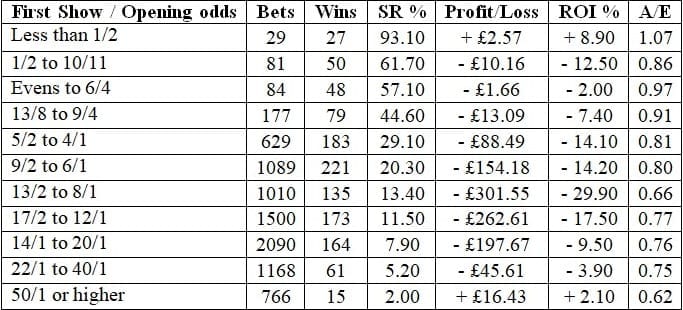
Small profits at either end of the scale but no staggering findings.
Now a look at handicaps versus non handicaps.
I think most people will expect ‘gambles’ to occur in handicaps rather than non handicaps, and also more likely to be successful in that sphere.
Let’s see how the data pans out:

More qualifiers in handicaps as one would expect and the bottom line is far better in handicaps too.
I looked at days off the track and interestingly horses that were returning to the track within 2 weeks made a profit, albeit a very small one, as did horses that had been off the track for 8 months or more.
Both data sets were skewed by big priced winners however so we cannot be confident in the slightest that these profits would occur in the future.
By far the most important angle for most punters in terms of ‘gambles’ is the trainer angle.
You hear from time to time the term ‘gambling stable’ and knowing which stables like a punt is worth knowing.
When professional gambler Barney Curley became a trainer he landed a few notable gambles – he stopped training in 2012 which is the first year covered by the data in this article, and in 2012 he had 5 runners whose price reduced by at least 40% and remarkably 4 of them won.
Curley though is possibly though best known for the Yellow Sam betting coup of 1975 where he netted IR£ 300,000.
Let me now look at all trainers who have had at least 50 runners where their price has contracted by at least 40%:
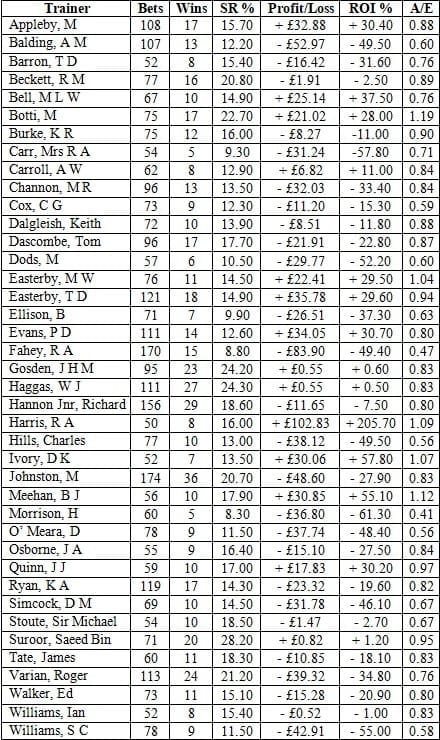
A few trainers have proved profitable and before concluding this piece I want to look in a little more detail at four trainers to share some extra stats.
Marco Botti – has a decent overall strike rate in excess of 20% and his record with more fancied runners which have been well backed is impressive. When his runners have been ‘gambled’ on and when their opening show price has been 10/1 or lower, his results read 15 winners from 42 runners (SR 35.7%) for a profit of £23.71 (ROI +56.5%).
Tim Easterby – Easterby has a very good record at shorter distances especially in handicaps. In handicap races of 7f or less Easterby’s ‘gambled’ on runners have provided 13 winners from 58 runners (SR 22.4%) for a profit of £53.70 (ROI +92.6%).
Mick Easterby – Mick is renowned as a gambler and his strike rate with these ‘gambles’ of 14.5% is far higher than his overall strike rate in all races for all his horses (9.1%). He has a much better record with his ‘gambles’ in handicaps compared with non handicaps. In handicaps his ‘gambled’ on runners have won 10 races from 55 (SR 18.2%); in non-handicaps his record reads 1 win from 21 (SR 4.8%). He also has done well in low class races (class 6 or lower) from a limited number of runners – 24 runners have gone on to win 7 times (SR 29.1%) for a healthy profit of £43.93 (ROI +183.1%).
Richard Hannon (Jnr) – Hannon has made a small loss with his gambled on runners but his record is much better on the all-weather with 13 wins from 44 (SR 29.5%) for a profit of £16.67 (ROI + 37.9%).
Overall it is very difficult to profit from ‘gambled’ on runners – as mentioned earlier, by the time a gamble is underway, the ship has essentially sailed. However, I hope this article has been an interesting read and if you are able to predict gambles from certain stables, you would have a sporting chance of making a long term profit.
Anyone know Mystic Meg’s number??!
David Renham