

In Play Betting On The Flat
It has been around six months since I looked at ‘in play’ betting in horse racing and I am returning to this idea for my latest piece. I have used UK flat racing data from the last four full seasons (2017 to 2020).
This is a more general piece than my last one and I am trying to establish whether any specific race or type of race, etc produces more horses that trade odds on ‘in play’. Horses that trade odds on ‘in play’ and go onto lose are the type of horses many traders are looking for to potentially make an easy ‘buck’ through laying to lose late on in a race.
Now, just over 1 in every 6 runners trade odds on in running (e.g., under 2.00) – 17.8% of all runners to be precise. Of these about 60% go onto win the race while 40% do not. The majority of that 40% would have looked like winning at some point during the contest, normally late on. Quite often they will have led the race at some point in the final furlong.
The first task I set myself was to look to see whether courses differ in any way in terms of what percentage of the runner’s trade odds on. For example, do stiffer tracks see more horses trade on odds for example?
The reasoning behind that would be that leaders, who are going to trade low in running, are more likely to run out of gas late on and hence get passed. An alternative theory is that courses with easier finishes will see more horses push too hard from the front and hence also potentially get run out of it close home.
Here are the top 10 courses in terms of highest percentage of odds on runners ‘in play’.
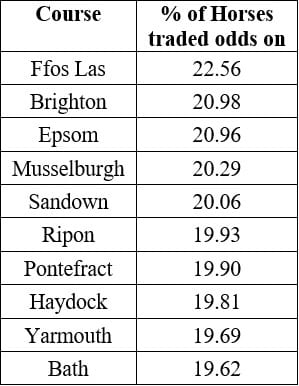
I would say the top 4 courses Ffos Las, Brighton, Epsom and Musselburgh could all be considered on the ‘easy’ side, as would Ripon in 6th. Sandown in 5th and Pontefract in 7th are both fairly stiff, or at least have uphill finishes. The evidence may be pointing to ‘easier’ tracks producing more odds on runners ‘in play’. However, I cannot be overly confident about this.
In terms of courses with the lowest percentages, three courses had particularly low figures of under 15% (Thirsk at 14.7%, Ascot at 14.5% and York at a lowly 14.2%).
The second area I wanted to research was class of race – did that make any difference?
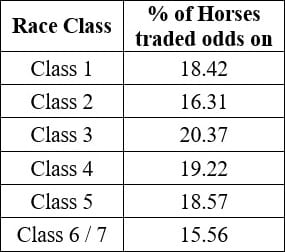
I wasn’t sure what to expect from this, but the lowest percentage in the lowest classes of race does make some sort of sense. Lower class races quite often are less competitive and hence less competitive races are likely to have fewer horses that will trade odds on ‘in play’.
Having said that, I cannot easily explain why class 2 also have a ‘lowish’ percentage. My only thing I can think of is that a fair proportion of class 2 races are big field handicaps and races with bigger fields do have lower percentages in terms of horses trading odds on.
Overall, it does seem that class 3 and 4 races offer traders better chances of making money from odds on losers.
For Gold members David compares handicap and non handicap races and takes a look at race distances and horses ages to see if these have any effect on trading in play, and of course the effect of the jockey!
If you would like to upgrade your account, go to https://www.oncourseprofits.com/upgrade
Prefer betting before the off? Try our betting favourites system
Featured Image by Julia Joppien on Unsplash