
Paul Moon – The Racing Horse
We continue this month with Paul Moon’s The Racing Horse where he offers up his thoughts on Horse Ratings and The Optimum Ground.
Paul regularly shares with our members his Racecourse Templates for Friday racing.

Trainer Form
The form of a trainer always has been, and always will be, a vital component in assessing a horse’s chance in a race – Timeform (updated 5 February 2014)
Trainer form is the single most important factor in any horse winning a race – if there is a cornerstone to wagering, then this is it!
There are professionals who consider analysing trainer form a flawed exercise and their individual successes gives credence to that view, but as far as we are concerned, based on 56-years of betting experience, it has been proven.
Considering whether a trainer is in or out of form, is a subjective exercise. The Racing Horse takes a mathematical look, primarily to counter randomness, bias or false view. Our first action when assessing a race is always to acknowledge trainer form and measure it against their respective national averages, more on this phrase in the next chapter.
The trainer is the only one tasked with supervising the care, nutrition, and fitness of racehorses.
Each horse has a potential ability level, whether they achieve that is another matter. The better the horse is trained and looked after the more it is likely to achieve. It is accepted that genetics and skeletal soundness are factors outside the trainer’s remit, as is the willingness needed from the horse.
Finding the bandwidth to which each horse can aspire, needs the trainer to be totally in tune with his charge, and, whilst some achieve, most fail in this regard. Based on this incongruity we only trust recent form and trainers of some quality.
If one was securing disproportionate odds (real perceived value) for a horse trained by an out of form trainer, then this could trump our mathematical rule.
For example, there are times when a trainer’s horses are returning to form without winning, so his/her 7% strike rate mean they can fly under the radar, at least as far as most punters are concerned. On those occasions we might get involved if there is perceived value attached.
This is not a contradiction to the views expressed above. VALUE IS EVERYTHING IN BETTING, or at least perceived value is, because no human being can say for sure what exact value is at any given time, not even a bookmaker!
There are highly skilled trainers who truly succeed but are few in number and the bandwidth of a trainer skill set is particularly wide. For example, Charlie Appleby trains horses and so do Jim and Suzi Best, the similarity ends there!
We do NOT subscribe at all to the view that if a certain trainer had a potentially great horse in his/her care they could replicate the numbers and triumphs of top trainers.
For example, had Richard Hannon or Mark Johnston trained Frankel we ask the reader five questions:
- Would he have retired winning 14-14 for 100%?
- Would he have been an unbeaten 10-time Group 1 winner?
- Would he have been the highest ever rated by RPRs?
- Would he be standing at Banstead Manor Stud (GB) for £275,000
- Would he still be considered the greatest racehorse ever?
No, of course not!
Just the idea of Hannon or Johnston running the bottom out of the horse in all sorts of races is horrendous and cannot possibly compare to the way the great Henry Cecil looked after and navigated him.
By the way, Frankel achieved greatness despite a certain Tom Queally in the saddle, his riding skills (especially fractions in a race) were grossly disproportionate to the horse he rode. The jockey deserves his place in history but was never a great rider!
We have a list of trainers we would not back with counterfeit money. There are so many races to choose from, so do not need their shenanigans or bottom basement skill sets on our betting slips!
Looking at a time frame in isolation is always flawed, publications like to use the last 14 days, but the trainer might have only had two runners in that time at odds of 25/1 and 12/1, so context is required, context, relevance and pertinence is always required.
Beware those racing journalists, pundits, and commentators who us the words “trainer form” in every other sentence, without truly understanding what good trainer form really is! They seldom elaborate or contextualise, and their words are often vague and flaky, so of little value.
Whenever we use the phrase, we prove it with cold mathematics which is devoid of opinion!
Within the next chapter we talk about national averages and their importance and especially their relationship with trainer form.
National Average
Every trainer has a NATIONAL AVERAGE but what is it, and what relevance has it to a wager? The Racing Horse will answer both questions.
The national average is the strike rate of the trainer over 5 years (as opposed to all-time figures) and it is imperative to know what that is! This strike rate is deemed to be an honest indicator, a barometer, an impartial yardstick against which current form can be measured.
In the event of a trainer having less than 5-year data then we use their strike rate to date figure.
This factual figure is ignored by punditry despite its core value.
Secondly, the national average is always relevant, contextual and pertinent because of the cold mathematics contained within them. They are devoid of opinion.
As a general rule, trainers with bigger numbers must be considered more proficient than those with smaller numbers. In part-clarification we look at the national averages of 20 trainers currently competing in the UK and ask the reader to absorb then consider their fitness:
- Charlie Appleby 29%
- William Haggas 23%
- J & T Gosden 21%
- Roger Varian 20%
- Michael Stoute 19%
- Ralph Beckett 18%
- George Boughey 17%
- Edward Bethell 16%
- Andrew Balding 15%
- Charlie Johnston 14%
- Aidan O’Brien (UK runners) 13%
- Marco Botti 12%
- Richard Hannon 11%
- Richard Fahey 11%
- Brian Meehan 10%
- Gay Kelleway 9%
- Jonathan Portman 8%
- Scott Dixon 7%
- Brian Barr 6%
- Frank Bishop 0%
We are not suggesting the figures should be taken literally, but we believe proven mathematical laws are the governing force of horse racing betting!
With this in mind, it must be reasonable to acknowledge the trainer’s national average, and the solid and true history contained within them.
There are any number of random factors that can affect a result and it takes small margins to win most races.
These issues are more likely to be compounded if the horse is not ready or prepared for the particular task!
Furthermore, if one accepts that handicap racing forms more than half of all races on the cards of UK race meetings, a few pounds of improvement or decay can mean the difference between winning and finishing down the field.
These margins are contained and embedded within the national averages.
In conclusion, we believe the national averages are a form of seeds or rankings and definitely matter when processing or filtering a race. This is not a fixed position; the term national average is always used in context.
In a general sense, good recent trainer form is an indicative test suggesting or confirming the well-being of the stable’s horses, and a readiness to run positively. Measuring good recent form against a national average, represents a logical first step when analysing a horse race!
Here is a recent example (Kempton AW Races 16 October 2023) where our Racecourse Template highlights National Average, Course Form and Current Form.
These numbers must be helpful and at a glance we can gauge form:
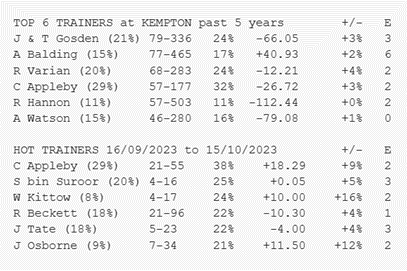
For example, we note Charlie Appleby has a national average of 29%, at Kempton All Weather he scores 57-177 for 32% (-26.72) which is +3% above his national average and he has two runners at this course on the day.
But, on the Hot Trainers List he shows he is in excellent form showing 21-55 for 38% in the last month or so which is +9% above his national average! So, his course and current form can easily be measured against his national average giving a true collation of the facts!
Another example shows Roger Varian with a national average of 20% whilst Richard Hannon has one of 11%.
Had Varian shown a current strike rate of 11% (-9%) over the last month or so, that would be a cause for concern. However, if Hannon had shown the same strike rate there would be no cause for concern, because he is replicating/matching his natural average.
Opinion, bias and guesswork has been surgically removed in the above examples.
We accept there are many professional bettors who do not consider trainer form as the cornerstone of betting as we do.
The Racing Horse knows of a number of accomplished bettors who enjoy betting in both high and low grade handicaps, where literal trainer form does not have the same supremacy.
These are areas where argument weighting and perceived value prices are more important, but our betting and emotional need is one based on high winning strike rates and shorter losing runs.
Paul Moon – The Racing Horse