

Product Reviews – Race Advisor
As you will likely know, because of modern technology, there is a ton of data at our disposal when it comes to horse racing. It can be a little overwhelming at times for a couple of reasons. The first being what pieces of data to use/listen to and the second being how to interpret it. I feel that both of those come down entirely to personal preference because you simply can’t use it all, there is too much, and it can start to contradict itself.
So, I do like it when this work is done for you.
There are a few different sites and racecards available online now which show various pieces of data. One of those is the Race Advisor, which I have been using recently and not only do they have racecards, but other features to use as well, some of which use data but some of which enhance the betting experience in its entirety.
I want to share the experience I’ve had using Race Advisor and outline some of the key features that it possesses.
Racecards
Starting off with the racecards, they are comprehensive and give plenty of information about each runner without the need for any configuration. Each horse has the usual stuff you would expect of a racecard, but the extra bit that I do like is the stat pointers for course and distance, class, ground, and race type.
The indicators are colour coded dependant on the horses record against today’s race conditions. Anything in yellow is good, as that indicates a strike rate of 50% or better for that indicator for the race conditions.
So, the more yellow the better and it’s a very quick thing to analyse at a glance without needing to delve deeper into the horses form for those facts.
The more grey there is, the more question marks there are, as that indicates a strike rate below 25%, with blue splitting the difference.
Every trainer and jockey has a strike rate displayed for the previous 14 days, which is a little added substance to the form study, and this is also colour-coded. Green is 20% and above, which would generally be a very good sign.
For the naturally higher strike rate trainers like Willie Mullins and Paul Nicholls, it’s not necessarily as good of an immediate indicator, but it’s useful nonetheless if you’re someone who likes factoring in trainer and/or jockey form.
Getting deeper into the racecard, there is some unique things that the Race Advisor offers, which is what really brings it into its own.
The first is the “Horse Most Likely To Win” percentage. This is one of a number of things on the website that compiles a load of data together, this one in order to come up with a winning percentage chance for every horse in the race.
I found this especially useful when looking to back up my initial thoughts on a race.
Ratings
The final two columns on a racecard are the most intriguing.
These are the ratings that Race Advisor provides. The first are the Power Ratings, which compile a range of different ratings and weights them according to the race conditions and combine those with the live market odds.
The second rating is called the Van Der Wheil (VDW) rating. It is a methodology that is primarily based on a horse’s ability and the class of races it has been running in. There is a little more to it than that, so if you want to find out more about that specifically, I’d suggest having a read on Google (it’s a little technical for me). Race Advisor uses these figures and combines them with the live market odds to formulate a rating.
Something to note about both of the ratings is that the lower the number, the better.
You can sort the columns accordingly and I like to use them, as with the Horse Most Likely To Win percentage, to back up and confirm my initial thoughts on a race.
For example, if a horse that I like then has the highest win percentage and lowest ratings, it would increase my confidence. But personally, I wouldn’t let them put me off a horse (unless the ratings were really bad against the field), as I feel figures and ratings like that can only tell you so much. Nonetheless, I like that these ratings are based on facts and figures and are quantifiable, which I find more useful when helping with my own study than ratings which are devised by another person’s opinion.
Race Advisor Insights
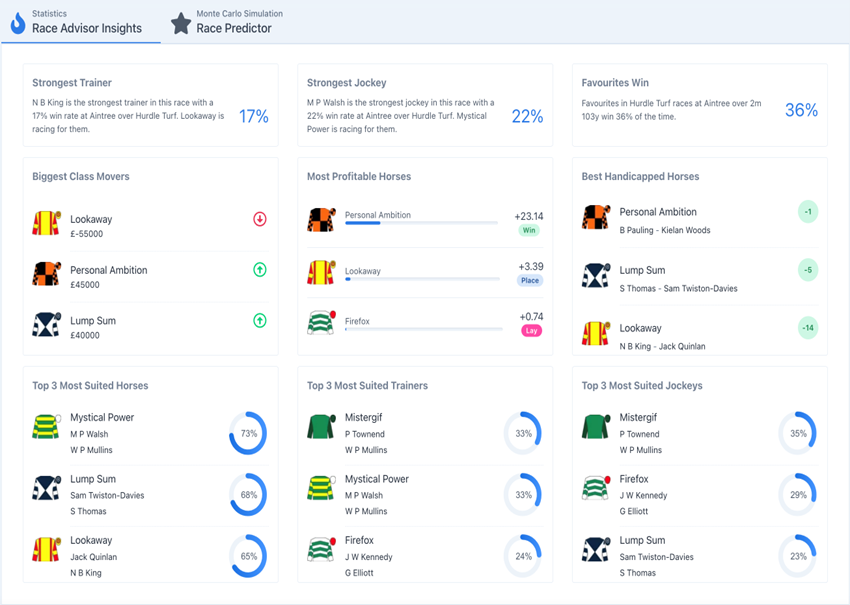
Below the racecard is a section which is one of my favourites on the website. This insights section has a load of helpful key stats which are great pointers to different horses according to different factors, at a glance.
The trainer and jockey stats indicate who has the best strike in the race conditions. So, at the Grand National Festival for example, it stated which trainer/jockey has the best strike rate at the track over either chases or hurdles. Then the favourites stat indicates the winning % of favourites over the obstacles and sometimes takes into account the distance as well, which adds more substance.
The stats below that are even better, with the biggest class movers stated by prize money, I think this is especially useful in handicaps.
Most Profitable Horses shows the horses which will have earned you the most money from backing them to win, backing them to place and also laying. This is good when relating the horses to their current odds and isn’t something I’ve seen anywhere else.
Best Handicapped Horses again is something which is very helpful in handicaps, less so in conditions races.
The final set of stats indicates the top three horses most suited to the race by horse, trainer, and jockey separately. It combines running well percentages for the horse, going, distance, class, and race type for each of the horse, trainer, and jockey.
I like this as a generic thing for each racecard as it reminds me of the importance of trainers and jockeys.
To be honest, these insights combined with the ratings above pretty much do the form study for you.
Monte Carlo Simulation – Race Predictor
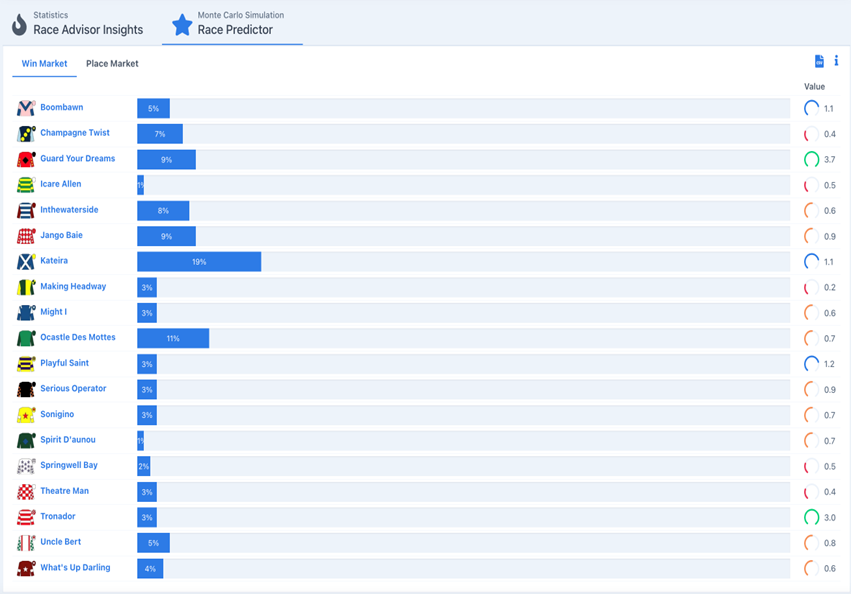
You will likely have seen race predictors before in some form or another, and Race Advisor has its own one, which uses the Monte Carlo Simulation.
It uses all the ratings available for horses within the database and runs many simulations according to these to produce the final prediction. For context as to how thorough this is, it states that a 10-runner race would result in around 4 million simulations.
A percentage is then produced for each horse, and it also shows the value that horse represents compared to its live market odds. This is available for both the win and place market, which is better than other predictors I’ve seen that are only available for the win market.
Horse/Trainer/Jockey Tracker
I have seen and used horse trackers in the past, but I’ve never done it for trainers or jockeys before, so having that option at Race Advisor was pretty good. You can add notes to anything you’ve tracked and when visiting the tracking area, it shows the qualifying horses running today.
I’ve not come across a tracking summary before, but Race Advisor shows you the win percentage and ROI of your tracked items, which is a good little feature. I personally didn’t pay too much attention to that because when I use a tracker, it’s more for a horse with an eye for specific race conditions, so the ROI and strike rate aren’t too relevant. But if you use a tracker to back horses next time out, this would be valuable.
Bet Tracker
I have used a bet tracker for a while to keep track of my profit and loss, but this is one of the best I’ve seen. You can create strategies to split your bets and keep track of your bets as a whole as well as individually. So, you can create a strategy for tracker bets for example, so when you input the horse and the stake, you can add it to the tracker bet strategy to then analyse that category specifically and keep track of your running profit and loss, strike rate and ROI for that strategy.
I love the freedom this gives, and it means the more granular you want to get, the more you can hone your betting. Splitting bets into flat and jumps for example, or by distance, by course, anything at all.
It allows you to determine where your strengths lie and over time, can find your niche and bet on what makes you the most profit consistently.
I’d have to say this is my favourite thing about Race Advisor, it’s so useful.
Pricing Structure
The last thing I want to touch on about Race Advisor is the pricing structure, which again, is something I’ve not come across in racing before.
You simply pay for what you use, there isn’t a fee for a tiered subscription or anything like that. So, if you want just ratings, you can buy those. If you want to just track loads of horses, you just pay for that and so on. You can also do things like the ratings and Race Predictor on a daily basis as well.
So, if you’re going on holiday and don’t want ratings for a couple of weeks, you don’t pay for it.
There is also a price cap, so you won’t be charged more than the specified amount for each feature in any given period. Paying for what you use isn’t something that I’ve come across very often on the modern internet, companies generally want as much money as they can get from you, regardless of what you actually want to use.
This pricing structure from Race Advisor is refreshing and focussed on the user, which is rare for this type of product.
Summary
As someone who does a lot of regular form study, I’ve used my fair share of features and sites. I have my routine and know what I like to use, and it’s worked for me for a while. But I can honestly say Race Advisor has some excellent tools.
If you want to do your own form study but need a push in the right direction and some key and helpful pointers, use Race Advisor. Plus, for more advanced tracking and study, the bet tracker is invaluable.
Alex Peperell