
Signposts for The Cheltenham Festival
Last February the “beast from the east” hit our shores. Maybe we will see something similar this year, who knows given the strange weather we have had in the past 12 months?
I am writing this article at a time when the going description at some National Hunt tracks has been getting close to good to firm with some racecourses having to water.
In last month’s Acorns feature, I focused on those horses, jockey’s and horses that have traditionally done well in the January & February when heavy is the going description. By the middle of January, we haven’t come close to seeing heavy in the going either in Britain or Ireland.
February traditionally hasn’t been the strongest month in terms of quality racing which is not really surprising given its closeness to the Cheltenham Festival. This side of the Irish Sea arguably the biggest meeting is the Betfair Super Saturday meeting at Newbury. The fixture features the £155,000 Betfair Hurdle, which is now the richest handicap hurdle in the UK.
Also, on the Newbury card is the Betfair Denman Chase.
This Grade 2 race is a good prize in its own right but it’s now also seen as an ideal trial for the Cheltenham Gold Cup. In recent years the race has been won by Kauto Star, Denman and Native River on the way to winning jumps racing’s ‘Blue Riband’ race.
Since 2014, 108 horses ran at Newbury’s Betfair Super Saturday meeting before going onto the Cheltenham Festival, with six of them winning. Of those six, five of them had won at Newbury with the other unseating their rider.

One recent and welcome addition to the months racing has occurred in Ireland with the inauguration of the two-day Dublin Racing Festival at Leopardstown. This extravaganza on the first weekend of February is now a great festival in its own right, with the Irish Gold Cup and Champion Hurdle the feature races of the meeting. But it’s also become an ideal prep for horses heading to Cheltenham.
The next two month’s articles focus on the upcoming Cheltenham Festival. This one looks at how you can profit at Cheltenham from following horses that run at Leopardstown’s Dublin Racing Festival.
As ever the excellent www.horseracebase.com with its mine of detailed information and stats is the starting point for this month’s investigation. To get a decent sample size the stats used are from 2014 to 2018 and consist of 24 winners from 186 runners.
Getting started, before digging further into finding some profit angles. Let’s look at some general stats.
Starting with race type:
National Hunt Race Code:

There’s a spread of winners from the three types of code with hurdlers providing the most solid set of results.
Handicap or Non-Handicap:

Runners from Leopardstown who went on to run in non-handicap races at Cheltenham have produced most of the winners but they have also been most of the runners.
Still, they are performing 17% better than market expectations which at least shows they are going off at a value price.
Race Type:
Breaking down the results further by race type:
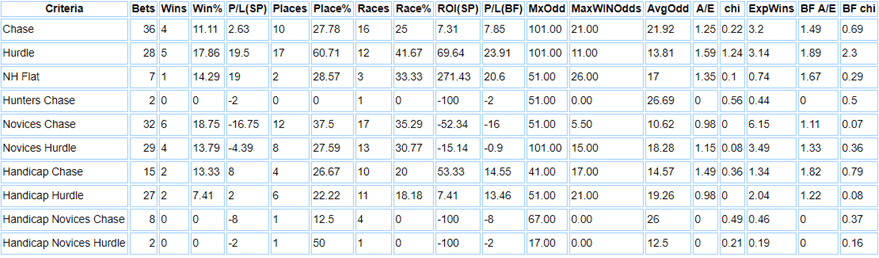
I would be wary of taking too much away from the above table but those runners in hurdle races, such as the Champion Hurdle & Stayer Hurdle are providing a solid 18%-win strike rate, a good level stakes profit and are performing 59% better than the market expects, On the negative side Leopardstown runners heading into the novice handicaps have struggled to make an impact, having yet to register a winner from 10 runners, although two have placed at 22/1 in the Close Brothers Handicap Chase and 16/1 in the Fred Winter Handicap Hurdle.
Last Time Out Placing:

Looking at the above table ten horses that won at the Leopardstown meeting have gone on to glory a month later at Cheltenham. With 41% of winners coming from just 26% of the total runners.
Previous Cheltenham Runs:
It’s said that previous experience of Cheltenham is a positive and the stats below seem to bear that out.
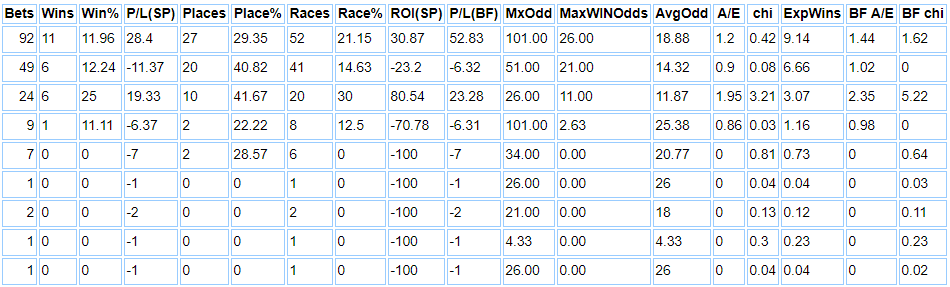
Those Leopardstown runners that had 1 or 2 previous starts at Cheltenham have provided 50% of the total winners from 37% of the total runners. With such qualifiers performing 23% better than the market expectations and providing a small level stakes profit of +7.96 and +14.35 backing them each way.
Headgear:
Granted small sample sizes but runners in headgear are 1 winner from 32 runners 3% -22m A/E 0.35 10 placed 31%. The decent placed percentage figure at 31% means it would probably be wise to tread wearily with these results. However, those runners from Leopardstown racing in first time headgear at Cheltenham are interesting having produced 1 winner from 4 runners 25% +6 3 placed 75%. Backing such qualifiers each way increased the profit +14.40.
Best In Three Runs:
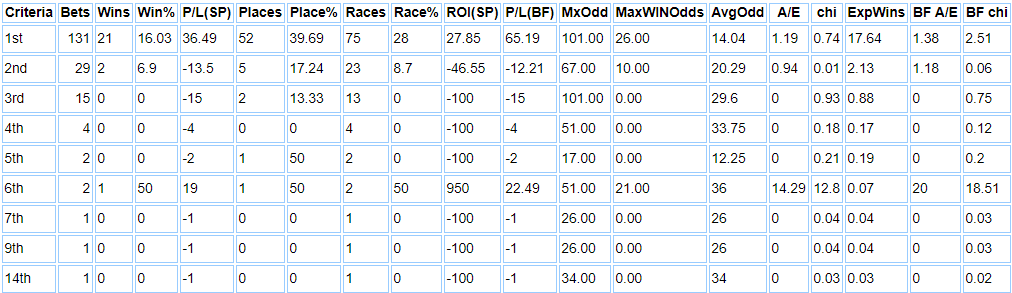
The above table underlines the need for a Cheltenham horse to have winning form in at least one of their previous three starts.
Origin Of Horse:

Irish bred horses have provided the most winners and most of the profit and are also performing 37% above market expectations.
Trainers:
Which are the trainers who have successfully used this meeting as a prep for Cheltenham? Here are the trainer results in numerical order.
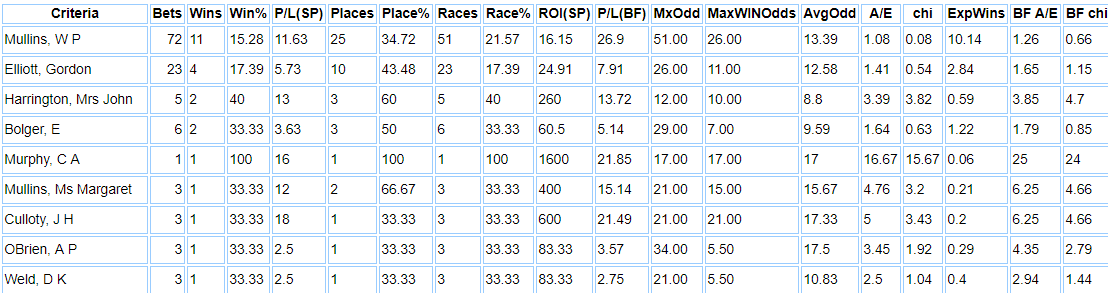
Not surprisingly Willie Mullins has provided most of the winner and he’s seven ahead of his nearest rival Gordon Elliott. However, the latter trainer qualifiers have provided punters with more value.
Willie Mullins
Seven or 64% of the Mullins winners from 32% of his total runners had the following traits:
- Last Time Out Placing: 1st
- Headgear: None
7 winners from 23 runners 30% +15.13 A/E 1.22 12 placed 52%
System: Back Willie Mullins Cheltenham Festival runners not wearing headgear that won at Leopardstown in February
Gordon Elliott
Digging further into the Elliott stats.
All four of his winners had the following traits:
- Headgear: None
- Runs at Cheltenham: None
4 winners from 14 runners 29% +14.73 A/E 2.25 6 placed 43%
System: Back Gordon Elliott Cheltenham Festival runners not wearing headgear that ran at Leopardstown in February who have not had a previous run at Cheltenham.
Jessica Harrington
Jessica Harington’s record is interesting, albeit from a small sample, and all her Leopardstown runners going to Cheltenham are worth noting.
System: Back All Jessica Harrington Cheltenham Festival runners who ran at Leopardstown in February.
Like many of the methods outlined above. The above figures are based on historical data and whilst history has a good habit of repeating itself, it often doesn’t.
It is important to remember that these bets are solely for the Cheltenham Festival in March and as such there may be too many or indeed too few qualifiers for you, depending on your betting strategies.
Until next month. When I will once again be looking at some profitable Cheltenham Festival angles.