
Specialising over a specific Course and Distance
Nearly 25 years ago I started a tipping service which I did for around 6 years. My selections all came from 5 to 6-furlong handicap sprint races. There were two main reasons for this approach.
Firstly, at the time my main expertise was in draw bias and sprint races offered the strongest biases. Draw biases were more prevalent in those days and many punters were less aware of them. This gave me an edge.
Secondly, specialising in a particular type of race made sense to my logically thinking brain. I got to know many of the horses inside out, as handicap sprinters tend to run regularly over a year, and hence when I analysed a race, I would have a good knowledge of a high percentage of the runners.
It made no sense to me to try and analyse other races when I could focus solely on courses, races and horses I was familiar with.
Therefore, when I thought about what to write about in this piece, I thought I would look at a specific course and distance to see what patterns or angles I could find. This is the ultimate in specialisation.
Clearly, I wanted to find a Course & Distance that had a good number of races each year and hence it made sense to steer myself to an all–weather track. I chose Wolverhampton over 7 furlongs as this C&D averages around 135 races per year.
I did feel the need to add a couple of additional filters which were sticking to handicaps only but ignoring 2yo ones. I did this to try and avoid too many shock results.
I decided to include races from the last five years which at the time of writing (21/11/24) gave me 411 races in total – certainly a good enough sample size.
All profits and losses have been calculated to Betfair Starting Price (BSP) with 5% commission deducted from any winning selections. To make it easier to pick out profits and losses, any profits will be coloured in green, losses in red.
Betting Prices / Betting Market
My first port of call was look at the spread of prices in terms of the winners. The Starting Price bands are based on Industry SP not BSP.
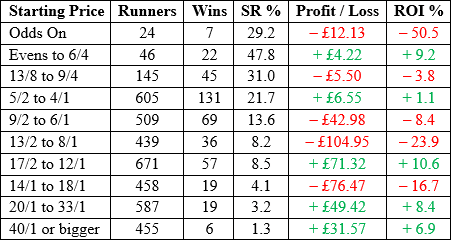
There have been very few odds-on shots as you would expect in handicaps but from this small sample, they have underperformed.
Looking at the results of runners priced between Even money to 4/1, they have snuck into profit … just.
When examining larger prices, profits were made in three price bands (17/2 to 12/1, 20/1 to 33/1 and 40/1 or bigger. Of these three bands the 17/2 to 12/1 one may offer punters some value. The A/E index was fairly decent at 0.94 so I would not be put off by backing horses in that price range.
Clearly though they win rarely which for some people is not for them. The much bigger prices (20/1 and above) have been skewed by a few unusually big priced winners on Betfair.
Sticking with the betting market, if we compare the record of the first four in the betting, we something quite interesting:
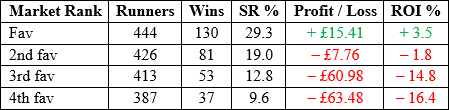
Favourites have made a tiny profit, while second favourites would have lost you less than 2 pence in the £. On the other hand, 3rd and 4th favourites have offered punters very poor value showing significant losses to BSP.
Taking all the market / price data into account, it makes sense to primarily focus on the top two in the betting. Horses priced 17/2 to 12/1 are probably worth a second glance too.
Gender of horse
The sex of the horse does tend to make a difference on the sand with male runners generally running more consistently than female runners. Let me look at the splits for these races:

There are more male runners than female, and males have scored more often and been better value.
I would not read too much into the fact that male runners have made a blind profit, as their figures are skewed by a handful of winners priced 40/1 or more on the Betfair machine.
Having said that, male runners have been much better value than female runners when we compare the stats for horses that started in the top four of the betting.

These results are not skewed by big priced winners and with males losing just over 3p in the £ and females over 16p, as well as having a better strike rate, one would generally prefer to back a male horse than a female one when positioned in the top four of the betting market.
Draw
I mentioned draw bias earlier and at Wolverhampton over this 7f trip there is a slight bias to lower drawn runners as the table below indicates.
I have split the draw into quartiles / quarters with quarter one being the lowest draws, quarter four being the highest draws.
It is impossible to split the draw evenly unless the number of runners is a multiple of 4 so that is why there will not be an equal number of runners in each of the four quartiles / quarters:
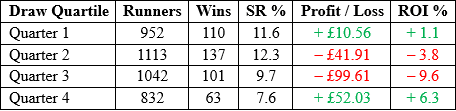
The strike rates show that the bottom half of the draw (Quarters 1 and 2) produce more winners than the top half (Quarters 3 and 4). Essentially the bottom half of the draw have won 1.37 times more often than the top half. Hence there is a draw bias in play here and a lower draw is preferable.
For me, I need a good reason to back any horse drawn 9 or higher over this C & D (maximum field size = 12).
Class Change
When betting in handicaps I always to check to see which runners have been upped in class, which ones are racing in the same class, and which one have been dropped in class.
Let us see what has happened in these 7f handicaps for each group:

The majority of horses have remained in the same class which is what one would expect. Class droppers have performed quite poorly and would have lost you the most money.
I would be a little wary if planning to bet a class dropper here.
|
The rest of this article is for Platinum members. You've just seen what our experts do with publicly available data — the Platinum section is where the specific angles, numbers and actionable conclusions live. Platinum members also get daily system selections in their inbox by 2am, tips from top tipsters, Win Big Golf selections, and access to 11 years of magazine archives. |