
Statman Reborn – Episode Five
Despite the Cheltenham Festival sneaking up on us, I am not one for taking ante post bets when horses have so many potential targets at this stage of proceedings, so something a little more “basic” this month as we look to enhance our betting banks ahead of the glory meetings in the months ahead.
I do have a bee in my bonnet about trainers improving horses be that from other yards or simply through racecourse experience and that sort of balances with trainers who do NOT have them ready first time out if that makes sense – but which is which (or who is who)?
Concept
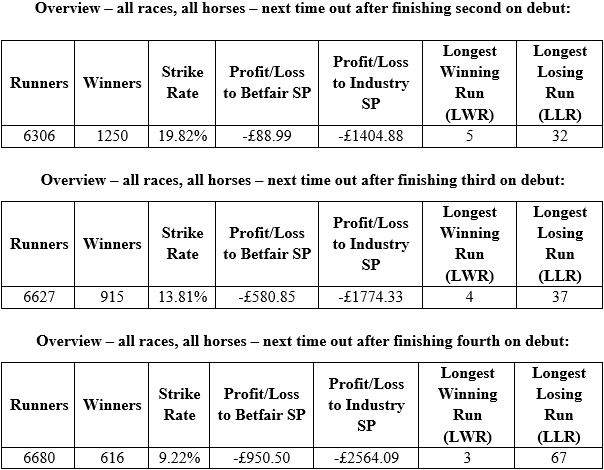
A simple enough thought this month – do horses who finish second on debut often go on to go one better next time out – or not?
Do some trainers see more dramatic improvement than others, and how about horses who are less obvious coming on for a run, those who came third, fourth – or even lower in the order of things – let’s have a look and see what we can find.
The Data
Data is recorded from 1st January 2004 to 28th December 2024 (when I ended the database updates), and because of the time of year, I am only looking at National Hunt racing – so bumpers (National Hunt Flat races), hurdles, and chases.
Naturally, some trainers will have retired and they will be removed as I write, but it should give us a good long-term overview of which trainer’s horses improve the most (or don’t) – and whose horses are then worth supporting in the market.
Please note – point-to-points are NOT included in any calculations.
All races are included unless annotated differently, for both the United Kingdom and Ireland for clarification.
The Presentation
Tables time once more – hopefully you are getting the hang of them now as I still see them as the cleanest and simplest way to display all the information you need every month?
Each table will be clearly labelled as we all see where this takes us –
Summary
No great shock I’m afraid – we all know horses that finish placed on debut are often over bet next time out, but who thought it would be quite that unprofitable?
So, this is where we look for our first edge – do some trainers leave a little more to work with than others, and if so, which ones (minimum 10 qualifiers and 2 or more winners to be concluded).
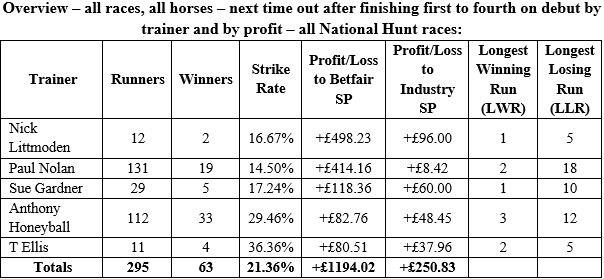
Those may not be “wow” numbers to some of you – but they are to me! A (better than) one in five strike rate, a return on investment of 85% to bookmaker starting price, and a return on investment to Betfair Starting Price of 404.75% from very selective bets of 30 a year or so – now that’s impressive.
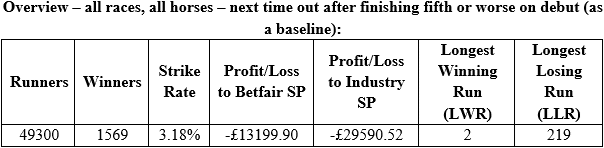
Our (natural) next step must be horses who did NOT finish in the first four on their debuts – are any trainers adept at improving darker horses enough for them to win on their next outings?
Summary
Just look at those horrendous numbers!
As a profit maker you are better off laying them than backing them, but the same question arises – are some trainers more astute than others (minimum 10 qualifiers and two or more winners to be included) – the answer is a resounding Yes!
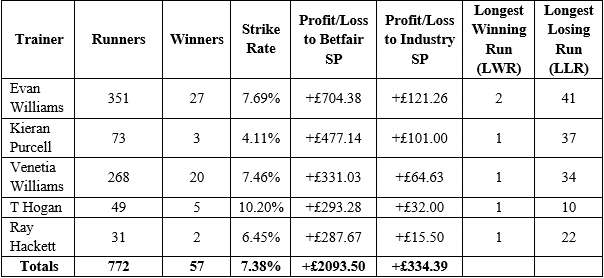
Some very poor strike rates coupled with long losing runs make this an option for those with a healthier than average betting bank, and I do not (personally) think those figures are to be repeated – a return on investment of 271.18% to Betfair Starting Price is too much to ask for – but there must be something to any system that also makes profits to bookmaker SP.
The two “Williams” (Evan and Venetia) do stand out from a larger sample as improving their horses considerably for a first run and theirs are the figures I will be taking away with me for future use.
Overall conclusion:
As with most concepts I could dig for ever to fine tune this idea – chasers only, hurdlers only, bumpers only, by distance, by days since last race, horse age or sex, and so on – but I like to keep things simple and relevant for these articles, and what I have produced above is a good start – or food for thought at least, depending on how you look at it.
If you want to follow the trainers listed blindly, then you have a good chance of making a profit if past performances are repeated – but more importantly, you now have a list of trainers who have in the past proved themselves more than capable of improving a horse considerably from their first start to their second, and that looks a very useful weapon to have in your armoury to me.
Sean Trivass is a well-known freelance journalist who specialises in horse racing.
His books can be found on Amazon https://tinyurl.com/c69cs97b while his weekly blog is updated Friday evening on his website at www.writesports.net. Any ideas for future articles – contact Sean via his website and he will investigate further!