The PACAFI Approach
Paul Moon takes us through his PACAFI Approach to horse racing this month and starts with a look at 4 race courses where he has applied his individual technique.
There are 60 licensed racecourses in Great Britain and not two of them are alike. With the exception of Chelmsford and Ffos Las all the courses date back to 1927 or earlier maturating their own characteristics, shape, size, cambers, gradients, undulations, right and left-hand travel (including ambidexterity), altitude and various surface-types. No other country in the racing world has our course diversity, but has this certitude been truly factored/translated into our betting decisions?
We would suggest not, personal experience confirms a serious lack of learning in this regard. Winning or losing in a professional sport often comes down to the smallest of margins – a bet is often determined by those small margins. Seasoned bettors to pundits tend to focus on the form of the horse, trainer, jockey and the price; mistakenly there is a scant consideration for the course title. If accepting the opening premise we must classify the course or its inherent nature into help or hindrance categories, if the course negatively impacts upon the bet, we stand down and wait for another opportunity.
For example, a small nimble speedy juvenile suited to a fast 5f has two entries, one at Beverley and the other at Catterick – which race gives the best percentage chance of success? We do not need an opinion, mathematics and common sense give us the answer. The Beverley 5f is uphill all the way and takes a lot of getting particularly if the word soft is in the going title. In total contrast, the Catterick 5f is downhill all the way but with an extreme downhill first furlong, this clearly enables the small nimble type and not the large galloping sort.
These two courses could not be more different but how many of us actually know that?
The configuration of a racecourse should be a prime consideration before wagering. Every racehorse that has ever been born has its own optimum conditions that have been genetically predetermined, our job is to marry a bet to the racecourse and surface whenever possible, and failing that we seek conditions to suit.
To hone our betting we set up a composite antechamber and incorporated the course/surface the horse would race on, with other critical features including trainer form, distance, class and jockey competence. Each element receives different weighting but more of that in another post. To assist, we developed templates for most of the UK Racecourses for reference and periodically refer to it when considering the compatibility of horse to the course to the surface. Updating the template is very simple as the information is readily available and once done makes for a most persuasive overview. So what form does this template take?
Primarily, we are most interested in recent form so use statistics for the current year, when starting a new year we refer to the previous quarter until we have a large enough sample to replace them. The template is made up of an overview containing four key elements. Rather than explain it we would like to walk the reader through the first example then show details of another three. The four elements highlight how the favourites perform in both handicap and non-handicap races for the different age groups, then the trainer, jockey and owner statistics at that particular course. Even a cursory look will give the reader a switched-on feel for the course and we promise its pertinence will be of significant value. We start with Wolverhampton and then post three more courses within the UK.
Wolverhampton
Wolverhampton racecourse is a left handed all-weather course with a Tapeta racing surface.
The course is only a mile all the way around and its oval shape means that it is very similar in configuration to most US racetracks. Wolverhampton is tight with a short straight and like most of the all-weather tracks tends to suit horses that race handily because it is hard to come from a long way behind.

Our relevant and up to date information (14 August 2018) would look like this:
NON-HANDICAP RACES (5 YEARS) HANDICAP RACES (5 YEARS)
2yo: 110-263 for 42% (-37.08) 37-105 for 35% (+3.66)
3yo: 183-385 for 48% (-34.69) 250-671 for 37% (+0.27)
4yo+: 90-187 for 48% (+8.11) 440-1355 for 32% (-64.12)
Total: 383-835 for 46% (-63.66) 727-2131 for 34% (-60.19)
Immediately our eyes are drawn to the differentials and their significance. Our next look is at the trainer leader-board for 2018.
2018
Tom Dascombe: 12 winners from 50 runners for 24% (+120.72)
Michael Appleby: 11 winners from 94 runners for 12% (-2.70)
William Haggas 8 winners from 19 runners for 42% (-2.28)
Archie Watson: 9 winners from 26 runners for 25% (+5.41)
Hugo Palmer: 7 winners from 22 runners for 32% (+4.84)
William Haggas carries a 42% strike-rate at the course this year but Tom Dascombe has the most winners and biggest level-stake profit. We now look at the leading jockeys.
2018
Oisin Murphy: 23 winners from 87 runners for 26% (-0.13)
Rossa Ryan: 14 winners from 48 runners for 29% (+27.78)
Luke Morris: 14 winners from 142 runners for 10% (-49.86)
Richard Kingscote: 14 winners from 84 runners for 17% (-14.59)
Edward Greatrex 13 winners form 43 runners for 30% (+17.00)
James Doyle: 12 winners from 18 runners for 67% (+24.00)
Jockeyship is the conduit from horse and trainer to the betting slip. The figures on this board often surprise us.
This year James Doyle claims a staggering 67% when riding at the Wolverhampton.
This board can change rapidly.
Finally, we look at ownership.
2018
Godolphin: 9 winners from 24 runners for 38% (-1.36)
Cheveley Park Stud: 6 winners from 25 runners for 24% (+16.25)
Dr Marwan Koukash: 5 winners from 48 runners for 10% (-13.59)
Sheik Juma Maktoum: 5 winners from 7 runners for 71% (+14.14)
Anthony Brittain: 5 winners from 57 runners for 9% (-5.00)
Amazing Racing: 4 winners from 9 runners for 44% (+11.00)
Could the reader have envisaged a 46% winning strike-rate with favourites in non-handicap races and the most profitable of those with horses aged four-years old and older? Conversely, the same age group fare the worst in handicaps. So, some interesting figures there, we will now look at the results for Windsor, Goodwood and Catterick.
WINDSOR
This course is unique!
It is the only flat track in the UK to have an overall figure of eight shape, so races of 12 furlongs or more horses go both left and right-handed. Races below that distance have only right-hand turns. The course is perfectly flat throughout and its configuration means it is quite sharp and should not suit long striding horses. Conversely, the run-in is nearly five furlongs giving galloping sorts a chance to run on, but we doubt that type is at Windsor to race seriously so we take a watching brief. When the going is very testing field tend to track across to the far side, although it is a greater factor at sprint trips.
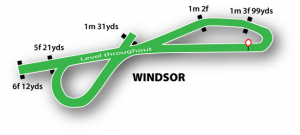
Here are the latest figures from Windsor (up to 14 August 2018).
NON-HANDICAP RACES (5 YEARS) HANDICAP RACES (5 YEARS)
2yo: 83-159 for 52% (+12.93) 9-19 for 47% (+5.51)
3yo: 71-135 for 53% (+15.80) 98-263 for 37% (+8.93)
4yo+: 23-44 for 52% (+11.87) 77-263 for 29% (-26.42)
Total: 177-338 for 52% (+40.59) 184-545 for 34% (-11.98)
2018
Richard Hannon: 13 winners from 65 runners for 20% (-1.94)
John Gosden: 6 winners from 14 runners for 43% (-0.31)
Clive Cox: 6 winners from 37 runners for 16% (-6.52)
Mark Johnston: 6 winners from 18 runners for 33% (+4.83)
Ed Walker: 5 winners from 23 runners for 22% (-3.12)
2018
Adam Kirby: 12 winners from 56 runners for 21% (-2.84)
Tom Marquand: 9 winners from 56 runners for 16% (-13.50)
James Doyle: 7 winners from 25 runners for 28% (-7.73)
Rob Havlin: 6 winners from 28 runners for 21% (-13.81)
Silvestre de Sousa: 6 winners from 11 runners for 55% (+8.61)
2018
J C Smith: 3 winners from 6 runners for 50% (+10.00)
King Power Racing: 3 winners from 7 runners for 43% (+0.44)
P C F Racing Ltd: 2 winners from 2 runners for 100% (+6.00)
K Abdulla: 3 winners from 11 runners for 27% (-0.75)
Chris & David Stam: 2 winners from 2 runners for 100% (+10.50)
Saif Ali: 2 winners from 3 runners for 67% (+1.72)
GOODWOOD
This is a right-handed undulating track.
There are two bends with all races up to a mile and a quarter using the lower bend, and in excess of eleven furlongs uses the top bend.
Although there is a five-furlong run-in from the top bend, the turns and the pronounced downhill gradients make Goodwood essentially a sharp track, favouring handy types, particularly in the shorter-distance races.
The five-furlong course is one of the fastest in the country, meaning speedy sorts often have an advantage.
A notoriously tricky course, those held up regularly meet trouble in the straight, particularly when kept to the rail.

Here are the latest figures from Goodwood (up to 14 August 2018).
NON-HANDICAP RACES (5 YEARS) HANDICAP RACES (5 YEARS)
2yo: 46-106 for 43% (+0.95) 4-22 for 18% (-7.42)
3yo: 37-83 for 45% (+3.77) 50-162 for 31% (-1.13)
4yo+: 25-60 for 42% (+2.76) 54-172 for 31% (+8.63)
Total: 108-249 for 43% (+7.48) 108-356 for 30% (+0.09)
2018
Mark Johnston: 11 winners from 56 runners for 20% (-13.41)
William Haggas: 6 winners from 29 runners for 21% (+7.00)
Tony Carroll: 3 winners from 16 runners for 19% (-7.91)
Michael Stoute: 4 winners from 15 runners for 27% (+3.45)
Ralph Beckett: 3 winners from 16 runners for 19% (+9.50)
2018
Jim Crowley: 6 winners from 29 runners for 21% (-7.82)
Ryan Moore: 5 winners from 29 runners for 17% (-2.80)
Silvestre de Sousa: 4 winners from 18 runners for 22% (+5.58)
Jamie Spencer: 4 winners from 7 runners for 57% (+9.37)
Joe Fanning: 4 winners from 28 runners for 14% (-13.50)
2018
K Abdulla: 4 winners from 7 runners for 57% (+17.20)
Hamdan Al Maktoum: 4 winners from 16 runners for 25% (-2.42)
A W Carroll: 3 winners from 4 runners for 75% (+4.08)
Sheik Rashid Maktoum: 3 winners from 3 runners for 100% (+10.00)
Cheveley Park Stud: 3 winners from 11 runners for 27% (+10.25)
CATTERICK
This is a sharp oval-shaped track, measuring just nine furlongs, with a run-in of three furlongs.
It is a racecourse for specialists and its undulations combined with its exceedingly sharp nature makes it a difficult course for the big galloping sorts and particularly suits the speedy type who races handily. The round course is virtually downhill all the way from 7 furlongs out, and the 5 furlong races which start on a separate chute are also downhill all the way with the first furlong being quite an extreme downhill section. On the softer ground, the field sometimes comes more down the middle or near the stand side.

Here are the latest figures from Catterick (up to 14 August 2018).
NON-HANDICAP RACES (5 YEARS) HANDICAP RACES (5 YEARS)
2yo: 41-77 for 53% (+9.00) 11-31 for 35% (-1.18)
3yo: 19-50 for 38% (-15.69) 36-115 for 31% (-10.31)
4yo+: 18-38 for 47% (+0.56) 65-238 for 27% (-20.94)
Total: 78-165 for 47% (-6.13) 112-384 for 29% (-32.42)
2018
Richard Fahey: 4 winners from 27 runners for 15% (-2.75)
Kenneth Slack: 3 winners from 6 runners for 50% (+4.15)
Ann Duffield: 3 winners from 8 runners for 38% (+56.50)
Julie Camacho: 3 winners from 6 runners for 50% (+4.87)
David O'Meara: 3 winners from 16 runners for 19% (-8.25)
2018
Paul Mulrennan: 5 winners from 16 runners for 31% (+3.62)
Paul Hanagan: 4 winners from 16 runners for 25% (+8.00)
Ben Curtis: 3 winners from 10 runners for 30% (+28.00)
Conor Beasley: 3 winners from 9 runners for 33% (+58.00)
P M McDonald: 3 winners from 18 runners for 17% (+5.50)
2018
David Armstrong: 2 winners from 2 runners for 100% (+3.37)
Mrs Amanda Harrison: 2 winners from 2 runners for 100% (+7.75)
Global Racing Club: 2 winners from 2 runners for 100% (+22.00)
Mrs Greta Sparks: 2 winners from 2 runners for 100% (+19.00)
Evelyn Duchess: 2 winners from 2 runners for 100% (+59.00)
The above figures could have changed significantly by the time this piece goes to post so in need of an update. We remain certain the figures contain both interest and value.
A racing consensus declares favourites win about a third of the races but we find differently.
Our figures above show three-year olds in non-handicaps doing much better and register 310-653 for 47.47% and even the handicaps produce 434-1211 for 35.84%.
Favourite backers might want to concentrate on three-year olds in non-handicaps given these figures?
We have templates in alphabetical order covering the three codes of racing and even though we are well aware of the general content, new information continually comes to light and when that happens, we almost feel we have received a message to our advantage.
Very few readers have the time for this detail but betting to win demands hard work.
We repeat, once the templates are in place they are very easy to update, it takes us a couple of minutes before racing and sometimes during this period a piece of information shouts at us!
I do hope this piece has been of some interest…
My thanks to On Course Profits for giving me a platform to air some thoughts.
If the reader has any views or questions on the above then please get in touch at paulmoon@theracinghorse.co.uk
© 2018 Blue Delta Marketing Ltd