

A Three-Year-Old Edge That Holds Up
A suspected three-year-old advantage in all-aged handicaps – worked carefully to find whether it is real, where it pays, and whether it survives on years it never saw
A new Smartform subscriber asked how you’d use the database to test an old belief – that three-year-olds are dangerous when they start competing in handicaps against their elders – and find out whether it’s true, and where. Whether or not you ever open Smartform, you’ll come away with a real, tested edge you can use. And if you’d like to do this kind of analysis yourself, you’ll see how it’s done in plain English – racing knowledge, not coding – with every query, and a way to run it on today’s card, in a quick-start guide with your first Smartform subscription.
A Question of Good Instinct
Most experienced punters carry a version of this: three-year-olds can be dangerous in handicaps against their elders. They’re lightly raced, often improving fast, and, perhaps most importantly, they carry a weight-for-age allowance that we suspect the handicapper doesn’t fully cancel out. Sound racing sense, compounded by the familiar feeling of watching an improving three-year-old quicken clear of exposed older horses.
But a general axiom isn’t a usable one. How much of an advantage, and — the real question — is it spread evenly, or does it live somewhere: certain months, trips, kinds of race? You can’t get to that without serious number crunching. And the broad version is no secret anyway; the market sees these horses and shortens them, so whatever value survives is in the corners it has priced wrong. Finding those corners means measuring – which is what the subscriber’s question set us doing.
Rigorous Answers Within Reach, Without Writing the Code
The investigation below draws on every all-aged Flat handicap run in Britain and Ireland since 2008 – over two million runners, each carrying hundreds of recorded details. All of it comes from the Smartform database, which you install and run on your own machine. Until a couple of years ago, getting answers out of it meant querying it with your own code, which kept it a powerful but specialist resource – the preserve of professionals, quants and serious form students with the skills to use it, and closed to a lot of good racing minds without them.
That particular barrier has come down. You no longer have to write the code: you describe what you want in plain English and an AI assistant – Claude is particularly well suited to it — turns it into the query, which you then run against your own data. Let me be clear about what that does and doesn’t remove, though, because this is a valuable piece of analysis and it won’t simply snap into life. You still have to be willing to set up and run a database, to work back and forth with the assistant, and to think like an analyst – this took a sequence of questions, each one suggested by the last result (e.g. is it real, does it hold everywhere, what if we split it this way?), and a good deal of care over what the numbers were really saying.
In the full guide, the same investigation runs to a good many queries, each of which is reproduced.
What has gone is the need to learn to code. What remains is racing knowledge and a bit of graft – and the racing knowledge and the critical thinking, the part you can’t outsource, were always what mattered most. The AI removes the coding, not the thinking.
Is There A Real Edge?
Getting back to the edge we’re analysing, we start broad: from July on – once three-year-olds have run into a mark and the all-aged handicaps open to them – do they win more than their share? Share of winners over share of runners; one is par, above one is genuine outperformance.
And yes, three year olds competing in all aged handicaps clear this bar: an edge ratio around 1.2 across the summer, winning some 20% more often than their numbers predict. But the raw strike rate underneath it is a trap: they do win more than their share — but not by the eye-catching margin the summer reputation suggests, and their winners still go off around 6.8 on average, a price that already reflects it. The market knows. A high strike rate at a short price is a fact, not an edge – which is why the field-relative ratio, and then the price, are what the rest of the work analyses.
Where the edge lives — and why each boundary has a reason
What lifts the next part of the investigation above data-mining is that every boundary has an independent racing cause. When the numbers and the logic agree from two directions, it’s structure, not a fluke.
By prize money, not class. We split by money — decisively because Irish racing carries no class outside the top grade and money is recorded throughout, and sensibly because in a handicap, with no black type on offer, the prize is the main lure. The split has a clear shape:
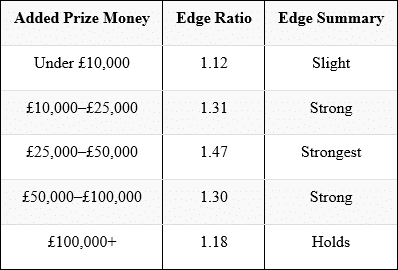
The edge rises to a clear peak at £25–50k, and – worth noting – it doesn’t disappear in the richest races either; three-year-olds keep winning more than their share right up the scale. That fits the reasoning: three-year-olds improve faster than older horses, and the fastest-improving are aimed at the better prizes, so the more valuable handicaps concentrate the horses whose mark most lags their ability. The advantage is broad, then; the mid-money band is simply where it peaks. Whether it pays is a separate question — and, as we’ll see, a narrower answer.
By distance. Weight-for-age is a weight concession, so it should tell more the further they go — nothing over 5f, meaningful over 1m4f. Splitting the sweet-spot band by trip, on profit at Betfair SP, across found-years and held-back years:
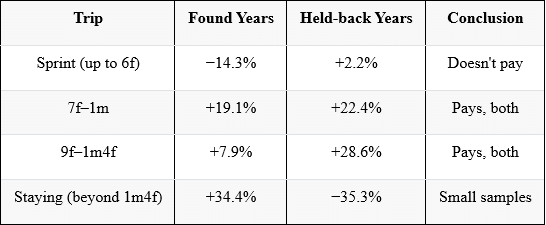
As predicted: it strengthens with distance and barely registers in sprints. And the longer-trip effect holds across all prize bands, not just the profitable one — a general truth about the allowance, which is why it can be trusted.
The dependable ground is 7f–1m4f. (The staying swing, on a handful of bets, is the data’s own warning label — read the race count before the number.)
By season. A summer edge, and again with a cause: the weight-for-age allowance is largest early in the season and narrows as the three-year-old matures, so the advantage lives where the age gap is widest — high summer into early autumn.
Winning More, Versus Being Worth Backing
This is where most “systems” fall down. Winning more than your share isn’t profit if the market has already priced it. And it mostly has: the form advantage is real in every prize band, but in nearly all of them the price is right, so there’s no value even though the horses genuinely win more. It survives in one tier — £25–50k — where the market prices the effect a shade loosely. It’s also an exchange edge: at bookmakers’ SP the same bets lose. Betfair SP or nothing.
The full record, year by year
Based on our known or found years, we freeze the rule — Flat (Turf), all-aged handicaps, £25–50k, 7f–1m4f, three-year-olds, July–October, Betfair SP, level stakes — and run every season. This is the table that matters, because it hides nothing:
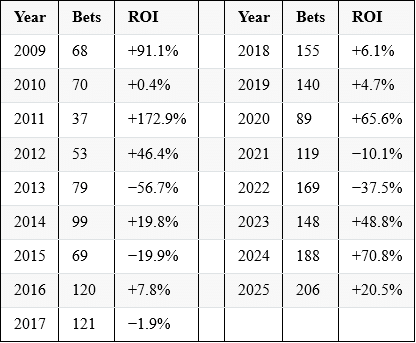
Profitable in 11 of 17 seasons (and all but break-even in a twelfth), long-run +18.9% net at Betfair SP across roughly 1,900 bets — through some brutal years (2013 −57%, 2022 −37%).
But read the “red” years properly: the losing seasons — 2013, 2015, 2017, 2021, 2022 — are scattered, not bunched at the recent end, and 2023, 2024 and 2025 are all strongly positive.
An edge being competed away fades late; this one is doing the opposite. Nearly two decades of profit, and a market that still hasn’t corrected it — a durable, structural mispricing, with the drawdowns the price of admission rather than a sign of decay. Note, too, the sample growing over the years (37 bets in 2011, 206 in 2025) as prize money and more qualifying races spread the qualifying pool wider.
(Nb. Profit and loss is shown from 2009, as Betfair starting prices in Smartform are complete from 2009 onward; the edge itself, being a matter of strike rate rather than price, is measured across the full record.)
Not A Black Box — A Shortlist
The number that matters most is hidden in plain sight: that +18.9% is backing every qualifier blind. But the rule throws up several qualifiers in a race, often — so it isn’t one mechanical bet marched off a cliff, it’s a shortlist that is already profitable before you’ve applied any judgement of your own. The filter does the hard part, putting you onto structurally underpriced horses in the right races. Going, draw, trainer intent, the shape of the market — what you bring is upside. Backed blind and over the long run it makes money; with an eye picking among the qualifiers, more.
What You Can Take From It
The eyeball filter, no database required: three-year-olds, all-aged Flat handicaps, July–October, £25–50k, 7f–1m4f, taken on the exchange. A broad suspicion turned specific and tested — a different thing from a hunch.
And the three we set out with. Smartform holds the answers — two decades, two million runners, any question you care to put. You needn’t be a programmer to ask — plain English becomes a query with the aid of an AI assistant, and the racing knowledge is the part that counts. The full working behind this analysis is available as part of the Smartform subscription — every query behind these tables, the complete detail, and the method for automating it so today’s qualifiers arrive on screen each morning, set out in a 24-page quick-start guide, with a series of other worked papers.
One question, of good instinct, worked through to a tested shortlist — and you can do the same with the next one you think to ask.
Colin Magee
Smartform is available from betwise.co.uk/smartform; the quick-start guides, including the full version of this analysis, come with every subscription.