

Analysing the Performance of 3yos in Non-Handicaps Early in the Season
In this article I am going to look at how 3yos have started the season specifically in non-handicap races. I have sourced UK flat racing data covering eight full years from 2018 to 2025 and this includes turf and all weather. As I am only concerned with ‘early season’ stats I have restricted the search to include the last week in March combined with the whole of April. I have calculated profits/losses to Betfair SP (BSP), with commission of 2% considered on any winning bets. Before getting into this deep dive it should be noted that roughly 50% of non-handicaps were Novice races, around 35% were Maiden races, just under 10% were at Group or Listed level, while the rest (around 6% of all races) were either sellers, claimers, classified stakes or conditions races.
Market Factors
Let me start by looking at the performance of these 3yos as regards market rank their position in the betting market. I have used Betfair SP rather than Industry SP to rank the horses:
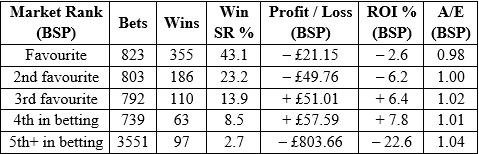
As we can see third and fourth favourites have both made a blind profit, but the fourth favourite stats have been skewed big time by a 70.53 BSP winner. There were also a handful of winners priced BSP 25.0 or bigger so therefore we can take that profit figure with a pinch of salt. Favourites have done OK, losing roughly what we would expect, while horses fifth or higher in the betting market have really struggled. Backing all such runners would have seen us losing over 22 pence in the £ for every £1 bet.
Sticking with favourites for a moment, let me share their record in the three main race types that were noted in the first paragraph:
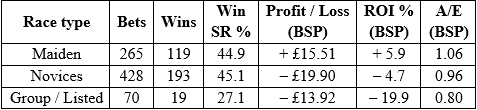
In Maiden races, the market leaders have nudged into profit returning just under 6p in the £. In better class races though (Group / Listed) favourites have struggled albeit from a smallish sample. Losses have been just shy of 20 pence for every £1 bet.
For the rest of the piece I am going to focus in on horses that were in the top three in the betting. This is mainly to avoid any big priced winners skewing the profit figures.
Race Type
So back to race types to see what the splits were when we include the second and third favourites too:
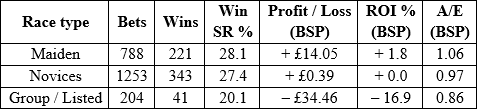
The top three in the betting in maidens have still been the best value, but horses in Novice contests have improved to hit a break-even situation. Second and third favs in the Group or Listed races have not really improved matters – it seems that the market has not been the best guide for these better class of races so early on in the season.
Sex of Horse
Let me see if the sex of the horse has made any difference. The splits for horses from the top three in the betting were thus:

We have similar win strike rates, but female runners have proved to better value than their male counterparts by over 16p in the £. Now, of course, females race in female only races as well as mixed sex races, but the really interesting stat has been their record in mixed sex races. When in one of the top three market positions in these mixed sex events females have won 59 races from 240 runners (SR 24.6%) for a healthy profit of £54.64. This equates to returns close to 23p in the £. Females have made a profit in female only races too, but the returns have been much less at a little over 4p in the £. It seems that female runners that are fancied in the market could offer us good value over the next five weeks or so, especially when racing against the males.
Career Starts
3yos that are running in non-handicaps early in the year are still likely to be lightly raced. Therefore, I wanted to check out their performance in terms of career starts and the table shows my findings:
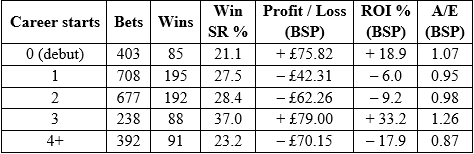
Some interesting nuggets here. Firstly, horses making their debut have had an excellent record when filling one of the top three spots in the betting. Very impressive returns of nearly 19 pence in the £. In terms of negatives, horses with four or more career starts have performed quite poorly, so we need to be aware of these runners in those early weeks of the season, and almost certainly avoid them. Horses that have had three career starts have done extremely well – a very high win rate and excellent profits to boot. How this has happened though is something I cannot explain. It might be a weird anomaly – I am just not sure.
Race Code LTO
Next, I am going to take a look at whether the last run of the horse was on the turf or on the sand. Here are the splits:

These numbers are quite conclusive showing that a run on turf last time out has been preferably to one on the AW. All the metrics are in favour of LTO turf runners.
Days Since Last Run
Onto time off the track since their last race now. Here are the findings:
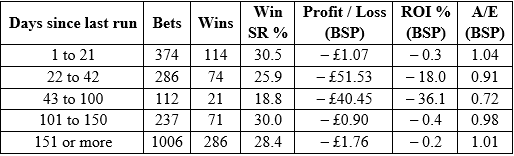
These stats have given us a relatively clear picture – a run within the last three weeks has proved to be fairly positive, as are long spells off the track of over 100 days. More than three weeks off the track to around 14 weeks though have been really poor. There is some correlation there with the previous LTO turf versus AW stats, as good proportion of the 22 days to 100 days group would have run on the AW last time out.
Position LTO
My penultimate port of call is to look at the last time out finishing positions of these horses that started in the top three in the betting. Here are the stats:
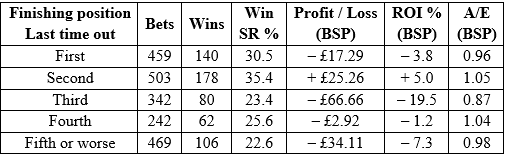
The only positive has been runners-up LTO. They would have offered us some value. Other finishing have not been value investments.
Trainers
Last but not least I will take a quick look at some trainer data. The data is quite limited for many trainers but those listed in the table have had at least 75 3yo runners that started in the top three of the betting during this time frame:
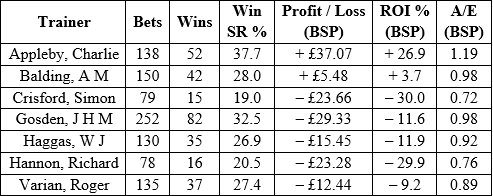
The stand-out by some margin has been the performance of runners from the Charlie Appleby stable. They have come out firing early season. The other trainers, with exception of Andrew Balding have all struggled especially the Crisford and Hannon stables.
To conclude 3yo non-handicaps early in the season should offer us some decent betting opportunities. It makes sense to focus on the top three in the betting and from these runners the key stats seem to be:
1. Avoid Group or Listed races as the market has not been a great guide.
2. Maiden races have been the best races for horses in the first three in the betting.
3. Females have a great record in mixed sex races.
4. A run on the turf last time out is far more preferably than a LTO run on the AW.
5. Horses making their debut have done very well when fancied in the betting.
6. Avoid horses coming back to the track after a break of between 22 and 100 days.
7. Keep on the right side of Charlie Appleby trainer runners.
David Renham