Flat Jockeys
People that bet on horse racing vary hugely. You have the pros, and semi pros, of which many will spend many hours most days analysing form, crunching data, creating ratings, etc. At the other end of the scale, you will still have the casual Saturday punter who goes down his / her local bookies on Saturday morning and has a series of small bets, usually on the races that are to be televised on terrestrial TV that afternoon. The majority of the readers of this article will be somewhere between the two.
The main problem with approaches to betting on horse racing is that there is no ‘right’ way; no magic bullet – if there were bookmakers would be out of business. However, from a personal perspective, I am a firm believer that hard work and a logical approach can make a big difference to your success as a punter.
Ultimately to make money long term you have to find value selections – horses that are a bigger price than their true odds. If you do that over time you will make a profit. I bet most days, but I generally focus on shorter distance handicaps (5 furlongs to 1 mile), usually for older horses. I will consider a combination of factors with more weighting given to some than others. Key factors for me include the potential run style of the horses, the draw, speed figures and form (both short term and long term). I will also factor in the going, especially if it is soft or heavy, the trainer and the jockey.
Now 20 years ago I must admit I did not really worry too much about the jockey, but in recent years my thinking has changed. This is mainly down to the run style data I have delved into over the years.
For example, some jockeys are better on front runners than others. One such jockey is Jason Hart – when he is on a front running handicap sprinter he performs well above the norm, both from a win perspective and placed one.
Understanding jockey patterns when it comes to run style has made a big difference to my bottom line in recent years. In this article I am focusing on jockeys, but I am not looking at run style stats, I am looking at jockey data that I have not looked at in detail in the past. I am examining two main things – firstly which jockeys are best in close finishes, and secondly, I am going to compare jockey performance by splitting their results into a specific price band.
Close Finishes
I am sure you have all had many bets that have beaten in a close finish. I am also fairly sure that you have probably cursed the jockey on more than one occasion blaming them for the narrow defeat. Hence, I thought it would be useful to try and find out which jockeys do best in a close finish.
In order to try and establish this, I have looked at races in which the jockey has either won or has finished within 3/4 of a length of the eventual winner. My theory is that the jockeys with the higher percentage of wins are those who are best in close finishes. Whether this is the case is conjecture, but there is plenty of logic behind my idea / method. Here are some of the stats (50 or more wins minimum to qualify):
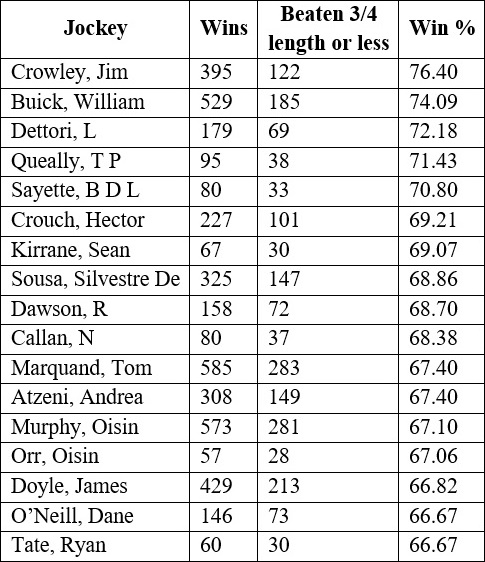
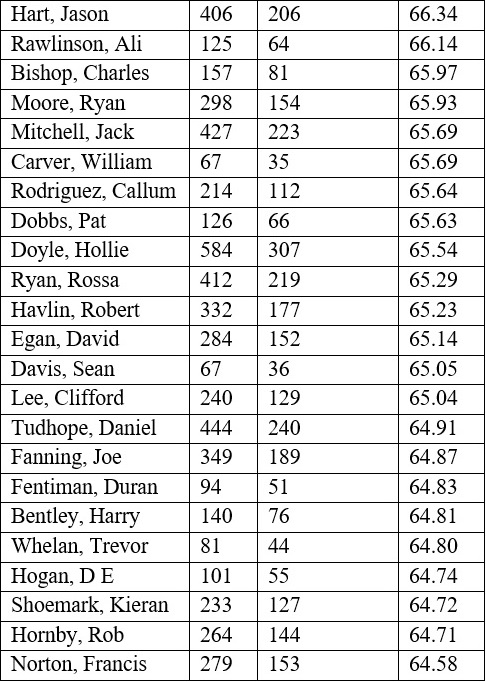
(Editor’s Note: The calculation is Wins /(Wins + Close Finishes)
These are the top 40 jockeys in terms of win percentage.
For the record, the average win percentage figure for ALL jockeys combined stands at 62.7%. These 40 jockeys are above the average: some well above.
I would argue that all of these are jockeys are good in a close finish.
Crowley, Buick and Dettori head the list with outstanding figures – all three are jockeys I like, and although Dettori is retiring later in the year, I am sure readers will be backing one or more of his mounts during the rest of this season.
At the other end of the scale, here are the jockeys with the lowest win percentages.
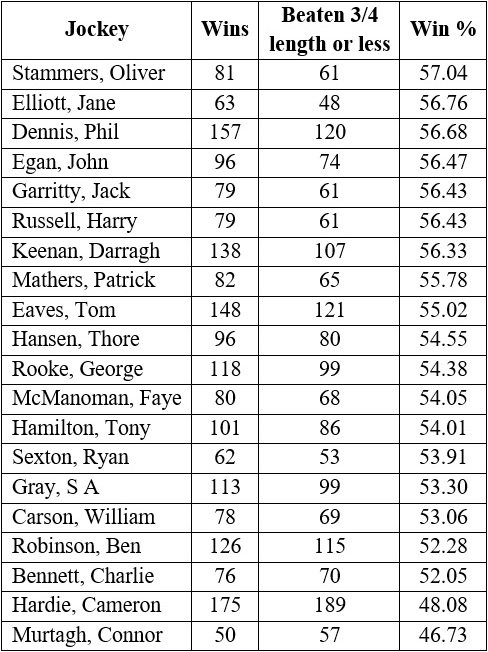
All these jockeys are at least 5% below the average – knowing this now, I would be extremely wary if any of them were riding a horse I fancied.