What about the going?
Since 2007 it has been mandatory for British racecourses to report the going of their track. Assessed by an official (the clerk of the course) on the day, the going is determined by the amount of moisture in the ground on the track.
But basically, we are talking a man with a stick! Yes, it is really that scientific.
Although an official requirement the reported going is a wholly subjective decision made by the clerk.
The clerk will use a “Going Stick” which is prodded into the ground and depending on how far the stick goes into the track, the reading will show how much moisture is being held. We suppose we should be grateful for the invention of the going stick as prior to that we were dependent on how far clerks heel of his welly went in or the pointy end of his walking stick!
The reported going on the turf can be anywhere from Firm through to Heavy, while the All Weather operates a going of either Standard or Slow. But a thorough understanding of goings can be an integral part of your selection process when choosing your bets for the day.
All horses are different, and some will be happy running on “softer” ground, where there is more moisture in the ground and therefore more give in the ground, where they can “get their toe in”. While other horses preferring to run on top of the ground, i.e., where there is less moisture.
Any report on the going is critical for the decision of whether a horse will run or not, but as we know, the weather can change very quickly, and therefore too the going, and dare we say it there are occasions where reported goings are not quite as they seem.
Generally, jockeys will report on their return to the enclosure on whether a track is running as reported, and often you will find that they will disagree with the clerk of the course.
For reference the different types of going on the turf are self explanatory and are as follows:
Heavy Going
Heavy going will mean you will need a horse that likes to get his/her toe in the ground and has plenty of stamina to boot. Horses that enjoy this going are few and far between but there are some. Heavy going may also be described as a bog.
Soft
This is the type of going we have come to expect during the winter months in the UK during the jumps season. The ground is more difficult for horses to run on in general with give in the ground and horses will generally run more slowly, however from a jumps perspective this going is often considered safe as limiting impact when jumping faces. Many horses will enjoy soft ground and will run solely on this going.
Good
Good ground in general is the most common type of ground raced on and is the benchmark for the ground conditions. Good ground is as it says, it is considered the preferred ground for horses to race on as it offers fairer race conditions. Easy for the horses to run on.
Firm
Firm going will generally be found during the summer months, that is if we have a summer…and will affect the Turf Flat season runners.
Dry ground will mean faster race times but can come with its own dangers particularly during the Summer Jumps when impact landing for the horses can be problematic. Some flat horses, delicate by their nature, may also not be happy running on hard ground.
And of course, we have everything in between! Good-Soft, Good-Firm. Oh, and if you hop over the water to Ireland, they will refer to Good-Soft as “Yielding”.
All Weather courses are generally easier to describe, but although all weather it doesn’t mean they are not affected by the elements.
The general rule of going for All Weather tracks is “standard”, assume the equivalent to Good going on the turf. The ideal condition for racing with not too much nor too little moisture in the track. The other types of going on the all weather are slow (moisture in the track) and hence track times will be slower, and fast, where there is minimal water in the track and runners may post much faster track times than the standard times.
Anyway, on to more pressing matters, finding profits.
Our head tells us that with Spring here, no, really, it is, well almost, and with summer on the horizon, (wishfully thinking), we will be expecting plenty of good going…
Well, we thought we’d look back and see if the going in recent years has been as good as we had hoped for given how our memory is telling us we were all very wet!
Years 2019-2021 (April – September)
UK National Hunt

Going was reported as Good for most of the races at the National Hunt meetings in the UK during the period, with almost 75% of the races being run on reportedly “good” going, but what about the Flat?
UK Turf Flat
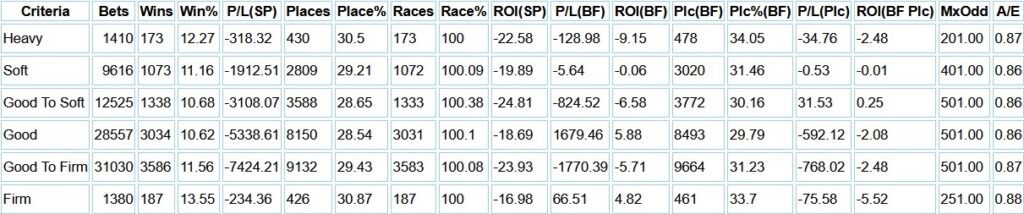
On the turf flat just over 33% of the running’s were on reportedly “good” going with most races having been run on Good to Firm.
So maybe it didn’t really rain as much as we thought it did!
Summer Jumping
Personally, we prefer to see a little give in the ground at jumps meetings during the summer and as such we are going to concentrate on trying to find some profits from those runners over the hurdles and on the NHF for the summer when it rains…
…you know it will…
So, we will keep an eye on those conditions where the going is good-soft or soft.
During 2019-2021 (April – September inclusive) we had 3637 running’s on reportedly Good-Soft or soft ground over the hurdles and on the national hunt flat with the bulk of races having been run over hurdles as would be expected.

We are unlikely to find profits in the summer NH Flat, past years saw profits from the Nicky Henderson yard, but any value and profits have been eroded from these now.
Trainers over the hurdles who have piqued our interest though (with at least 10 runners over the period) are as follows:
Gordon Elliott, Jim Goldie, Ben Haslam, Charlie Longsdon and Harry Whittington.
In terms of win percentages over the period Gordon Elliott has had some success with his runners over hurdles during the summer with an excellent win and place rate in 2019 of 57% and 71% respectively.
2020 he had no runners, and in 2021 Elliot was banned for 12 months. He is now allowed back into the fold so it may be that he can replicate summer results of 2019.
Jim Goldie landed a profit in 2020 and 2021 but from less than a handful of runners through the summer period, but one of his two winners landed at 40/1 and both of which ran in September.
We’ll be keeping an eye on whether any of his runners turn up during the April -September period for a run out.
Ben Haslam again is one who has just a small pocket of runs during the period and any profits came from a big, priced winner in Aug 2020 (66/1), with 2019 landing 2 from 3 with prices of 8/1 and 9/1.
2021 was 3 losses from 3 so no profits there, but we’ll be watching this year for any potential profits.
Charlie Longsdon, with a similarly moderate number of runners as Gordon Elliot has profited each year, albeit slightly in 2020.
Harry Whittington produced a nice profit in 2019 with 4 from 8 winning their races and producing a profit of 33 points. No runners in 2020 and a quiet time with just 2 runners in 2021 it will be interesting to see whether there are any in thee stable that come out for a run during this summer.
All but 1 of those winners from the above trainers came in Maiden Hurdles, Novice Hurdles or Handicap Hurdles so stick with these race types.
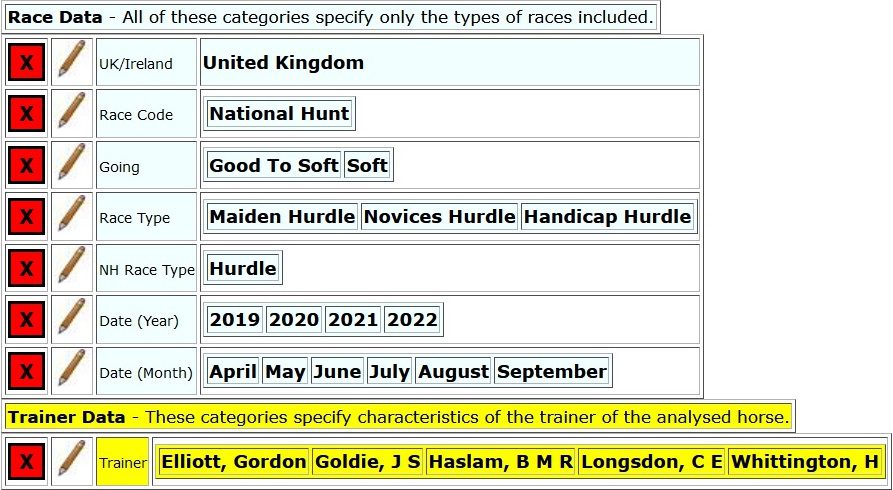
System 85: Back hurdlers from the above stables during the months of April through to September when the going is reported officially as good-soft or soft in the following race types: Maiden Hurdles, Novice Hurdles and Handicap Hurdles.
We are not suggesting that these trainers are going to yield us massive profits but what we would suggest in all your betting is that you take note of the going on race day.
If you are interested in reading more about the infamous “Going Stick you can read that here.
In terms of keeping up to date with the reported going then look at www.turftrax.co.uk
The website also has an archive of the reported going for each course going back to 2013.
The OCP Team
Featured Image: Thank God for Wellies – cc-by-sa/4.0 – © Jeff Buck – geograph.org.uk/p/4348784