
Research Corner – How much difference can a jockey make?
In years gone by we have tended to try and second guess which trainers may help us get off to a flying start on the turf but with the weather to contend with the historical data may not provide its usual insights for this activity.
In its place this time around, we are going to turn our attention to the matter of how much difference a jockey can make in the outcome of a race. The jockey statistics tend to be self-fulfilling in that the best jockeys are retained by the best trainers and owners, and, by that very fact, they win a larger percentage of the races that they get to ride in.
Yes, jockeys can come in and out of fashion; you may recall Frankie Dettori falling from grace at the end of 2012 having been suspended from riding for six months after being found guilty of taking a prohibited substance.
Prior to that he had been retained by the all-conquering Godolphin racing empire and had ridden numerous winners in the top races all over the world.
After riding freelance for a while, he soon found himself back in favour by becoming the retained jockey in Britain from June 2013 to July 2018 for Sheikh Joaan Al Thani's Al Shaqab Racing. More recently he has been riding winner after winner for the John Gosden stable including the likes of Enable, Stradivarius and Palace Pier.
Having set the scene we wanted to explore an avenue that may provide a more tangible based hypothesis than the normal parameters such as Strike Rate, number of wins or prize money won by a jockey.
For this we turn to a stalwart of the horse racing world Simon Rowlands, who had been involved with the Timeform operation since 1986, and is now a freelance writer/blogger, and has been raising the platform of sectional timings across a number of popular sites such as Attheraces and betting.betfair.
He also kindly got involved in a Q&A with this very publication which can be read here.
In one of his more recent research pieces he attempted to resolve a question that he was being asked on a regular basis “can sectionals measure the ability of a jockey to ride horses efficiently over many races?”
You can read the output in full here but a summary of its findings were:-
Sprint Jockeys
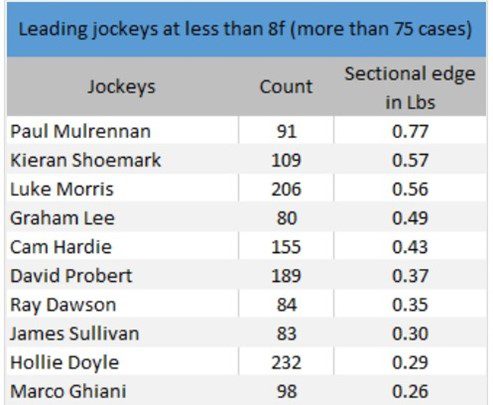
The jockey that you want on your side based on the research data over the shorter distance races is Paul Mulrennan. That’s good to know but can we use that information to our advantage in our day to day punting.
Paul Mulrennan
If we fire up the trusty System Builder at Horseracebase we find the following track record during the most recent 5 year period.
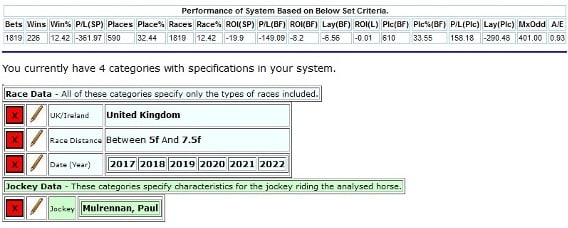
Whilst the results are not too bad blindly backing the horses that he rides over the shorter trips isn’t a direct route to profits. Let us carry on digging: –

The above table splits his rides between those in non-handicap and handicap races and it is clear to see that his riding skills over the shorter distance races does have a positive effect.
Blindly backing all the runners in handicap races when Paul Mulrennan is aboard turns a small profit at the Betfair SP.
The Official Handicapper’s job is to rate the horses based on the available form lines so that the OR allotted in handicap races gives all the runners an equal chance of winning. They are not able to factor in the level of skill that the jockey may be able to bring to the task, notwithstanding the allowances for apprentice jockeys.
Can these basic figures be improved upon without overworking the data?
Sprint races can have field sizes of a few runners all the way up to the cavalry charges of 20 plus, and you would imagine that if there were a format that this particular jockey could bring his riding skills to the fore in it would be in the smaller field sized races?
Is that really the case?
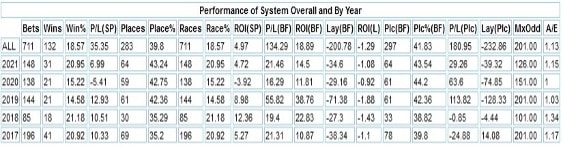
The individual races over the 5 year data spread show races with 3 runners all the way up to 27 so we will split these into 3 categories:-
Number of runners 3-10
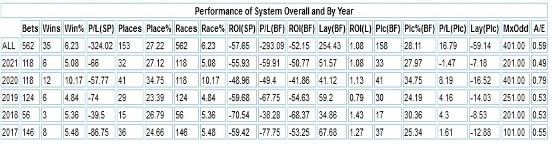
Number of Runners 11-20
Number of Runners 21-30
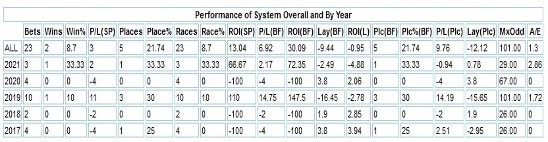
It is very evident that when the number of runners goes to 11 and above the potential skill factor of Paul Mulrennan has less of an effect on the outcome of the race.
Yes, there was a small profit from the 21-30 dataset but 2 winners from 23 rides in such races does tell its own story.
We have added a couple of further criteria in that we will focus his rides on the Flat Turf campaign and, given that a good percentage of his rides in shorter distance handicap races actually place, using the 5 runner cut off allows for Each-Way staking if the odds offer that opportunity.
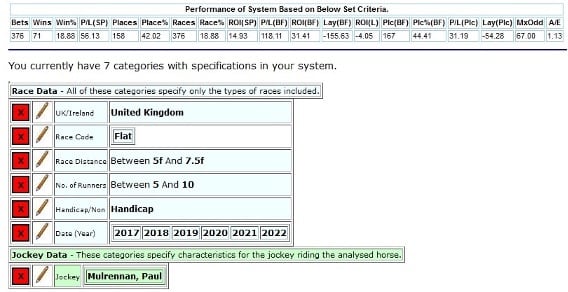
System: Back the horses ridden by jockey Paul Mulrennan when competing on the Flat Turf in handicap races of up to and including 7 ½ furlongs.
Moving on to the next category in the original research piece we find the following:-
Longer Distance Jockey’s
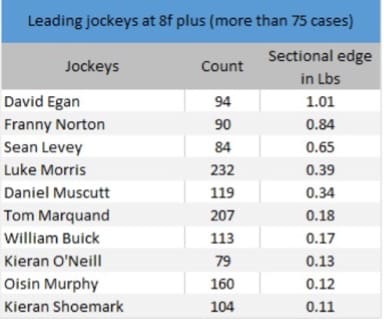
The standout Jockey in this category is David Egan
Let’s see what the data at Horseracebase reveals:-
David Egan
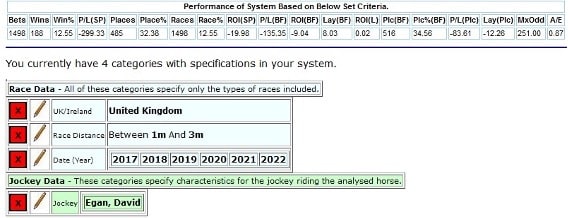
As with Paul Mulrennan the bare stats show a loss blindly backing his mounts in longer distance races so following a similar process let us dig a little deeper.

Although a larger majority of Davis Egan’s rides over the review period were in handicaps the returns are only marginally less (ROI) over non-handicap races.

What is more promising is when we consider the two different race codes for Flat racing which clearly shows that his rides on the All-Weather are the ones to home in on.
However on closer inspection we find:-

The most recent couple of years have seen a decline in the results, and whilst the jockey’s record when riding for trainer Roger Varian has been positive, most of the gains stem from a trio of big priced winners during 2018.
With that in mind we will move on to the remaining categories in the original research.
Turf Jockeys
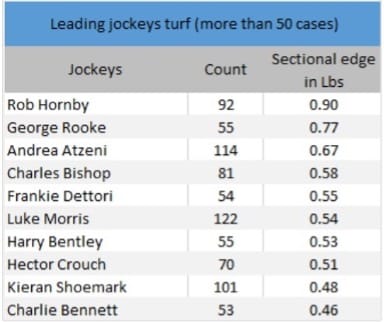
With more familiar names such as Frankie Dettori and Andrea Atzeni it does come somewhat of a surprise that Rob Hornby sits on top of this particular category.
Rob Hornby

Quite a lot of the gains achieved during the 2017-18 period have been given back especially during 2021.
What about race type?

The rides in handicap races during the research period have recorded a higher Strike Rate, P&L and A/E but 2 out of the most recent 3 years were negative.
Going forward it may pay to keep an eye on the horses ridden by Rob Hornby in Flat Turf races, and with a few sensible checks on the form you may find the winners.
The next category up is on the artificial surfaces:-
All-Weather Jockeys
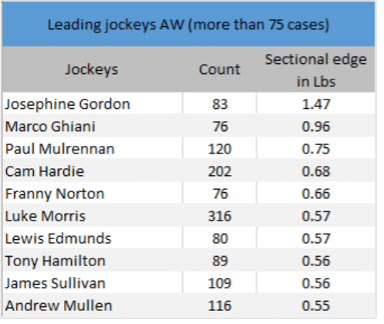
What really stands out in the above table is the gap from the leading riding Josephine Gordon to the next one down.
Josephine Gordon
Having previously been retained stable jockey to Hugo Palmer the jockey went freelance in 2019 so it will be interesting to see how things panned out:-
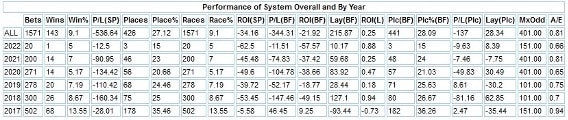
On the face of it going from 68 winners in 2017 down to 14 in 2021 on the AW doesn’t make the best of reading.
One area where she does seem very adept is at making the running in small field races. So, whilst not a system per-se it should pay to check when she is booked to ride a horse that generally races prominently in races with 7 or less runners.
Sectional timings are a fascinating topic but equally a challenging one given the diversity of track configurations in the UK, but it may well provide those of us that are willing to add it to our armoury some out of the box thinking and of course the holy grail of profits!
Steve Carter
Featured Image: Jockey carrying a saddle