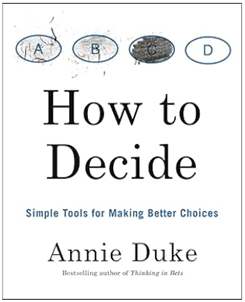
How To Decide by Annie Duke
If you've ever backed a horse, watched it get beaten a nose, and spent the next hour convincing yourself the bet was a bad one — Annie Duke has written this book for you.
How to Decide isn't about horse racing. Duke is a former World Series of Poker champion turned decision coach, and her focus is business, investing, and everyday life. But strip away the poker analogies and the corporate case studies, and what you're left with is one of the most useful frameworks a serious punter could own.
The central argument is this: we're terrible at judging the quality of our decisions, because we almost always judge them by the outcome. Duke calls this resulting — and once you know the term, you'll see it absolutely everywhere in betting.
You back a 7/2 shot that's well-fancied, handicapped perfectly, and travelling sweetly entering the final furlong. It gets chinned on the line by a 20/1 shot that was never on anyone's radar. Bad bet? Most punters will say yes. Duke says no — and she's right. The decision was made on information available at the time. The outcome doesn't change the quality of the thinking. A bad result doesn't retroactively make it a bad bet, just as a big winner off a terrible selection doesn't make you a genius.
This sounds obvious when you say it out loud. But our brains don't work that way, and the consequences for punters are significant. If you abandon a method every time it has a losing run, you'll never give a profitable system long enough to prove itself. If you chase a system every time it produces a winner, you'll buy at the peak and suffer the inevitable variance. Both errors flow directly from resulting.
Duke's solution is to build what she calls a decision journal — a record not just of what you backed, but why you backed it, what you expected, and what information you were working from. Then review it against outcomes over time. Sound familiar? It's essentially what any serious punter running a staking plan should already be doing, though few actually do it systematically enough.
The section on calibration is also worth your time. Duke argues that most people are either overconfident or underconfident in their predictions, and that true skill lies in matching your stated probability to reality. If you say a horse has a 30% chance and you make that call 100 times, roughly 30 of them should win. Getting comfortable expressing assessments as percentages rather than gut feelings is a genuine edge — particularly in a market where most of the money comes from punters expressing opinions as certainties.
She also covers the outside view — the habit of asking what the base rate is before making a judgement. Before you get swept up in the narrative around a horse (the trainer's in form, it won well last time, the handicapper's been kind), what does the raw data say about horses of this profile, at this distance, off this preparation? Good form students do this naturally. Duke gives you a framework for building it as a conscious habit.
The book isn't perfect. The writing can get repetitive in places, and some of the exercises feel designed for a corporate audience rather than a practical decision-maker trying to get things done. The poker examples, while Duke's natural home, occasionally feel overdone for a general reader.
But the core insight — that separating decision quality from outcome quality is the foundation of rational thinking under uncertainty — is one every punter should internalise. Horse racing is a high-variance game. Even the best bets lose most of the time. The punters who survive long-term are the ones who can tell the difference between a bad decision and an unlucky outcome, and keep backing the former regardless of what happened last time.
Duke won't teach you how to read a form book. But she might stop you torching a profitable method the first time the results turn against you. On that basis, the £14.99 is a solid each-way bet.
You can read a preview of How To Decide on Amazon – https://amzn.to/4bOyiRY
Darren Power