

Understanding the Value of a Machine Learning-Driven Oddsline:
A Look at the Betwise Daily Oddsline
The modern betting landscape has evolved significantly with the introduction of technology-driven tools that enable bettors to make more informed decisions. One such innovation is the machine learning-driven oddsline, as exemplified by the Betwise Daily Oddsline. This article will explain the process that goes into creating the oddsline, explore the core advantages over traditional odds compilation methods, and discuss how a purely data-driven approach that avoids using the market can provide bettors with a unique perspective.
The Concept of an Oddsline
A quick recap on some familiar concepts: an oddsline is simply a representation of the probability of different outcomes in a sporting event, typically expressed in decimal or fractional odds. It reflects the likelihood of an event happening, such as a horse winning a race. The market itself is expressed in the same way as an oddsline, except the probabilities in an oddsline should add to 100%, and there is an inbuilt house edge in any market oddsline, be it the bookmakers’ overround, the commission or spreads in an exchange, or the pool takeout in a pool betting system.
With a set of independent probabilities relating to an outcome, bettors can assess the fairness of the market odds and identify potential value bets, hence the concept of “underlay” or “overlay.” An overlay occurs when a horse's odds offer better value than the true probability of winning, meaning the horse is underbet and the market has underestimated its chances.
An underlay means the opposite—the horse is overbet, offering poor value for the bettor, or signalling that the horse may be better value to lay.
Even though most bettors don't compile full oddslines for an entire race, anyone who believes they've found a betting opportunity is essentially assessing whether the market has over- or underestimated a horse's chances.
The Evolution of Oddslines: From Bookmaker Tissues to Data-Driven Models
The process of setting the first prices on any given horse race, historically referred to as creating a “tissue”, has long been a crucial part of the bookmaker’s craft. A tissue price, in essence, is an initial estimation of a horse’s winning probability, relying on a combination of expert form reading, insider knowledge (e.g., stable knowledge or whether horses are likely to come for significant money or both), and experience.
Of course, money in the market continually causes adjustment of odds, up and down, to reflect the weight of support or lack of support for any contender. With money moving between all forms of betting—bookmaker, exchange, and pools—it is fair to say that by the time the race starts, most available market information has been incorporated into the odds.
How are we to compete against the market reliably and consistently, then?
Human error, cognitive biases, and incomplete data consideration can all undermine the accuracy and reliability of manually constructed oddslines.
Enter machine learning.
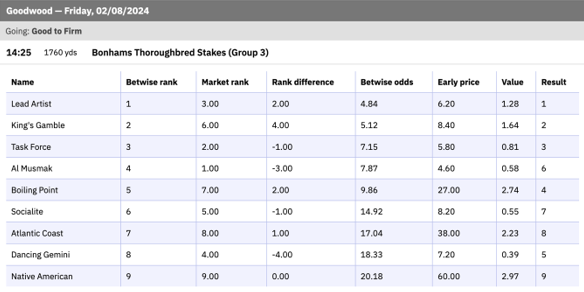
An example of a good day at the office for the Betwise oddsline at Glorious Goodwood!
Win up, both places up, Exacta and Trifecta both hit.
First and second home were also identified early as overlays
What Makes a Machine Learning-Driven Oddsline Different?
The fundamental difference between a manual oddsline and one derived from a machine learning model lies in the sheer volume of data processed and the consistency of the method. Where a manual oddsline may involve the subjective judgment of an expert, a machine learning-driven oddsline, such as Betwise’s, is based on sophisticated algorithms that analyse hundreds of features and historical data points to predict the probability of an outcome.
Our original data source is our own Smartform database, but that only represents the very start of the journey. From there we take raw data and engineer hundreds of additional, derived, features. We’ve been at this for the best part of a decade, so the features are continually added to, refined, tested and improved. From there the best features are selected using specific feature selection methods. a regular part of the machine learning process, and models are subsequently trained and tested using a variety of techniques from logistic regression to random forests.
Machine learning models excel at detecting patterns in vast datasets, combining the influence of different variables such as a horse’s past performance, trainer and jockey statistics, breeding, course history, and many others that would be impossible for a human to evaluate consistently. These variables are not considered in isolation but in concert with one another, revealing complex relationships and trends that provide a more nuanced and accurate oddsline. This gives us a set of probabilities for any given race that can then be normalised to 100% and compared to the market.
The Wisdom of the Market: Respecting the Collective Knowledge
Of course, all that glistens is not gold, and while using an oddsline to look for a “rick” (a significant error in the odds) can be tempting, bettors often underestimate the competition. Market odds in exchanges and pari-mutuel systems reflect the collective knowledge of the crowd, which includes experienced bettors, insider money, and syndicates – who often employing similar methods. This amalgamation of public and private information tends to produce an accurate picture of each runner's chances.
Large early wagers or syndicate activity can skew these odds, but generally, market rankings are well-informed.
However, the Betwise Daily Oddsline is formed without any reference to market moves, playing a key role in helping bettors navigate this dynamic. The oddsline is built entirely on fundamental data.
When the Betwise oddsline aligns with the market ranking, it’s often a sign the model is accurately reflecting reality, reinforcing its reliability. However, where the Betwise oddsline diverges from the market, bettors may uncover potential value bets, as the model identifies opportunities the crowd may have misjudged. These often happen in pockets rather than wholesale. Indeed, one of the most satisfying outcomes of the oddsline effort can be seeing the market fall into line with the data-driven assessment of the race's ranking.
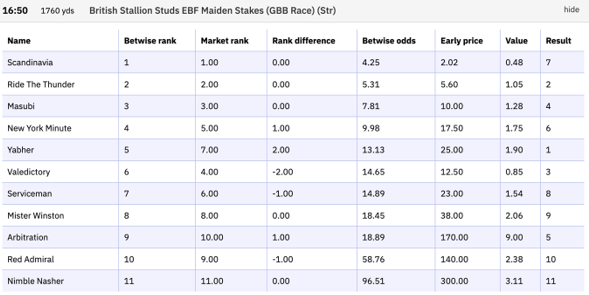
A maiden race from yesterday (as I write this) at the Doncaster St Leger meeting
Note that the early Betwise oddsline predicts well the pecking order of the early market.
The eventual winner, Yabher, though an outsider, is also identified as a strong overlay
Thus, while the “wisdom of the crowd” should be respected, the Betwise oddsline can provide an important independent check on market movements. By comparing the oddsline’s form-driven estimates to the market, bettors can spot inefficiencies that could represent genuine value.
Consistency and Coverage
One of the standout advantages of a machine learning-driven oddsline is consistency. The Betwise Daily Oddsline, for example, uses the same rigorous algorithm day in and day out, ensuring that each race is analysed using the same data-driven process. This removes the potential for human error, ensuring that decisions are not influenced by subjective factors such as fatigue, distraction, or emotional biases—common pitfalls for manual odds compilers.
This consistent process also allows for comprehensive coverage. Betwise’s model doesn’t focus on just a handful of popular races; it applies the same detailed analysis to all available events. The scope of data examined includes form variables that even the most experienced form reader might overlook, meaning that the model does not miss out on crucial trends or opportunities.
Quantitative, Repeatable, and Backtestable Process
Another benefit of a machine learning-based oddsline is that it operates through a quantitative, repeatable process. Bettors who rely on manually constructed odds are often at the mercy of decisions that cannot be easily tested or repeated across different contexts. A manual approach to setting odds makes it difficult to analyse how effective any odds-setting process is over the long term.
In contrast, the Betwise Daily Oddsline is underpinned by a model that can be backtested against historical data. This capability means that the model's predictions can be reviewed and tested for accuracy, including consistency of strike rates in different odds ranges and rankings over time, allowing for continual improvement (all these statistics and more are available to subscribers, and we’ll also be writing about them in the next magazine). The more the model learns from past outcomes, the more it can refine future prediction.
What’s Next for the Betwise Oddsline?
The Oddsline has been offered on the site for over two years as a free download for members (free to sign up), and recently transitioned to a small subscription model. This will allow us to continue enhancing the oddsline, deploying new models, and publishing more data on backtesting and profitable angles for subscribers.
Not all types of racing are treated the same by our modelling approach. Domain expertise comes into play when splitting the data into relevant but statistically significant samples. For example, we evaluate each racing type independently.
It would be ineffective to evaluate veteran chase races in the same way as two-year-old sprints, but focusing only on two-year-old maidens at Newmarket in the autumn would reduce sample sizes too much. Thus, we will continually refine the underlying models, take account of new data and report on optimal strategies.
In short, it’s a journey, not a destination, and we’d love for you to join us on it.
You can find out more and sign up at:https://www.betwise.co.uk/oddsline
Colin Magee