
National Hunt Trainers Who Send Only One Runner To A Course On A Given Day
Last month I looked at UK flat trainers who have sent just one runner to a specific course on a specific day. It makes sense therefore, given the National Hunt season is gathering pace to do the same for National Hunt trainers.
My plan is going to be very similar to last time. I will look at individual trainer records, but I will also analyse more general data combining all trainers within certain parameters. The data for this article has been taken from 2018 to 2024 for UK National Hunt racing – this covers the last seven years.
As ever, profits and losses have been calculated to Betfair Starting Price (BSP) less 2% commission on any winning bets. The A/E index (Actual / Expected) has also been calculated to BSP.
Let me start this piece by looking at all qualifiers from all trainers in terms of having one runner at the course on a given day:

About half of the number of total runners compared to the flat, but the strike rate is within 0.03%!! (11.26 versus 11.23).
The ROI percentages are around the same figure too, with the NH one slightly better than the flat one.
Essentially, this is not the worst starting point with losses around 1.5 pence in the £ when looking at all 85,000 plus qualifiers.
Before digging further, there is always a potential problem using BSP as we can get some huge prices hitting the jackpot and winning. This can skew bottom lines markedly. Hence, for the remainder of this article I am going to restrict all findings to horses that had a BSP of 12.0 or less. I put this price restriction in place for the majority of the flat article too.
Let me look then at the results for all qualifiers that were BSP 12.0 or shorter:

The win strike rate has hit just over one win in every five starts and we have turned a small loss into a tiny profit.
I am going to split these BSP 12.0 or less results by Race Class first to see whether I can spot any significant patterns.
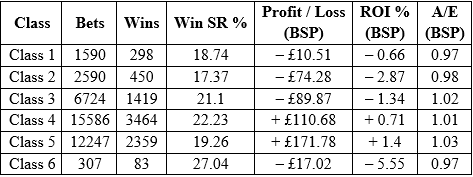
The Class 6 data is limited, while qualifiers in Class 4 and Class 5 races have nudged into profit. There does not seem to be any strong pattern or patterns though here, the results seem to be fairly consistent across all classes.
It is time to examine Race Type now so looking at the results in chases versus hurdle races versus NH Flat contests.
Here are the splits:

In reality, there is not much in it between chase and hurdle results, but the NH Flat results are clearly best. Looking at the NH Flat results in more detail, if we restrict qualifiers to those that were in the top three of the Betfair market we get the following splits:

These are an improvement on the overall NH Flat figures and looking at the yearly results for this cohort, we see that six of the seven years turned a profit.
An even stronger angle is when we focus on horses that had run at least twice before in National Hunt Flat races. This group of runners have secured a near 27% strike rate (167 winners from 622) for a profit of £123.45 (ROI +19.8%); A/E 1.17.
A look at the Betting Market next and the performance of the top three in the betting, based on their position in the Befair Exchange market. Earlier we saw positive figures for the NH Flat group. Here are the overall splits:

Favourites have a good record, and this has been especially true in chases. Over the larger obstacles favourite have returned a profit of £113.65 (ROI +3.1%) and it should be noted that all the profits came from handicap races.
I want to move on now and examine previous course winners.
When writing the flat racing article, I assumed that the results for past course winners may be good, considering they are the only horses from the stable running at the course on the day in the question. The results though did not back up my theory.
I wonder if it has been any different in National Hunt racing with the 12.0 price restriction in place. Let me see:

These results are closer to what I would expect hitting a near break-even scenario.
Having said that, non-course winners actually made a small profit.
However, digging a bit deeper we can find a subset of course winners that have proved profitable to follow.
If we concentrate on horses that have run at the course at least three times previously and have a 60%+ win rate at said course, we get the following results:

I used this very same subset of runners when analysing the flat data and that group too showed a decent overall profit.
|
The rest of this article is for Platinum members. You've just seen what our experts do with publicly available data — the Platinum section is where the specific angles, numbers and actionable conclusions live. Platinum members also get daily system selections in their inbox by 2am, tips from top tipsters, Win Big Golf selections, and access to 11 years of magazine archives. |