
The best horses, the best jockeys
The best horses the best jockeys, one of the best pieces of advice that I got when I started betting on horses was “don’t expect to make money following jockeys”. There are plenty of punters who do though and will back a jockey’s mounts pretty much blindly. It doesn’t matter how much chance the horse has on form, as they will stick by their favourite jockey’s mounts through ‘thick and thin’. Usually more of the latter than the former in my experience.
When I first started punting some punters would back Willie Carson when he was riding 7-13 and below or Pat Eddery on a track with an uphill finish or Steve Cauthan on front runners. Pat Eddery was very strong in a finish so it could be argued it that he would be at his most effective on a track with a stiff finish.
Willie Carson was not only one of the best jockeys of his generation but he was also able to ride sometimes as low as 7-7. So, if he was booked for a ride in handicap race on a lightweight close to his natural riding weight it would make sense to take notice. His strength in the saddle on lightweights was highlighted by his wins on Trainglot in the 1990 Cesarewitch off 7-12 or the Wokingham Handicap on Time Machine off 7-12 and the 1995 Ebor Handicap on Sanmartino off 7-11. Meanwhile Steve Cauthan certainly seemed to be able to get the fractions right on front runners such as Slip Anchor and Reference Point and often rode his fellow jockeys to sleep.
Now I am not sure if this group of punters made any money from these systems but there was some logic to their thoughts and I have to confess the Willie Carson on lightweights in handicaps was on angle for me in my early punting days.
Here are my ten attributes that separate the best jockeys from their more journeyman colleagues in the weighing room:
1. They break a horse in a way that allows it to get to its optimum position in a race.
2. They make sure their horse stays clear of trouble.
3. They keep the horse to the best part of the course.
4. They make sure their horse will get a good passage when making its effort.
5. They understand the right energy distribution for their horse and get the fractions right.
6. They understand quirky tracks and intermediate distances such as 7f and 1m 1f.
7. They make their effort with the horse at the right time.
8. They get their horse in a relaxed mode in the early stages of the race.
9. They get the horse to change their legs at the right time.
10. They have the ability to keep their mounts running in a straight line when making their effort, which is arguably one of the most important.
Some are just better than others!
Like any sport and life in general, horse racing has people that are better at it than others. Some jockeys seem to be able to ride just about any horse and get it to ensure that it runs to the best of its ability whilst others just don’t.
We see Jockeys that perform better at some courses and seem to click with certain trainers. They might have a better win strike rate in a certain class of race but do worse in another class. Some jockeys just seem to do better in a small field than larger ones.
Like horses, some jockeys seem to do better going right-handed than the other way or they might be more adept on a very undulating track or a track with an uphill finish. Some jockeys ride well on a straight track. Some jockeys excel over sprint trips rather than long distance races and of course vice versa. Some jockeys might not have the strength to win on heavy ground.
The importance of the jockey as a factor increases when the horse that you are considering for a bet is normally ridden in mid division or even held up at the back. Poor jockeys on horses that are expected to make ground in the straight are usually poor betting propositions unless the race is run at breakneck speed.
Confidence breeds success and in-form jockeys can sometimes defy the statistics by winning on a horse which looked to have little chance on form. Jockey’s lose races with poor rides far more often than they win races with brilliant rides, but about 90% of the time it has less to do with the jockey than the horse.
But If you want to improve your betting results then you should consider the jockey in your decision-making process. This is where the smart punter can get that vital edge of others by digging into the statistics.
When you look at the stats even the very best jockeys have strike rates in the teens or very low 20’s which means they lose more races than they win. Yet jockey stats are arguably the least used stats in horse racing, but they are still very important. Just like horse’s, jockeys have their strengths and weaknesses and this is evident in the stats.
Digging into Stats
They key is to find those profitable jockey stats. As ever the excellent http://www.horseracebase.com with its mine of detailed information and stats is the starting point for this month’s investigation.
Here are a couple of examples from top jockeys Silvestre De Sousa and Ryan Moore on the flat and the talented, if slightly underrated, Sean Bowen over jumps.
Silvestre De Sousa
Since the start of 2014 Champion Jockey Silvestre De Sousa has ridden 693 winners from 3856 rides 18% -303.01 A/E 0.97 1481 placed 38%.
Still, his biggest fans would have lost money if they had backed his mounts blindly. But they would be better advised to concentrate on his rides at Epsom & Ripon if they want to make money as he seems to excel at these contrasting tracks. All the right stat boxes ticked. A good sample size of results from each track. A good ROI for each track and solid chi score which indicates his success at both courses is down to skill rather than chance.
Ryan Moore
Arguably the best jockey riding in either Britain & Ireland. Since the start of 2014 Ryan Moore has had 588 winners from 2586 rides 23% -431.72 A/E 0.88 1194 placed 46%. He has almost won 1 in 4 of his rides but his backers would have lost even more money than De Sousa backers.
Unlike Silvestre, Ryan has the pick of Aiden O’Brien horses to choose from and those from Sir Michael Stoute stable which does help when it comes to his impressive win-strike rate. But there’s no money to be made backing his mounts for either trainer.
If you want to back Ryan Moore blind then the place to do it has been on the polytrack at Chelmsford of all courses. Since 2014 his rides at Chelmsford have produced the following set of results:
 His rides at the track are even going off at value prices, out performing market expectations by 35%, and a very nice ROI if betting to Betfair SP (BSP).
Sean Bowen
Sean Bowen is a jump jockey who I rate and he provides a good example of a jockey who does well on heavy ground. Here is his record on heavy going:
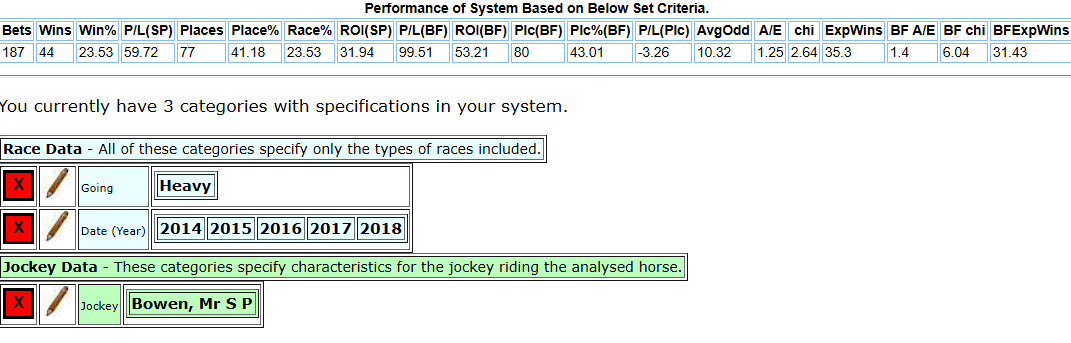 A 25%-win strike rate indicates his strength in the saddle and an appreciation of pace in not making his horses run to quick on testing ground. His profitability is bettered when just looking at his rides in handicaps on heavy ground:
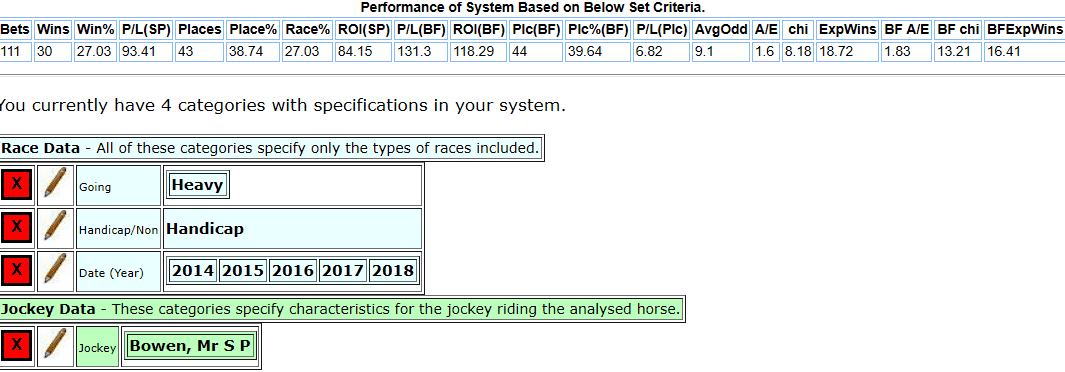 He’s been performing 60% better than the market expectations. The Chi Score and expected winners are all positive. An excellent ROI when betting to both Industry SP & BSP and his backers would have made a profit in all years since 2014.
 He is a jockey I will be following with interest in heavy ground handicaps next winter.
Summary
Remember that jockeys are just one of the variables you should consider when betting on a horse. Never bet a horse just because of the jockey engaged or indeed the trainer/jockey combination. Other factors like form must also support the horse as a good betting proposition.
Always base your assessment of jockeys on facts, not perception. If your horse is likely to race from the front then the importance of jockey is lessened. On the other hand, if your horse usually settles somewhere from off the pace to back in the field then the significance of the jockey increases. Moderate and poor jockeys on horses that need to make up ground in the straight to win are usually poor betting propositions.
Be wary about betting horses with a negative jockey change or poor trainer/jockey combination, particularly if the horse is racing in less than ideal conditions.
Avoid betting selections to be ridden by a jockey with a low win strike rate and poor recent form records (10% or less), even if they have won on the horse before. In terms of statistics, anything less than a 14 percent strike rate on rides less than or equal to 10/1 has to be a concern.
Of course, moderate and poor jockeys do win on a fancied horse but long term they are a poor betting proposition.
There will be times that inferior jockeys do win on your fancied horse, but in the long run, they are a losing proposition. Your aim should be to only make good bets and that requires both a good horse and good jockey.
Until next time.
John Burke
© 2018 Blue Delta Marketing Ltd