

The Other Half of the Pedigree
Smartform now treats the dam as a first-class citizen – in effect, a runner’s complete sibling record. Here’s what it can and can’t tell you, and some pointers on where it might earn its keep at the upcoming big summer meetings.
When the Oaks was run at Epsom this month, the filly who stayed on for third was an unfancied 25/1 shot – Sugar Island. However, this was not the fluke it might have seemed. She was the one runner in the race whose maternal family had been quietly insisting, all along, that a mile and a half at the highest level was well within her compass. The next day, a colt with similar credentials that we had picked out on the blog for the Derby – Christmas Day – went one better and won at 7/1 (much bigger in the morning and of course without the controversial elimination of the favourite).
Neither result needed a crystal ball. Both came out of the part of racing form most of us do not see or skip straight past: the dam.
Smartform has always carried the bare identifiers. Every runner’s sire, dam and damsire sit there in the data, and the more industrious among you have long built your own tables off them. What’s new is that the dam now gets the first-class treatment the sire has had for a while. The daily_dams_insights table works out the maternal line’s record for you — how a dam’s other foals have run across a range of windows and conditions — so you can call it straight from Smartform instead of rolling your own every morning.
Put plainly, it’s a runner’s complete sibling record served up ready to use: what this horse’s brothers and sisters have actually done, over the trip, at the track, at the age, and lately.
A Thinner Line
There are two honest reasons the dam line gets ignored. The first is habit — sire stats are everywhere and dam stats almost nowhere, so we reach for the stallion and forget the mare. The second is harder to argue with: the maternal record is genuinely thinner. A fashionable sire can have hundreds of runners standing behind every line of his figures; a mare has a handful of foals in a lifetime.
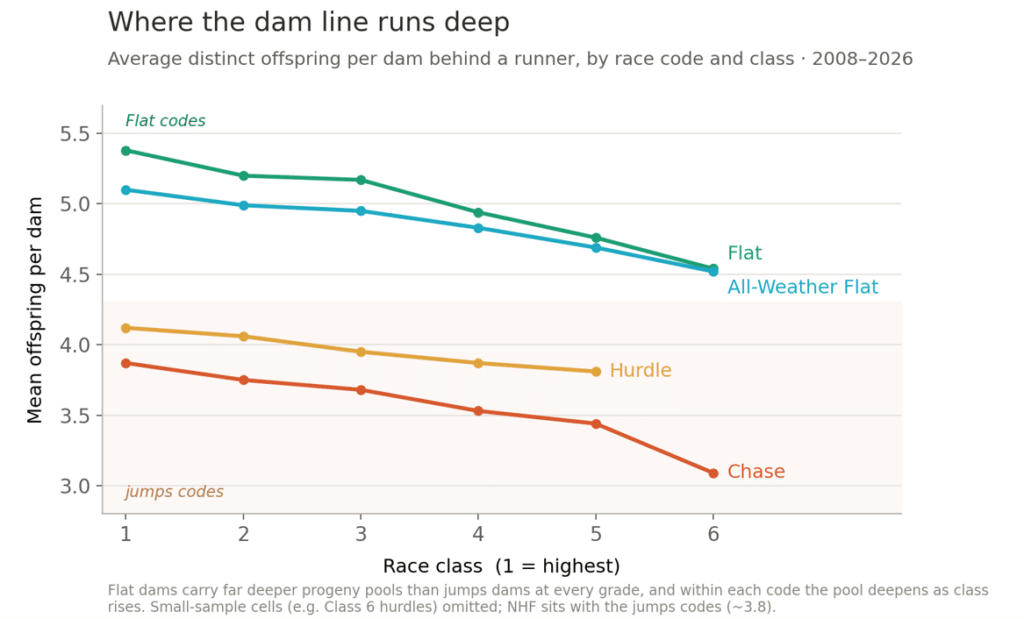
The data bears that out. Across the 2.4 million rows in the new table, the median dam has just a couple of named offspring to call on, against around half a dozen for the median sire — and roughly one dam row in eight rests on a single foal, which means the “family record” there is really just the horse’s own form wearing a different hat. Depth varies by where you look, too (Figure 1). Flat dams carry markedly deeper progeny pools than jumps dams at every grade, and within either code the pool deepens as the class rises: the better the race, the more foals per dam you are typically dealing with. The practical lesson is simple. The dam line is at its most reliable in good-class Flat races, and you should always glance at the sample behind a flattering figure before you trust it.
The Stayer’s Edge
Where the maternal line comes into its own is the very question the form book often answers worst: stamina. A lightly raced three-year-old stepping up to a mile and a half has, by definition, never been asked whether he or she stays – but their siblings may have.
That is why the dam statistics did their best work in the Epsom Classics. The prognosis that turned up Sugar Island at 25/1 and Christmas Day at 7/1 was doing nothing clever; it simply weighed the family’s record over the trip when the horse itself had little to no record of its own to weigh.
That makes the summer’s staying races the natural place to point it — and Newmarket’s July meeting, less than a month off as I write, is a good place to start. Run the maternal numbers back in Smartform over eighteen runnings of its three feature races and a clear pattern falls out, along with a useful warning about how not to use them.
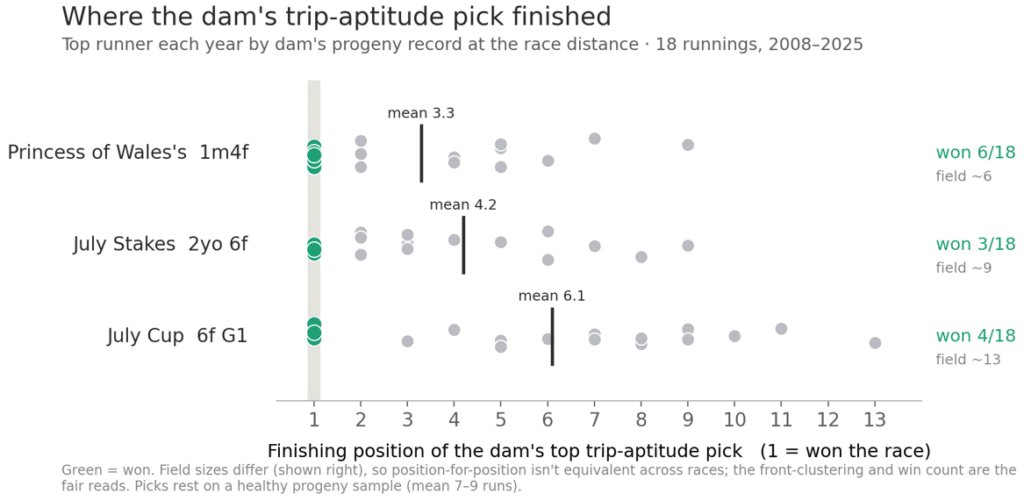
The Princess of Wales’s Stakes, a mile and a half for older horses, is the dam line’s race. Take the runner each year whose dam’s other progeny had performed best over the trip, and you would have landed the winner six times in eighteen — Lucarno (2008, 6/1), Crystal Capella (2011, 4/1), Universal (2013, 3/1) and El Cordobes only last summer (7/2) among them — with that pick first or second more often than not (Figure 2). For a single-angle filter on a Group race, that is a strike rate worth having.
One lineage at a time
The other two features are more instructive about the limits. The July Stakes, for sprinting two-year-olds, is a partnership rather than a dam’s race: the maternal trip statistic still earns its place, but it is no better than – and arguably second to – the sire’s overall record with juveniles, because precocity over six furlongs is a stallion’s gift as much as a mare’s.
Consult both; don’t expect the dam to carry it alone.
The July Cup is the honest counter-example. In a championship sprint where every runner is bred to the hilt for the job, neither half of the pedigree separates the field — the dam’s pick scatters all over the result, and so does the sire’s. Some races breeding simply cannot call, and it pays to know which they are before you stake on the theory.
Which brings me to the one rule that came out of all this clearly enough to bank. With a sire reading and a dam reading both in front of you, it is tempting to split the difference and call it a balanced view. Don’t. Tested across all three races, a straight fifty-fifty blend of the two never once improved on the better single lineage — it merely dragged the stronger signal back towards the middle. The maternal line is worth far more as an independent voice you weigh against the sire than as something you average with him. Lean on the dam where stamina and the trip are the question; lean on the sire where precocity is; and accept that some races neither can read well.
Where To Start
The daily_dams_insights table is in Smartform now, sitting alongside daily_sires_insights, and the updater keeps it current. If you already run sire angles, the dam ones cost nothing extra to bolt on — the structure mirrors what you know. And if you have never queried a pedigree in your life, the easiest place to begin is the one spot the form book struggles with most: the next time a well-bred maiden steps up in trip for a staying prize, go and look at what the rest of the family did when they were asked the same question.
The answer has been sitting in the breeding all along. We have just made it easier to read.
Visit https://www.betwise.co.uk/smartform
Colin Magee