
Whatever happened to… the winner of the corresponding race last year?
While browsing through the Smartform data dictionary looking for a feature to research for this month’s article, I came across an intriguing but underexplored data item: the winner of the corresponding race from last year. Despite having this information for every daily race, we’ve never fully researched its significance.
What Is a Corresponding Race?
A corresponding race refers to the same race at the same meeting one year ago, with identical race entry conditions. This could be anything from a 5-furlong maiden at Dundalk to the Aintree Grand National.
While there are many potential angles to explore—such as long-term trends in certain races—this analysis will focus on two specific questions:
- How do horses that won last year’s race perform when they compete in the renewal?
- How do trainers who won last year’s race perform when they enter a runner again?
Horses that won a maiden last year, for example, are ineligible to compete in the same race again, but their trainers may still target the same race with a different runner.
How Many Corresponding Races Are There?
Since Smartform’s daily races data starts from March 2008, we analysed the following:
- 150,134 races had a corresponding race and winner from the previous year.
- 71,714 races had no corresponding race or meeting from the year before.
So, approximately two-thirds of all races in our dataset have a corresponding race. The percentage is slightly higher in Jumps racing (72%) compared to Flat racing, indicating that there are slightly more regular and predictable renewals of all Jumps meetings compared to the Flat.
Filtering the Data: Which Races Are Relevant?
To focus on the success of last year’s winning connections (horse and trainer), we further filtered down to races where:
- Last year’s winning horse competes again this year.
- The trainer of last year’s winning horse enters a runner again.
This reduced the sample to:
- 11,066 races where last year’s winning horse competed again.
- 46,146 races where the trainer of last year’s winner entered a runner again.
In 815 of these races, the winning horse switched trainers before competing again.
Fundamentally we are now interested in whether horses trying to win the same race again or trainers trying to win the same race again demonstrate a greater or lesser capability to do so than any race they might compete in at random.
Baseline Win Rate for All Horses
The expected win rate for any horse winning a race at random in the reduced sample of repeat winners (based on field sizes) is:
- 10.1% expected win rate across all races.
Actual Strike Rates
- Horses attempting to win the same race again: 14.0% winning strike rate
- Trainers attempting to win the same race again (adjusted for multiple entries): 15.8% winning strike rate
This shows a clear uplift for both horses and trainers. However, trainers attempting a repeat win outperform the actual horses trying to win again, suggesting that trainer intent is a stronger factor than individual horse ability when targeting specific race renewals.
Bearing in mind that these statistics are from all attempted repeat winners (either trainers or horses) over all race types and classes, we need to drill down further to find out whether there are differences that can be exploited for profit, or indeed whether there is any profit to be had at all.
Breaking the Data Down Further
Last Year’s Winner Competing Again – Trainer’s Only Runner
We first examined races where last year’s winning horse runs again as the trainer’s sole entry in the renewal.
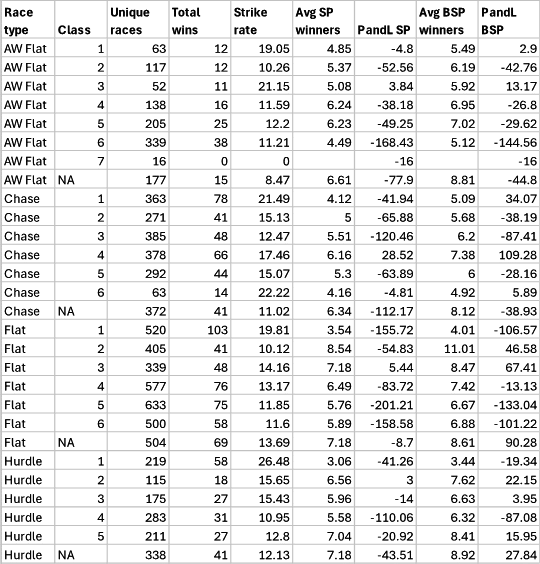
Here's the full breakdown, first for horses who compete for the repeat win, where the trainer only has the winning horse from last year as their entry (no multiple runners):
Key findings:
- Higher strike rates in higher class races, particularly Class 1 races as follows:
- 26% for Class 1 Hurdle races
- 20% for Class 1 Flat races
- 21% for Class 1 Chases
- 19% for Class 1 All-Weather Flat races
However, profitability varies. While strike rates are high, there are losses in some categories—especially Flat racing—suggesting that the market prices these factors in effectively.
Last Year’s Winner Competing Again – Trainer Has Multiple Runners
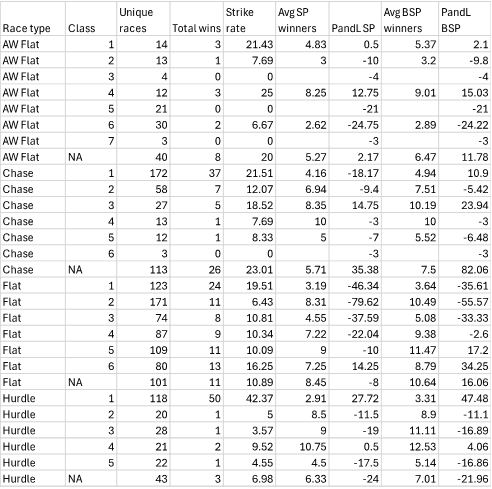
Next follows an interesting smaller data set where we consider winners from last year attempting to win the same race again, but where the trainer has entered additional runners (spoiler alert, the additional runners on top of last year’s winner are not worth considering with a strike rate not much different than the average, so we are only looking at last year’s winners in the multiple runner scenario):
Key findings:
- Class 1 races again show strong strike rates.
- Jumps races, particularly Chases and Hurdles, show strong profitability.
Jumps horses tend to have longer careers compared to Flat horses, at least in terms of ability to maintain a high level of form, so this may explain their ability to repeat success.
The profitability may indicate that punters might be confused when a trainer enters multiple runners, potentially creating value betting opportunities on the defending race champion.
Trainers Attempting a Repeat Win – But With a Different Horse
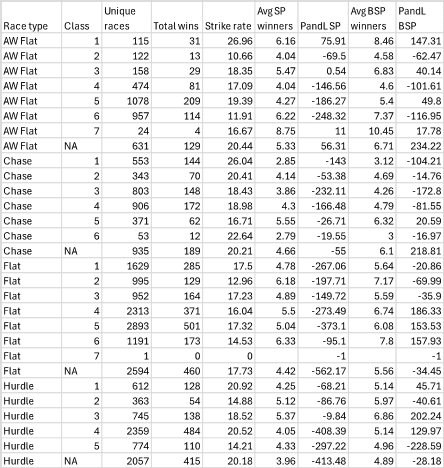
Now, we look at trainers attempting to win the same race again with a different horse (i.e., last year’s winning horse is NOT in the race).
In these instances, the winner of the race is excluded from the picture and not attempting a follow up – however, as discussed earlier, in many cases this may not even be possible depending on the race conditions, particularly where there are age restrictions or for novice / maiden events.
Key findings:
- Strike rates remain strong across all race types and at all levels
- A higher strike rate is still evident in top-class events, though not as extreme as when last year’s winner competes again.
- Backing all such trainers at BSP produces a level stakes profit, though not a sufficient ROI to qualify as a blindly profitable strategy.
However, certain trainer specializations stand out:
- Irish Chasers (Class NA) tend to have high strike rates.
- Class 1 All-Weather Flat races see consistent positive returns.
Trainers Entering Multiple Runners – None of Them Last Year’s Winner
Lastly, we examined cases where trainers attempt to win the same race again with more than one runner but none of their runners are last year’s winner. This smaller cohort does not merit publication of the whole analysis table so instead we’ll summarise the findings as follows:
- Strike rates are lower across all categories.
- Most race types show a level stakes loss.
- Backing multiple runners per race inevitably dilutes profitability, since at least one horse will lose in every race.
The only notable exception is:
- Class 1 All-Weather races, where trainers attempting a repeat win still show a profit, suggesting that trainer expertise in these races is not fully priced in by the market.
- The strike rate in Class 1 AW Flat races even when allowing for multiple runners is still 22%.
Final Thoughts
Our research highlights several key trends worth noting. Trainers attempting to win the same race again—whether with last year’s winner or a different horse—consistently show a stronger-than-average strike rate. The most notable advantage appears in Class 1 Jumps races, particularly Chases and Hurdles, where both strike rates and profitability are well above the norm.
On the Flat, the market tends to be more efficient with respect to pricing in trainers particular proficiency in targeting a repeat race, to the extent that these horses are overbet, limiting opportunities for value betting. However, Class 1 All-Weather races stand out as an area where trainer specializations may not yet be fully priced in, potentially offering an edge.
While there’s no blanket strategy for blindly backing repeat runners or trainers, these findings reinforce the idea that certain race types and conditions create profitable niches.
We hope the detailed breakdown of last year’s winning connections attempting a repeat victory, analysed by race types and classes presented above will provide further opportunities to spot microsystems in the data that could be worth further exploration for profitable betting angles.
Colin Magee – www.betwise.co.uk