

Which National Hunt trainers prosper during summer months?
It is that time of the year again when we take a look at the summer jumps scene in the UK and Ireland to find which National Hunt trainers prosper during the summer months?
I am a much bigger fan of jumps racing than I am of flat racing as, in my humble opinion, it is a lot more exciting. I also feel it is a lot more rewarding as a tipster to pick jumps winners as there is so much more that can go wrong, and so much more going on, when a horse has to negotiate obstacles in addition to outrunning the opposition.
The jumps season reaches a crescendo at Cheltenham, Aintree and Punchestown but then settles down in to the summer jumps scene proper and that is where we are heading this month as we try and uncover trainers and horses who can make us all a profit while the flat season is in full swing.
Summer jumps are understandably run on predominantly good ground so we are after those trainers whose runners act on such a surface and may have even been given the winter off in anticipation of a summer jumps campaign. This angle is fairly tried and tested but it can pay to look beyond the obvious and dig deeper into trainer performance to see if we can find an edge that not only makes us some money but also keeps us ahead of the bookmakers.
This month I try to do just that, and I am looking at all summer jumps races that have been run in the UK and Ireland since 2010.
I have
run the rule over all the data I could get my hands on and come up with a
portfolio of trainers whose horses might just be worth following from July
until September, at which point, the going changes and the national hunt season
starts in earnest.
That in itself is a tricky betting period as the flat transitions to the jumps
so it will be good if we can bank some profits before entering into what is a
notoriously difficult time for punters (end of September / October).
Willie Mullins
This may look like a way too obvious place to start but profiting from Willie Mullins is a full-time job in itself and you really need to dig deep to try and get some value and profit from the huge string he has in his yard.
Fortunately for us he runs plenty during the months of July to September and that gives us plenty of data to work with to try and unravel the conundrum of which ones we can profit from.
We start by looking at his overall record over the jumps in July through to September since 2010:

Straight away you can see he has a 30% strike rate from just over a thousand runners, but they return an overall loss, even on the exchanges which is always better than industry SP. So, the first thing we can do is look at the difference in performance between the handicappers and the non-handicappers.
He does not have the best record in handicaps and we find that the non-handicappers outperform their counterparts by some way with 274 winners at a strike rate of 36% compared to just 30 winners at a strike rate of 12%. Even better, we now begin to see a bit of profit, but nothing to get excited about.
Next, we can look at the age of the winners and we find that 162 of the 274 winners of non-handicap races were aged 5yo or younger. That means 4yo or 5yo but he is 3-6 with 3yo runners so we stick them into the mix, even if they only crop up once in a blue moon. That leaves 162 winners, aged 3yo to 5yo, running in July, August and September, from 384 runners. The win strike rate is 42% and the P/L is now £85.19 at Betfair SP.
Two simple filters and we are beginning to see some positive results.
Next, we want to have a look at the number of runs in the season.
Remember, the season officially starts at the end of April / the beginning of May, so we want to know if his winners have run already or if they are making their seasonal debut.
Interestingly, we find that 147 of the 162 winners had run no more than twice in the current season and that is another filter we can justifiably add.
That leaves us with the following set of figures for the Willie Mullins summer jumpers:

We can nudge up the strike rate, even if it is just slightly more than that already impressive 45%, if we take a look at the specific type of race that those winners have come from.
We find that the novice and maiden hurdlers and the bumper runners are the ones that realise the most profit and we can ditch the chasers, who are few and far between anyhow, and the non-novice, non-maiden hurdlers who return a small loss.

Finally, we can get the strike rate up over 50% if we stick to those runners having either their first start or had finished first or second on their previous run. When we do this, we arrive at our Willie Mullins summer jumps system, created by a adding a few simple filters.
Here are the numbers:

So, we have a system with a 50% strike rate and a near 50% return on investment from a trainer who needs no introduction and whose runners leave the bookies diving for cover week in week out. I for one will be interested to see how this performs this season.
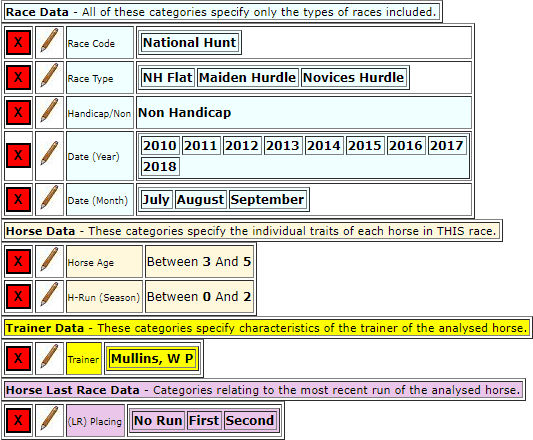
System 32: Willie Mullins 3yo to 5yo runners in novice hurdle, maiden hurdle and bumper races, July to September, with 0 to 2 runs in the season, making their seasonal debut or having finished first or second last time out.
Olly Murphy
Olly Murphy has quickly made a name for himself and may just be the jumps scene’s equivalent to David O’Meara on the flat, in so much that he takes cast-offs from other yards and turns them into winners in no time at all, often racking up a sequence.
It won’t be long before the bookies cotton on, in fact they most likely have, but are his summer jumpers going to go under the radar? His numbers are already quite impressive:

Only two
years’ worth of data but a mighty fine set of results by anyone’s standards.
It still gives us plenty of scope to dig a little deeper so let us see if there
are any angles to those 32 winners.
Well, he has had winners in both handicaps (18-79) and non-handicaps (14-34) and both make a profit.
Winners have come in bumpers, over hurdles and over fences and, again, all make a profit to a certain degree.
Race distance may be a factor, but I will leave that out and look for the stronger filters, one of which is age. All the winners were 8yo or younger and those aged 9yo and older have a combined record of 0-14.
Presumably his magic has yet to work on the veterans.
From here there are a few potential angles, and all are worth noting. So far, we are looking at Olly Murphy runners aged 8yo or younger in July to September.
Here are those mini angles:
1. Seasonal debutants:

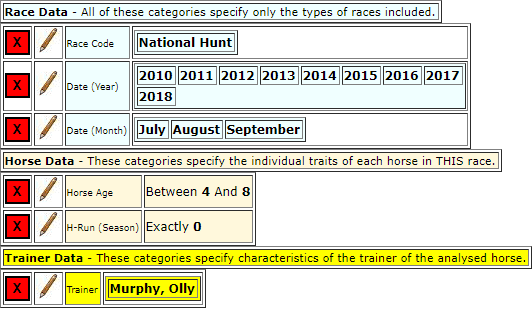
As you can see, first time up is a good time to catch his runners.
2. First run for the trainer:

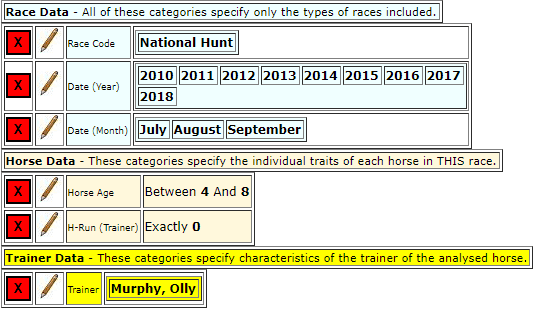
The first run for Olly Murphy is also a good time to back his runners. I am sure the bookies will have cottoned onto this so be careful.
3. Track. Fontwell, Market Rasen, Stratford, Newton Abbot.

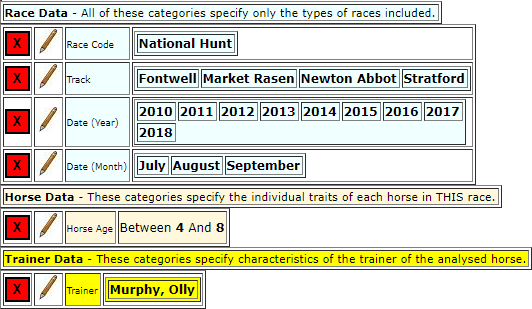
Clearly, he has his favoured tracks.
System 33: Backing his runners at Fontwell, Newton Abbot, Stratford and Market Rasen has seen some profitable returns and it is worth noting his runners that he sends to these tracks this year.
So, in summary, Olly Murphy is an up and coming trainer who has been going great guns since he took out a licence a couple of years ago.
His summer jumpers have been a profitable bunch to follow especially those having their first run of the season or their first run for the yard and we have picked out 4 tracks that have been far and away the best in terms of the number of winners, strike rate and profit.
Like I say, the bookies are not daft and this angle may disappear soon but definitely worth keeping an eye on his runners and in particular their price, which is the biggest indicator that the enemy knows what we know.
For our Gold members this month Nick picks up on three trainers, including one of the smaller yards, which may very easily pass by many a punter.
Keith Dalgleish
I like Keith Dalgelish as a trainer on both the flat and over jumps. He places his runners very well, finding them the best races in which they have a serious chance of winning.
This type of trainer goes into my notebook as it is easier to profit from the smaller yards than from the bigger ones who have a shotgun approach sending out umpteen runners a day. They get loads of winners but if you throw enough darts at the board, one will eventually hit the bullseye.
Working out which ones are likely to hit pay dirt is an oft impossible task. Trainers like Keith Dalgleish have to be far shrewder and their placement is incredibly well thought out. Their runners often go in at a decent price too.
Keith Dalgleish has sent out 48 summer jumpers since 2011 and 13 have won. That is a decent strike rate coming in at 27%. What is interesting is that all 13 have come from 41 runners since 2015 and the results appear to be improving year on year, which is exactly what you want when it comes to creating a system likely to continue to perform.
12 of those 13 winners were making their seasonal debut or had had just the one run in the current season. That improves things to 12-35.
11 of those 12 winners were making their career debut as we have just seen or had posted a top 5 finish last time out. That improves things again, this time to 11-23 and we are closing in on a 50% strike rate.
I am going to leave it there as we are down to a low sample size now.
I reckon we will get between 5 and 8 runners this summer that match the criteria, but with a 50% strike rate, we should find a winner or two:

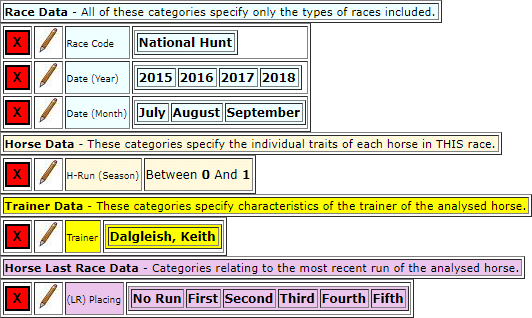
System 34: Keith Dalgleish runners in July to September, top 5 finish last time out or first career start, 0 to 1 runs in the current season.
Alan King
Back to one of the bigger yards and this time Alan King who has enjoyed some very productive summer campaigns recently.
Since 2013 he has banged in 50 winners from 162 runners at a strike rate of 31% and produced a profit of £64.33 at Betfair SP. The ROI is also a very commendable 40%.

Last season was particularly impressive with 15 winners from 37 runners at a strike rate of 41%.
Lots of data to get stuck into and we can improve on those impressive figures by adding in some filters, the first of which sees us ditch the Class 1 and Class 2 races where he has had a couple of winners but overall their strike rate is not as good as those racing at a lower class and they make a small loss.
The next filter is age.
He has run a few juvenile 3yo’s but these return a loss and those aged over 7yo also return a small loss, so it is best to stick with those aged 4yo to 7yo.
That still leaves 41 winners from 110 runners and a really good strike rate of 37%.
The number of runs in the season has little bearing with plenty of winners from seasonal debutants as well as those well into their early season campaign.
The final filter is simply to look at the tracks where he has had most success and there are a few standout courses where his summer jumpers appear to excel.
This is most likely a combination of good placement and suitability of the course such as whether it is tight or galloping, left handed or right handed etc. Horses for courses as they say.
Those courses are Bangor, Market Rasen, Newton Abbot, Southwell, Stratford, Warwick and Worcester.
When we combine those courses with the Alan King 4yo to 7yo’s entered into Class 3 to Class 6 races we end up with the following results:

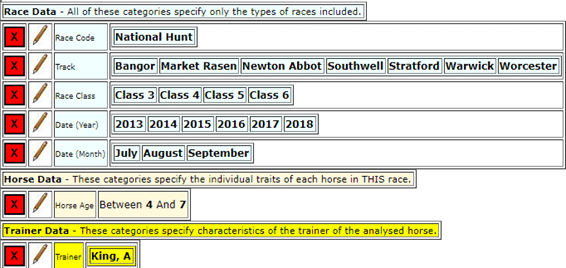
System 35: Alan King runners July to September, in class 3 to class 6 races, aged 4yo to 7yo at Bangor, Market Rasen, Newton Abbot, Southwell, Stratford, Warwick and Worcester.
Tom Lacey
Back again now to one of the smaller yards and this time we turn our attention to Tom Lacey, an improving trainer with a growing reputation.
12 winners from 57 runners in the months of July, August and September is a pretty solid set of figures.
What is more impressive is the fact he went 0-9 in 2015, the first year he had a summer jumps campaign, so his figures read 12-48 since 2016. That is a 25% strike rate and, as we have seen time and time again, the exchanges are our friend as these runners returned a profit of £32.92 compared to just £1.64 at industry SP.
If you don’t have an exchange account, you are missing out on a whole bunch of profit on all your winners.
Back to Tom Lacey and a closer look at those winners.
The first thing to note is that his runners do best in small fields of 8 or less runners.
Whilst this scuppers the aspirations of the each way punter it really does improve the results significantly, so back them straight win only.
That improves the figures to 11-26 (42% strike rate) so you get my drift.
Perhaps they can dominate small fields or do not like the hustle and bustle of big fields, but whatever the reason, fields of 8 or less appears to be a big factor.
The next filter is by far the simplest. Back his hurdlers. His chasers are 2-11 and his bumper runners 0-1.
Very much like John Ferguson and John Quinn, hurdling is the name of the game for the Tom Lacey runners and they are responsible for 9 of the 12 summer jumps winners he has saddled since 2016.

Obviously, that only leaves about 5 qualifiers a year, but this is a portfolio approach and we have included the likes of Willie Mullins and Alan King to ensure a decent amount of action overall.
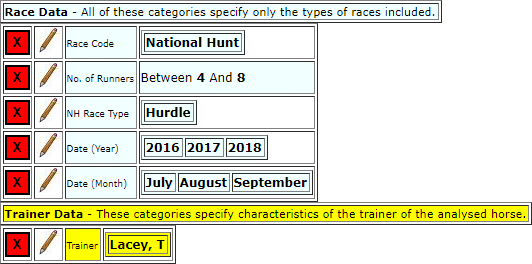
System 36: Tom Lacey hurdlers running in July, August and September in fields of 8 or less runners.